
At a glance
- Newton made an early profit of about £20,000, then bought South Sea stock again in June 1720 and kept buying as it fell.
- His net worth fell from just over £30,000 to about £20,000 by mid-1721, yet he left an estate of about £30,000 in 1727.
- The trap wasn't the first bet. It was getting back in after watching the price rise without him.
In this essay
The group chat lights up late on a weeknight. Someone posts a screenshot of a stock you sold months ago. It kept climbing without you. Nobody says anything to you directly. They don’t have to.
That small sting is where a lot of money gets lost. Not on the first bet, which you thought through. On the second one, made in a hurry to catch up.
Isaac Newton felt some version of it in 1720. You’ve probably heard the short story: the greatest mind of his age lost everything in the South Sea Bubble. The real record is less dramatic and more useful. By the end, you’ll know what Newton actually lost, what he kept, and the specific trap — buying back in after watching others get rich — that caught him.
The second bet is the dangerous one
Think about leaving a party early. You had a reason. You were tired, you had work in the morning, and you said your goodbyes. Then the photos start arriving. Everyone is still there, and it looks better than it did when you left.
Nothing about your reason has changed. You’re still tired. But a new question has crept in: what am I missing? That question has a pull your plan never accounted for.
Money works the same way. The first decision, to buy or to sell, usually comes with some reasoning. The decision to get back in often comes with a feeling instead. The feeling isn’t “this is a good price.” It’s “they got something I didn’t.”
That’s the principle this story turns on. Getting out of a rising asset is rarely the costly part. The costly part is the moment afterward, when other people’s gains start to feel like your losses.
What the records show
In 1720, Newton was Master of the Royal Mint and already a wealthy man. Andrew Odlyzko, who reconstructed Newton’s finances in a 2019 paper, found that slightly less than half of Newton’s assets were in South Sea Company stock before he sold in April 1720. The rest sat in government bonds.
The selling went well. Odlyzko estimates Newton made a profit of about £20,000 in the early stages of the bubble. His net worth just before the bubble began was just over £30,000. On paper, he had won.
Then the price kept going without him. One commonly cited set of figures puts the share price at £128 in January 1720, £330 in March, and £550 at the end of May.
In June 1720, Newton appears to have sold almost all of the government bonds he had just bought and put the money back into South Sea stock. When the price turned, he didn’t stop. He kept buying as it fell later in the year.
The fall was steep. The University of Oxford’s Newton & the Mint project puts the peak at £1,050 in late summer 1720, then a fall to £190, and £124 by December. By mid-1721, Odlyzko estimates, Newton’s net worth was down to about £20,000. He had lost all of his early profits and a good bit more.
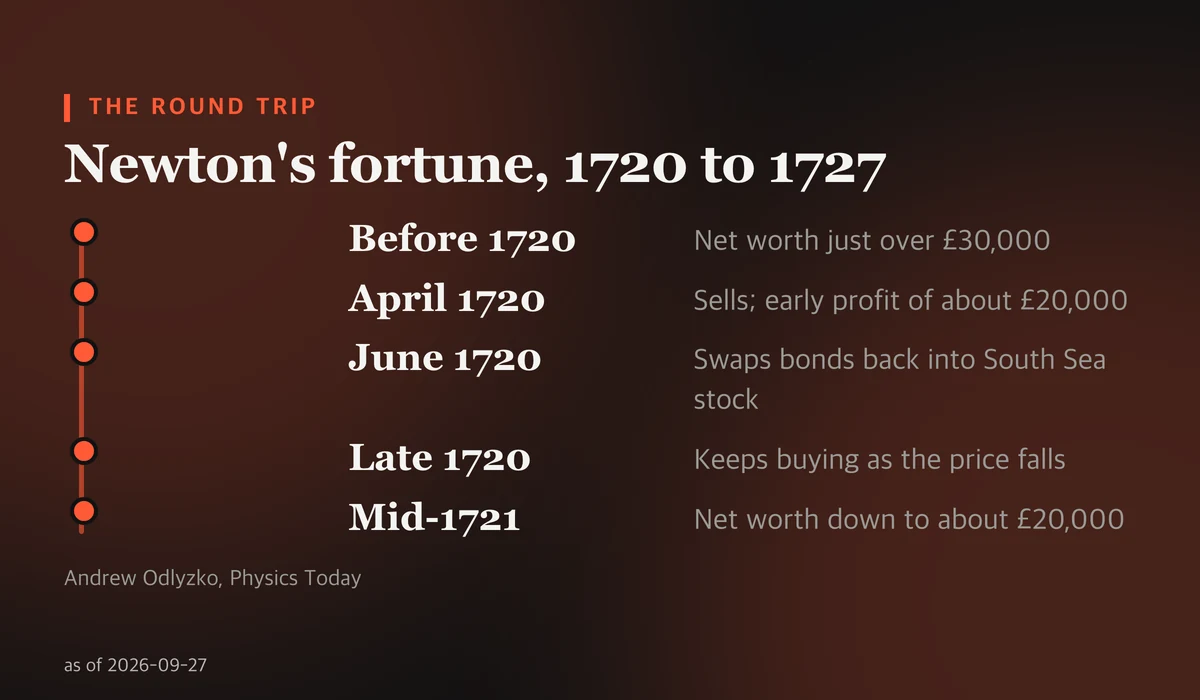
Here is the part the popular story leaves out. When Newton died in 1727, his estate was worth about £30,000 again. He died wealthy. The bubble cost him dearly, but it didn’t ruin him.
Odlyzko is careful about what anyone can know. His paper’s abstract says the traditional tale is “based on only a few items of hard evidence, some of which are consistently misquoted and misinterpreted.” Even so, his new evidence supports the core of the story rather than overturning it: a successful investor before the bubble, then substantial miscalculations during it.
So what went wrong? One way to read this: Newton wasn’t fooled from the start. He got out with a profit. His problem was coming back, and he came back while the price was still climbing — the moment when staying out feels most expensive.
Three habits for the second decision
First: count a sale as finished
A sale is a decision with its own reasons, and it can stand on them. Picture closing your brokerage app after selling a fund you’ve held for a while. You took the gain. That’s the end of the decision, not the start of a scoreboard.
What changes: you stop checking the price of things you no longer own. The “they’re getting rich without me” feeling has less to feed on.
Second: write your re-entry reason before the screenshots arrive
Before you sell, write one line about what would make you buy back. A lower price. A real change in the business. A change in your own needs. Put it in the notes app, next to the grocery list.
What changes: when the group chat lights up, you have something to check against. If nothing on your list has happened, the screenshot isn’t a reason. Newton’s records show the timing of his June purchase, not his reasoning. That gap is exactly what a written rule fills.
Third: don’t let a falling price talk you into more
Buying more as a price drops can be a plan. It can also be a way to prove the last purchase was right. Picture a red number on your phone before breakfast, and the thought that buying more would “bring the average down.”
What changes: you ask one question before adding. Would I buy this today if I owned none of it? If the honest answer is no, adding is a rescue attempt, not an investment. Newton kept buying through the fall. That’s how a lost profit became a real loss.
The other side
Start with the evidence, because it’s thin. Odlyzko says so himself, and sources disagree on the size of the loss. Wikipedia’s South Sea Company article says Newton lost at least £10,000. The Oxford page says he “supposedly lost a fortune of around £20,000” but that “the evidence is inconclusive.” John Maynard Keynes was among those who disputed how much Newton really lost. Any figure you see deserves an “about” in front of it.
The famous line is weaker still. You may have seen Newton quoted as saying he could calculate the motions of the heavenly bodies, but not the madness of people. The earliest known record is a note in Joseph Spence’s memorandum book from 1756, first published in 1820. It passes on what a “Lord Radnor” said Newton told him: that he could not calculate the madness of the people. The heavenly-bodies half appears to be a later embellishment. It’s a good sentence. It just isn’t a documented one.
There’s a limit to the lesson, too. The records show what Newton did and when. They don’t show what he felt. Reading his June purchase as fear of being left behind is an interpretation that fits the timing, not a line from his diary. He may have had reasons no document preserves.
And buying back isn’t always a mistake. Sometimes the facts really do change, and getting back in is the right call. The trap isn’t re-entry itself. It’s re-entry with no reason except other people’s gains.
Try this today
Open the notes app on your phone. Think of one thing you sold or passed on in the last year — a stock, a fund, anything that kept rising after you stepped away.
Under it, write one sentence: “I would buy this again only if ___.” There’s one rule. The blank can’t mention what anyone else made.
Then add a second line for the next time a screenshot lands in the group chat: “Wait one day. Read the sentence above.”
Sounds too small to matter? It is small. That’s the point: it’s small enough to use in the moment you feel the sting. Try it for one day. Not forever. One day.
Newton didn’t lose everything in 1720. He took a real profit, watched the price keep rising without him, bought back in, and kept buying on the way down. He lost those gains and a good bit more, and he still died a rich man. What caught him wasn’t a lack of intelligence. It was the pull of a party he’d already left. Now you know what that pull looks like, and you have one sentence ready for when it shows up.