
At a glance
- Franklin's 1789 codicil projected £131,000 per city after 100 years — if the plan ran "without interruption."
- Loan demand had all but disappeared by the mid-1800s and fights over control delayed payouts; the funds still reached about $6.5 million combined by 1991, per one dissertation.
- In household savings, similar leaks can look like idle cash, unplanned withdrawals, and no clear rule about who decides.
In this essay
It’s late, and a compound interest calculator is open in your browser. You type in a monthly amount, a return, thirty years. The number at the bottom looks like a different life. Most people read that number as a forecast. It’s closer to a best case: what happens if nothing ever interrupts the math.
In 1789, Benjamin Franklin ran the same kind of calculation by hand. He left £1,000 each to Boston and Philadelphia and wrote down what the money would become over two centuries. Then the two cities actually ran the experiment. By the end, you’ll see what 200 years of real compounding looked like, where the leaks came from, and which of those leaks show up in an ordinary person’s long-term savings.
A snowball needs snow
The compound interest formula carries one quiet assumption. The money never stops working. Every bit of return gets reinvested, every year, and nothing comes out early.
Picture a snowball you’ve pushed off the top of a hill. Each turn picks up more snow, and the bigger it gets, the more it picks up. That’s compounding. But the snowball only grows while two things stay true: it keeps rolling, and there’s snow under it. Stop it for a season, or roll it onto bare pavement, and the growth doesn’t slow down politely. It stalls.
Your calculator assumes snow all the way down. Franklin’s gift is worth studying because it ran long enough to show you the pavement, and because he wrote his assumptions down first.
What Franklin wrote, and what happened
Franklin’s plan was closer to a small lending program than a savings account. Under his 1789 codicil, each city’s £1,000 was to be loaned at 5% a year to young married tradesmen, which he called artificers. Borrowers had to be under 25, finished with an apprenticeship, and vouched for by two sureties. Loans ran from £15 to £60. Each year a borrower repaid interest plus one-tenth of the principal, so the same money could move on to the next young tradesman. Franklin had started his own printing business with loans from two friends. He wanted to pass that on.
Then he did the arithmetic:
If this plan is executed, and succeeds as projected without interruption for one hundred years, the sum will then be one hundred and thirty-one thousand pounds.
That’s £131,000 from £1,000. At that point, £100,000 was to go to public works and £31,000 was to keep lending. For the end of the second century, he projected about £4,061,000 for each city: £1,061,000 for the town and £3,000,000 for the state.
Notice the condition tucked inside his own sentence: without interruption. Stretch that phrase across 200 years, and what does it actually require?
The fund’s history, compiled from archival sources in an Appalachian State course reading, shows several interruptions. The first was the borrowers themselves. By the middle of the 19th century, demand for the loans had “all but disappeared,” as industrial factory labor displaced the old apprentice-to-master path. The program meant to keep the fund compounding lost the people it was built for.
The second was control. An 1893 suit by Franklin’s heirs contesting the Philadelphia fund failed. In Boston, the city treasurer and the fund’s managers fought over spending authority from 1895 to 1904. Boston’s full share wasn’t awarded to its intended recipient, the Benjamin Franklin Institute of Technology, until 1994, after further court proceedings.
And the money? At the 100-year mark, in July 1891, Boston’s fund totaled just over $391,000. When the 200-year term concluded around 1990–1991, HistoryNet reports about $4.5 million for Boston and about $2 million for Philadelphia. Together that’s about $6.5 million, which matches the combined 1991 figure in Bruce Yenawine’s dissertation on the trusts. In Philadelphia, the Franklin Institute received $850,000 from the bequest, which helped fund its 1990s Futures Center campaign.
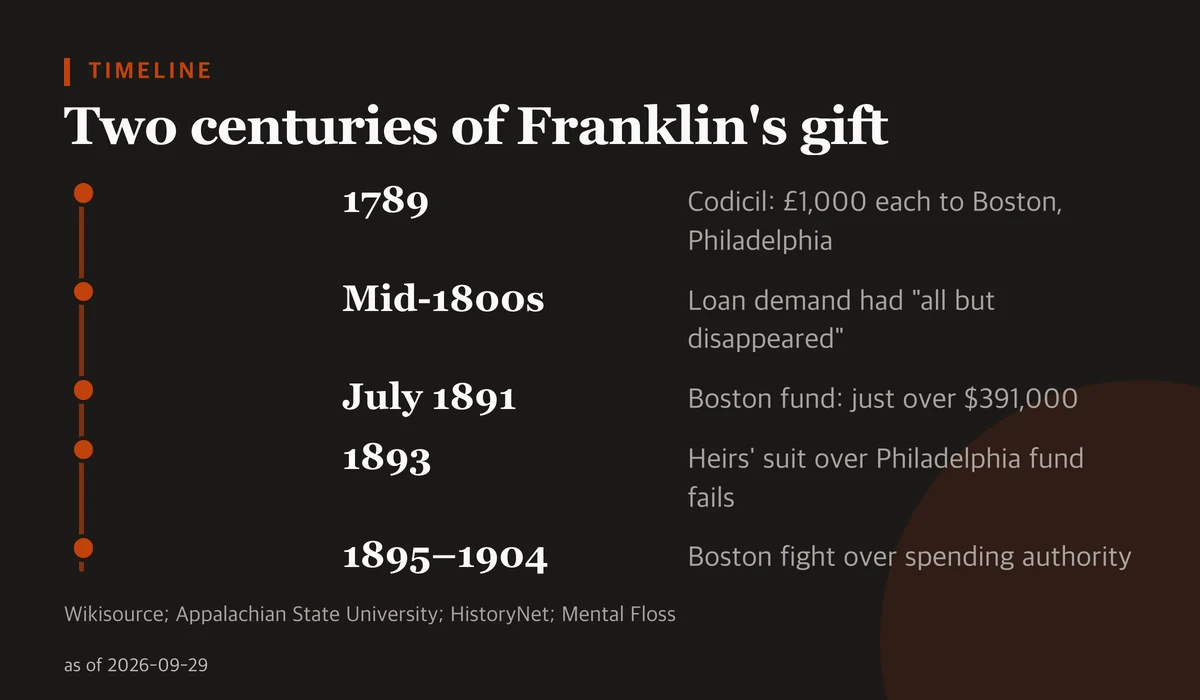
Here the facts end and the reading begins. Franklin’s projections are in 18th-century pounds. The results are in twentieth-century dollars. You can’t subtract one from the other. Yenawine’s dissertation describes the outcome as a large real return that still fell well short of what uninterrupted compounding at Franklin’s rate would have produced. One way to read this: the formula held up. The “without interruption” part didn’t.
Three leaks that show up in ordinary savings
Franklin’s fund leaked at a civic scale. You probably won’t face a lawsuit over your retirement account. But each leak has a smaller cousin in a household budget.
First: the engine stops, but the balance stays
Compounding needs something that actually earns the return, and a balance can sit still while looking safe. Franklin’s engine was one kind of borrower. When apprentices became factory workers, the snow ran out.
The household version is quieter. You change jobs and roll an old workplace retirement plan into a new account. Depending on the provider, the money may land as cash and wait for you to choose investments. Months later, it’s still waiting. The statement says “retirement account,” so it feels invested. What changes when you notice: you start checking what the money is doing, not just where it lives.
Second: withdrawals reset the base
Every withdrawal shrinks the base that later years compound on. Franklin planned one himself. His own numbers show it: £131,000 minus £100,000 for public works left £31,000 to carry into the second century.
His withdrawal had a date and a purpose. Yours might not. Picture cashing out a small retirement balance between jobs to cover a security deposit and a moving truck. Your next twenty years then compound on what’s left, not on what was there. Naming your withdrawals in advance, with a year and a reason, makes the unnamed ones easier for you to spot.
Third: unclear control costs time
When it isn’t clear who decides, decisions wait. In Boston, the city treasurer and the fund’s managers spent 1895 to 1904 arguing over who could spend Franklin’s money.
At home, this looks like you and a partner with a shared long-term account and no rule about when it can be touched. Every hard month turns into a negotiation, and the answer depends on who’s more tired. One written sentence changes that: “We don’t touch this unless both of us agree, and only for these reasons.” The decision gets made once, on a calm day, before you need it.
The other side
Sounds like a story about failure? It isn’t. Two gifts of £1,000 became about $6.5 million between them. Compounding worked. The honest conclusion is that compounding is conditional — on reinvestment, on a live source of return, on nobody diverting it — not that it’s an illusion.
The currency problem is real, too. Franklin projected in pounds; the results were reported in dollars, one and two centuries later. Prices changed enormously over that span, so even the 1891 and 1990 dollar figures don’t line up cleanly. If someone hands you a neat “he missed by X” number, it’s doing more than the sources allow.
The biggest leak wasn’t a money-management mistake, either. Nobody in 1789 could have planned around the factory system. Some leaks are nobody’s fault. For you as a saver, that’s a reason to expect unmapped ground, not a reason for blame.
Finally, some of the “leaks” were the point. Franklin designed the plan to spend: £100,000 on public works after the first century, the rest after the second. Money that compounds forever and never gets used isn’t much of a plan.
Try this today
Pick your longest-term account. Tonight, give it ten minutes.
- Check the engine. Log in and look at the holdings, not the total. Is your money invested the way you think, or sitting in cash?
- List the withdrawals. Write down any you expect, each with a year and a reason. Note any past ones you didn’t plan.
- Name who decides. Write one sentence about when this money can be touched. If your account has a beneficiary field, check that the name is still right.
You don’t have to change anything yet. Just look.
Franklin wrote “without interruption,” and the next two centuries showed what interruptions look like: borrowers who disappeared, a planned withdrawal, years of fights over control. The funds still grew into millions of dollars. By Yenawine’s account, they grew by far less than uninterrupted compounding would have produced. Your own savings cross the same kinds of ground at a smaller scale — an engine that stalls, a withdrawal that resets the base, a rule nobody wrote down. Now you know where to look.