At a glance
- "21 days" traces to Maxwell Maltz's 1960 line about "a minimum of about 21 days" for a mental image to change, not a habit deadline.
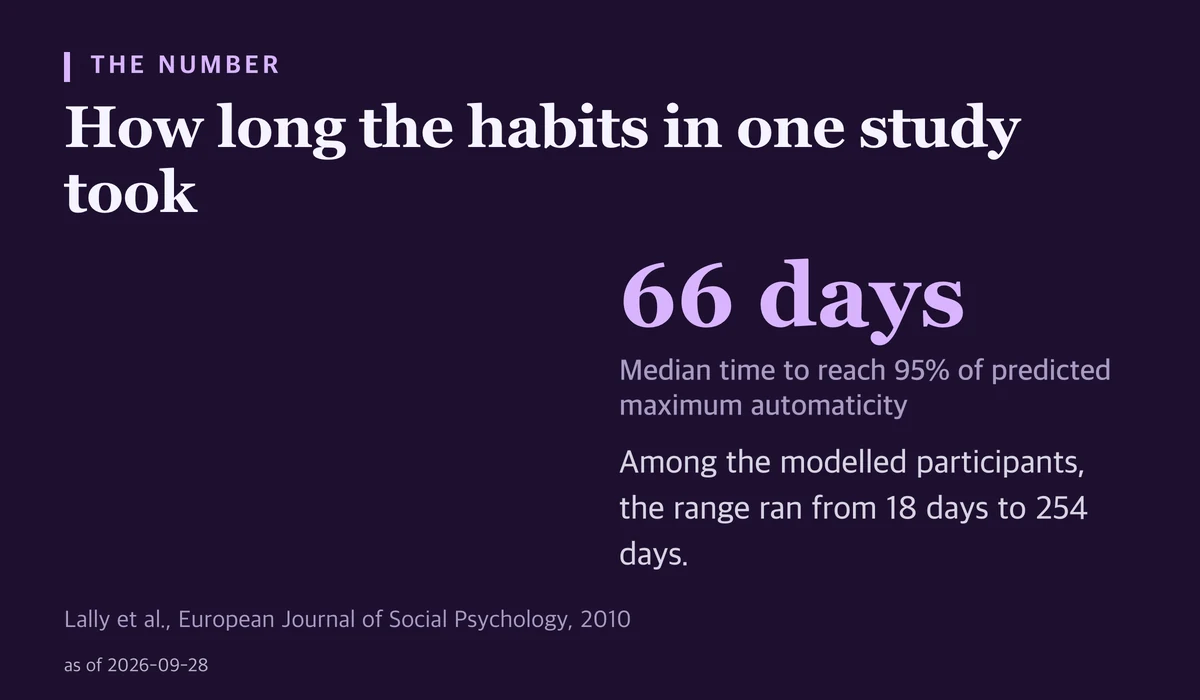
- In a UCL study, the median time to near-automaticity was 66 days, with a range of 18 to 254, among participants whose data could be modelled.
- Missing a single day did not seriously impair habit formation in that study, and Lally warns that 66 is not a new deadline either.
In this essay
It’s day 22. The calendar on the kitchen wall has a neat row of crosses, and you’re standing in front of it at 6 a.m., still arguing with yourself about the run. Three weeks were supposed to be enough. Somewhere you picked up the idea that 21 days turns an effort into a habit. So when it still feels like work, it lands as a verdict: maybe you’re just not a habit person.
That verdict rests on a number that was never measured as a habit timeline. It began as a surgeon’s observation about something else. When researchers finally tracked new habits day by day, they found something slower, messier, and more forgiving.
By the end, you’ll know why a new habit can still feel hard on day 22, what the measured timeline looks like, and why a single missed day mattered far less in that study than most people fear.
A floor, not a finish line
So where did 21 come from? Maxwell Maltz was a plastic surgeon. In his 1960 book Psycho-Cybernetics, he described a pattern he saw in his practice. Patients seemed to take about three weeks to stop being startled by their new face. People who had lost a limb felt a phantom limb for a similar span. His point was about adjusting to change in general, not about building routines.
The line usually quoted from the book reads:
It usually requires a minimum of about 21 days to effect any perceptible change in a mental image.
Notice the small words: “a minimum,” “about,” “a mental image.” Later retellings dropped “minimum” and “about” and swapped “mental image” for “habit.” A rough floor for one kind of adjustment became a finish line for every kind of habit. When a UCL research group later wrote about the idea, they called it a myth.
A better picture is a footpath across a lawn. The first few walks barely bend the grass. Keep crossing at the same spot and a faint line appears, then a clear track. After a while, more walking hardly changes it. The path is simply there. There’s no single day on which it became a path, and how long it takes depends on the ground and how often you cross.
That’s the one idea everything below builds on. In the study that measured habits closely, they behaved more like that path than like a countdown: a curve that rises and levels off, not a deadline you pass.
What the study actually measured
In a paper published in 2010 in the European Journal of Social Psychology, Pippa Lally and colleagues at University College London recruited 96 volunteers. Each person chose one daily eating, drinking, or activity behaviour and tied it to a fixed cue in their day. Examples included a 15-minute run before dinner, a piece of fruit with lunch, and 50 sit-ups after morning coffee. They kept going for 12 weeks, or 84 days, and rated each day how automatic the behaviour felt.
Only a subset of the volunteers gave enough consistent daily data for a curve to be fitted. For those people, the researchers estimated when each person reached 95% of their predicted maximum automaticity, which is close to the top of their own curve. The median was 66 days, and the range ran from 18 days to 254 days.
Lally has put it plainly:
The average time it took for the participants in my study to form a daily habit was 66 days. However, the range was 18 to 254 days.
Set that next to the old number. The median alone sits 45 days past the 21-day mark (66 minus 21 is 45). And because a median is the middle value, at least half of the modelled participants had not reached that point by day 22, or even by day 60.
One way to read this: a hard day 22 isn’t evidence that something is wrong with you. In this study, it was the ordinary position for at least half the people whose curves could be measured.
Three things the curve changes
First: watch the feeling, not the date
The study tracked how automatic a behaviour felt, so that is the signal worth watching. Picture the evening walk after dinner. In week one, you check the weather, hunt for your shoes, and talk yourself into it. Weeks later, you might find your hand on the door before the debate starts. Does it take less deciding than it did last week? If so, the curve is climbing, whatever the calendar says. Day 22 stops being a pass-or-fail exam and becomes one point on a line.
Second: start with the easy version
In the study, simpler behaviours, like drinking water, became automatic faster than demanding ones, like 50 sit-ups. Picture the kettle clicking off at 7 a.m. Filling a glass of water right then is small, and the cue arrives every morning without effort. Promising 50 sit-ups on the living-room rug before work is a much bigger ask of the same morning. Starting small doesn’t mean staying small. It means giving the curve a chance to rise before you add weight.
Third: a missed day is a gap, not a reset
Missing a single day did not seriously impair the habit-forming process; automaticity gains resumed soon after. Picture a Thursday that falls apart: a late train, a sick kid, a deadline. The streak app on your phone flashes back to zero, and the tempting move is to start over on Monday. The study’s curves didn’t drop to zero after one miss. A streak counter does. Sometimes the bigger cost of a missed day is the week you lose deciding you’ve failed.
The other side
It would be easy to swap one magic number for another. Lally herself says the 66-day figure is routinely quoted out of context. It describes how widely people varied, not a new deadline. A poster that says “66 days” repeats the mistake the “21 days” poster made.
The sample was fairly small, too. The study began with 96 volunteers, and only the subset whose daily data fit a curve fed the 66-day median. That makes it a useful first measurement, not a settled law.
Then there’s what was measured. Automaticity came from a daily self-report scale, not an outside record of behaviour. The curve tells you how automatic the habit felt to the person doing it, not how an observer would have scored it.
The timing has a wrinkle as well. The study ran for 84 days, and 254 is longer than 84. That suggests the longest estimates came from projecting where a person’s curve was heading, not from a day anyone watched arrive.
Difficulty matters, too. A glass of water and 50 sit-ups are different jobs, and no single number, 21 or 66, fits both. And the missed-day finding was about one missed day. It doesn’t tell you what a missed fortnight does.
So what does the study support? A shape, not a date, with a lot of room between one person and the next.
Try this today
Pick one small behaviour, glass-of-water size rather than 50-sit-up size. Tie it to something that already happens every day: the kettle clicking off, parking the car, closing the laptop after work. Then:
- Write the cue and the behaviour on your calendar or a sticky note: “After the kettle, one glass of water.”
- When the cue happens, do the behaviour. Just that.
- Before bed, write one word next to the date: “forced,” “easier,” or “automatic.”
Try it for one day. Not forever. One day. Tomorrow you can decide whether to do a second. If a day slips, write “missed” and pick it up the next day. Don’t restart the count.
That word on the calendar is the point. Day 22 can still feel hard because 21 days was never measured as the time a habit takes; it began as a surgeon’s rough floor for getting used to change. The study that did measure it found a median of 66 days, a range of 18 to 254, and no serious setback from a single missed day. The crosses on the wall were never the real record. The path forms at its own pace, and one word a night is enough to watch it happen.
A habit is a curve, not a countdown: watch whether it feels easier, and if you miss a day, just do it the next.