
At a glance
- When 16 Yale graduate students wrote out how everyday devices work, their self-rated understanding fell, then fell again after a pointed follow-up question.
- The drop was much larger for how-things-work knowledge than for facts or stories, and procedures showed essentially none.
- Leaning on other people's knowledge is normal; this essay argues the gap matters mainly when a decision or someone else's work rests on it.
In this essay
You have zipped a jacket so many times that your hands do it without asking you. If someone asked whether you understand how a zipper works, you would probably say yes, and it would not feel like a bluff. The teeth are right there. You have watched them close. The same goes for the toilet you flush every morning and the bike in the hallway. Things you use daily feel understood, and checking seems pointless.
A small set of studies checked anyway, by asking people to put that understanding into words. How can you tell, in a few seconds, whether you understand something or have only seen it often, and when does the difference cost you anything?
Why seeing it every day feels like knowing it
The belief has a sensible source. With a zipper, a bicycle or a lock, much of the machine sits in plain view. Being able to point at the parts feels a lot like being able to explain them. And who stops to test something that has never let them down?
Frank Keil, a Yale psychologist, has written about what happens when that feeling meets a direct question. In a 2010 review, he notes that people asked to explain objects as simple as cylinder locks, flush toilets and bicycles can often name only one or two correct components. Even those few parts may then be connected to each other incorrectly.
The artist Gianluca Gimini turned the same gap into art. For his Velocipedia project, he collected 376 freehand bicycle drawings between 2009 and 2016, from people aged 3 to 88 across 7 nationalities, with no reference images allowed. He then built photorealistic 3D renders that kept each drawing’s structural errors. The result is a gallery of handsome bicycles that could not actually be ridden.
Velocipedia is an art project, not a controlled study. It cannot say how common those errors are or who tends to make them. It shows something narrower: people who have seen bicycles all their lives can draw one that would not work, and nothing on the page warns them.
What happened when the explanation had to be written down
The clearest measurement comes from Leonid Rozenblit and Frank Keil at Yale, published in Cognitive Science in 2002. In their first study, 16 graduate students rated how well they understood 8 everyday devices: a speedometer, a zipper, a piano key, a flush toilet, a cylinder lock, a helicopter, a quartz watch and a sewing machine. They used a 7-point scale, with 7 as the highest.
Next, the students wrote a step-by-step causal explanation of each device and rated themselves again. Then they answered a pointed follow-up question about one detail of each device and rated themselves a third time. The average started at about 3.89. After writing, it fell to about 3.10. After the follow-up question, it fell again, to about 2.49.
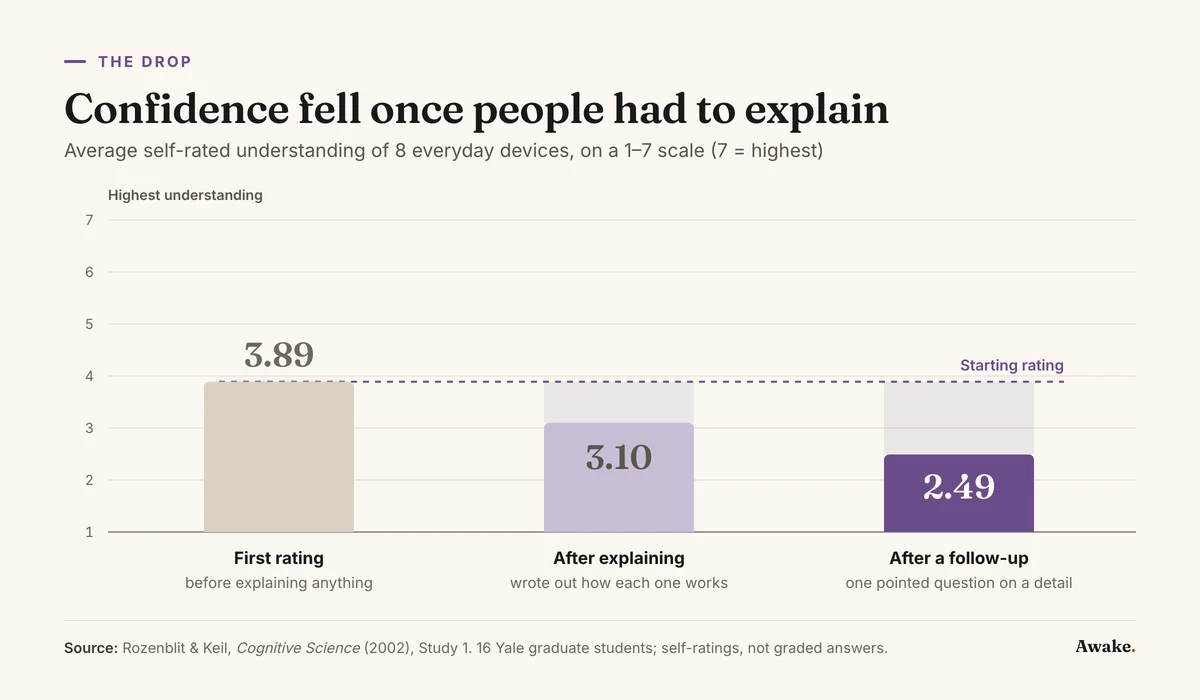
Sixteen people is a small group, all graduate students at one university, so the study cannot say how the general public would score. It also measured how people judged their own understanding, not how good their explanations were. What it does show is a direction. When these students had to produce the mechanism on paper, their sense of understanding shrank, and it shrank again when a specific follow-up question tested one detail.
Rebecca Lawson at the University of Liverpool found a similar gap with bicycles. In a 2006 study, she asked people to draw bicycles and to pick the correct frame, pedals and chain position from sets of four alternatives. On the four-option task, about 40% of participants, many of them psychology undergraduates who rarely cycled, made at least one error.
A summary by cycling journalist Dave Atkinson, who read the paper, gives a finer breakdown. Among 64 non-cyclists in the first experiment, 44% of freehand drawings had the chain in the wrong place, and the four-option task produced chain errors 36% of the time. Among 65 experienced cyclists in a later experiment, chain errors fell to 6% of drawings and 9% of the recognition task. The summary doesn’t say why, though a likely reason is ordinary: riders have more cause to notice how a chain sits.
Between the Yale students’ first rating and their second, nobody handed them a manual or a zipper to take apart. They only wrote down what they already believed they knew, and that alone moved the number.
The limits
These findings are easy to stretch into a claim that people overrate everything. The Yale team tested that stretch in the same paper. They ran the same rate, explain, rerate procedure on facts such as country capitals, procedures such as baking cookies or tying a bow tie, and narratives such as movie plots.
The drops were much smaller. For devices, ratings fell by about 0.86 to 0.92 points. For capitals, the drop was about 0.29, and for movie plots about 0.35. Procedures showed essentially no drop, just a slight rise. People who thought they could describe tying a bow tie still thought so after writing the steps down.
So this is not general overconfidence. It gathers around one kind of knowledge: how something works, cause by cause. Knowing that a fact is true, remembering a sequence of steps or retelling a story holds up far better under the same test.
The second limit goes deeper. Does failing to explain a zipper mean something is wrong with how you think? Keil’s 2010 review argues otherwise. Formal science, he writes, works much like everyday understanding: individual scientists hold incomplete, fragmentary models, and progress depends on a social infrastructure of knowledge and on deferring to the right experts. Steven Sloman and Philip Fernbach make a related case in The Knowledge Illusion: people constantly draw on knowledge stored in other minds, their bodies and their surroundings, usually without realizing it.
Seen that way, a shallow model of a flush toilet is not a defect. A plumber holds the deep version, and you know how to find one. The trouble starts when the shallow version is mistaken for the deep one at the moment a decision depends on it.
When the gap starts to cost something
Neither the Yale nor the Liverpool studies looked at decisions, so this part extends their findings rather than reporting them. Two moments seem worth watching.
The first is a choice that rests on a mechanism. A mechanic says the car needs a new part and explains why in a sentence or two. It sounds familiar, so you nod. That nod is the first rating the Yale students gave, before anyone asked them to write. One follow-up, “What does that part do, and what happens if it fails?”, shows whether you are agreeing with an explanation or with a familiar sound.
The second is an answer someone else will act on. A new colleague asks how the team’s spreadsheet pulls its figures, and you open that file every morning. Opening it daily is familiarity. If the colleague builds a report on your answer, any missing link in your mechanism becomes theirs. Saying you use it but would need to check how it calculates costs a few seconds and sends the question to whoever holds the deep version.
Outside moments like these, the community of knowledge does its job. Reading the time has never required understanding a quartz watch.
Try this today
The next time something feels too obvious to explain, explain it, out loud and in order. Say the first step of the mechanism, then what that step causes. “When you pull the slider up, it…” and see how far the sentence goes before it runs out.
If you can link two or three causes in a row, the understanding is probably real. If you stall after the first, or start naming parts without joining them, you have found what Keil described: one or two components, loosely connected. The check takes about ten seconds. It is a compressed version of what the Yale students did on paper, and nobody has tested this short form, so it works as a rough screen, not a measurement.
Then ask whether a decision, or someone else’s work, is about to rest on this. If not, let the gap stay open; someone else holds that knowledge, and leaning on them is how it is supposed to work. If so, close it by getting nearer the thing itself, which is likely what set Lawson’s cyclists apart. Look at the real chain, ask the mechanic to point to the part, or sketch it and compare your drawing with a diagram.
In Lawson’s first experiment, 44% of non-cyclists’ drawings put the chain in the wrong place. Among experienced riders, it was 6%. Most of what you use can stay at the non-cyclist level. The ten seconds are for the few things you are about to ride.
Before trusting that you know how something works, say two causes in a row out loud, then ask whether anything is about to rest on it.