
At a glance
- Junior NIH applicants just below the R01 funding line (623 near misses) had 16.1% of their papers become top-5% 'hits' within five years, against 13.3% for those just above it (561 narrow wins).
- The miss had a cost: a chance of more than 10% of disappearing permanently from the NIH system; the paper's estimate is 12.6% over ten years.
- The gap survived a check for survivor effects, smaller, but it comes from one modest, biomedical-only study, and nobody knows why it appeared.
In this essay
An early rejection feels like the moment the race was decided. Someone else got the grant, the job or the place you wanted, and with it the money and the momentum. You got an email and a reason to start over. The belief you are left with is hard to argue with: lose early, and the gap only widens from there. A 2019 study of junior biomedical scientists tested that belief at a line where a few points decided who got funded. The people on either side looked almost identical on paper. Over the next ten years, which side produced more of the work that mattered, how many who lost walked away, and what does it say about the rejection in your own inbox?
A few points below the payline
The study, by Yang Wang, Benjamin F. Jones and Dashun Wang, appeared in Nature Communications in October 2019. It followed junior principal investigators, meaning scientists who had made their first NIH application within the previous three years. Their applications for R01 grants were traced from 1990 to 2005 and linked to Web of Science.
Each application carries a priority score, and funding stops at a threshold. The authors kept only applicants whose normalized scores landed within 5 points of that line, on either side. That left 623 near misses just below it and 561 narrow wins just above. A density test found no sign that scores had been manipulated at the cutoff.
The decision was not small. Narrow wins received R01 funding averaging about $1.3 million over five years. Near misses did not, and over those five years they received about $0.29 million less in total NIH funding.
So did the near misses fall behind? The authors counted hit papers: those in the top 5% of citations among papers from the same year and field. In the first five years after the application, 16.1% of the near misses’ papers were hits, against 13.3% for the narrow wins. The two groups published about as many papers per person. Average citations ran 32.3 for the near misses and 27.0 for the narrow wins.
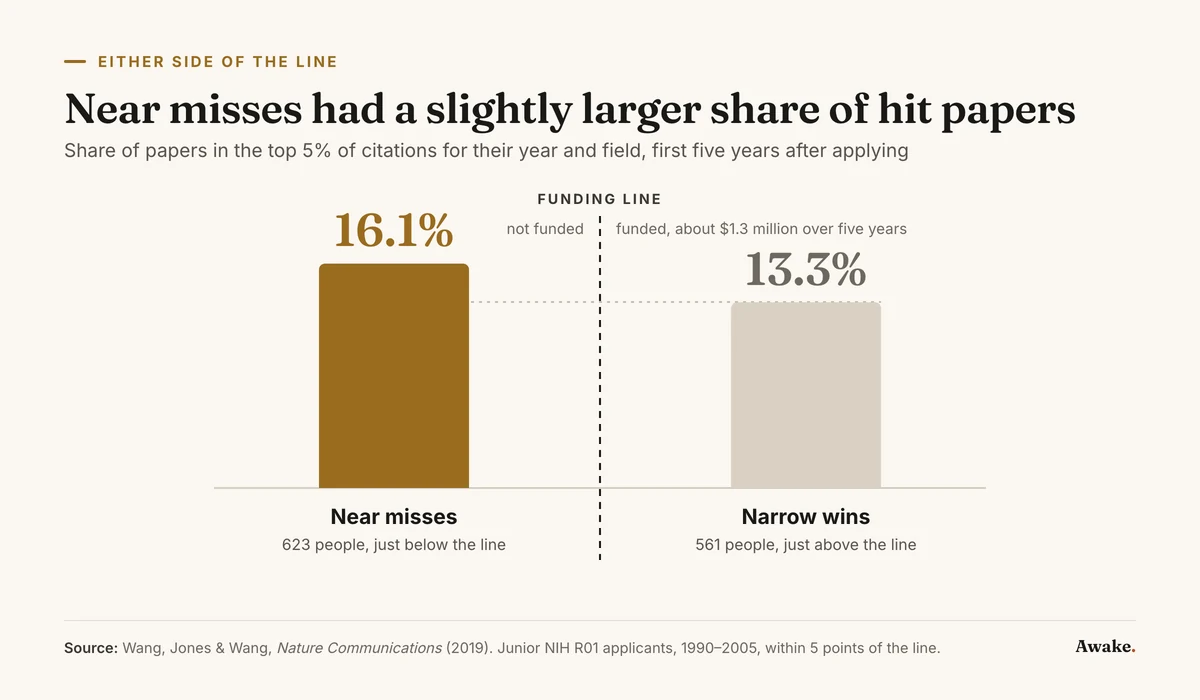
Over the full ten years, the main estimate was that one near miss raised the probability of publishing a hit paper by about 6.1%. The paper does not say whether that figure means percentage points or a relative change.
So among biomedical scientists who were nearly identical at the cutoff, the ones who lost went on to a somewhat larger share of highly cited work, with less money. They do not show why, and they say nothing about applicants who scored far below the line.
One rejection, two directions
The 623 near misses did better on that measure and worse on another. The paper’s abstract says an early setback significantly increases attrition, with a chance of more than 10% of disappearing permanently from the NIH system. The estimate in the main text is 12.6% over ten years. The gap opened quickly: one year after the decision, the near misses already had 11.2% fewer active investigators than the narrow wins.
Disappearing from the NIH system means no longer applying for or receiving NIH funding. It is not the same as leaving science. The lead author said as much:
The attrition rate does increase for those who fail early in their careers.
Side by side, the two results say something narrower than the familiar slogan. A close, early loss did not make people stronger as a group. It sent them in two directions: some out of the system, and the rest on to work that was cited a little more. Northwestern’s news office headlined the study with “what doesn’t kill you makes you stronger”, and claimed science proves it. That line keeps the second direction and drops the first.
The narrow winners went into the next five years with about $1.3 million. The near misses went in with only the choice to try again. Among those who made that choice, a larger share of the work ended up in the top 5% of its field.
Reading your own close call
That choice is the part of the study you can carry outside a lab. No advice was tested, so what follows is a reading of the pattern, not a proven method.
Find out how close it was
A near miss is a different event from a clear rejection, and you can read it as one. In the study, applicants within 5 points of the line were hard to tell apart before the decision.
You reach the final two for a job and the offer goes to the other candidate. An agent asks for your full manuscript, then passes. A community grant lists you as first alternate. Each one can land on you like a form letter. Once you know you were at the line, the open question is the one the near misses faced, whether to go again, rather than whether you belong in the field.
Keep the week of the rejection apart from the decision to stop
In this study the cost of a near miss showed up as people leaving, and the gap was visible within a year. Your rejection arrived on a date someone else chose. Stopping is a separate decision, and it can get made in that same week without being named: the draft folder archived on a Sunday, the next deadline allowed to pass. You can let the first event happen to you and still pick the date of the second. Would you make the same call a month from now, with the sting gone?
Where this breaks down
Before you lean on any of this, know where one study’s soft spots are. The most obvious is screening.
More near misses left, so the ones still publishing years later may simply be the most determined, compared against winners of every level of determination. That is survivorship bias, and the authors tested for it. They trimmed the narrow wins, removing those with the weakest later records, until attrition matched the near-miss group. The odds ratio for hit papers shrank from 1.25 but stayed at 1.17 (p < 0.001). Screening, they wrote, “appears insufficient to entirely account for” the gap. That is a conservative check, not proof of a pure causal effect.
The effect is also modest. The citation gap has a Cohen’s d of 0.08, small by the usual standard. The ten-year estimate for hit papers is borderline (p = 0.041), and the gain in the number of hit papers (p = 0.098) does not reach significance at all.
If your field is not biomedicine, the scope matters. The data cover one funder, one grant type, biomedical researchers and people near the cutoff. The authors say they cannot yet conclusively answer whether the advantage extends beyond near misses, and the study did not test other fields. They also could not pin down a mechanism; unobserved effort, grit or signaling are all possible. Asked about one alternative explanation, Jones was direct, as Kellogg Insight reported:
There’s no way for me to know if that’s what happened.
Nothing here suggests you should lose on purpose. The winners still had the money, and nobody in the data chose to miss.
Try this today
If a recent near miss is on your mind, write down two things: how close you came, and when you will go again.
Open the rejection. Under it, write one line about how close it was, in facts rather than feelings: shortlisted, final round, asked for the full draft, named as an alternate. If you can’t tell, you can ask; a short, polite email requesting feedback is a reasonable way.
Then put one entry in your calendar: the next place you will send the work, or the next round you will enter, with a date. The date can be months away. You are deciding it now, apart from the week the email came. This step, too, is untested.
In the 2019 data, 623 scientists missed funding by a few points. More of them than of the winners disappeared from the NIH system, and that loss was real. The near misses who stayed went on to a slightly larger share of their field’s most-cited papers, a gap that held up, smaller, when the authors tried to explain it away. For them, an early loss was not where falling behind began.