At a glance
- Asked about the calendar-X method in a 2014 Reddit AMA, Seinfeld called it a 'non-idea that was not mine'; it traces to a 2007 Lifehacker post by Brad Isaac.
- In controlled experiments, fewer people kept going after a logged streak broke, even when their actual effort was identical.
- Giving people a way to repair a broken streak won back about 16 of the 24 points lost, but not all of them.
In this essay
A wall calendar hangs next to the fridge. A long row of red X’s runs across it, then one empty square from the Tuesday the kid got sick and the day disappeared. By Friday the marker is back in the drawer. Nobody decided to quit. It just stopped feeling worth it.
If you’ve kept a habit chain, you may know this flaw. The whole system is built around never missing, and there’s no plan for the day you miss. The method usually arrives with a famous name attached: Jerry Seinfeld. He says it isn’t his. The more useful story is what happens right after a streak breaks. By the end, you’ll know why a broken streak makes quitting feel logical, and how to set up a habit tracker so one missed day doesn’t end the whole thing.
The chain, and the goal hiding inside it
The method spread from a 2007 Lifehacker post by Brad Isaac. Isaac wrote that Seinfeld had once given him advice: get a big wall calendar, and each day you write, put a big red X over that day. “Your only job is to not break the chain.” James Clear’s write-up later called it the “Seinfeld Strategy.”
Seinfeld saw it differently. In a Reddit AMA on January 6, 2014, someone asked whether he still draws an X on his calendar. According to a transcript of the thread, he answered:
It’s the dumbest non-idea that was not mine, but somehow I’m getting credit for it.
So the name is borrowed. The calendar still does something real.
A streak quietly gives you a second goal. The first is the habit itself: write, walk, practice. The second is keeping the count alive. Researchers who study streaks put it plainly:
Consumers consider maintaining a logged streak to be a meaningful goal in and of itself.
Why would a row of marks matter that much? Picture a clean kitchen counter. While it’s spotless, you wipe up a stray crumb right away. Once a stack of mail lands on it, one more cup hardly seems to matter. The counter barely changed. Your reason to protect it did. A streak can work the same way. Once it breaks, the second goal is gone, and your habit has to stand on its own.
What researchers saw after the break
You don’t have to take this on faith. The effects are modest, and the limits come later.
Jackie Silverman and Alixandra Barasch published seven studies on streaks in the Journal of Consumer Research in 2023. They defined a streak as at least three repeated, consecutive behaviors with no missed opportunity in between.
First, they checked how much people care. In a pilot survey of 100 online participants, 59% said they had gone out of their way to avoid breaking a logged streak. One did a 7-minute workout in the back of a bar to keep a fitness streak alive. If you’ve ever protected a streak at an odd hour, you have company.
In fall 2018, 980 university employees joined a 30-day challenge to walk 7,000 steps a day. On a given day, people were significantly more likely to hit the step goal when their logged streak was intact than when it had just been broken.
The researchers also ran experiments where actual effort was held identical and only the on-screen log changed. In one, 601 participants did the exact same four exercises. Some saw the effort logged as an intact streak. Others saw it shown as a broken streak, blamed on an app glitch. About 66% of the intact group chose to keep exercising, versus about 58% of the broken group. Same work. Different picture.
Another study looked at blame. Continuation was about 53% after an intact streak and about 42% after a streak broken by something external, a quota message. After a streak broken by the participant’s own failure to finish a task, it was only about 29%.
One way to read this: a broken streak doesn’t just take away a small reward. It tells you a story about your past, and you act on the story. When the break feels like your own fault, the story is harsher. Stopping can then feel less like giving up and more like agreeing with the calendar.
Three ways to plan for the miss
First: Keep the habit and the count apart
The habit is the goal; the count is only a record of it. That line blurs fast. In one study, about 45% of participants said they would watch an unwanted ad just to keep a logged streak intact.
Say you track reading before bed. Write the habit in words at the top of the page, “read before bed,” and let each X be a note rather than a score. When a square goes blank, your habit is still there on the page, named and unchanged. Only one note is missing.
Second: Build the repair in before you need it
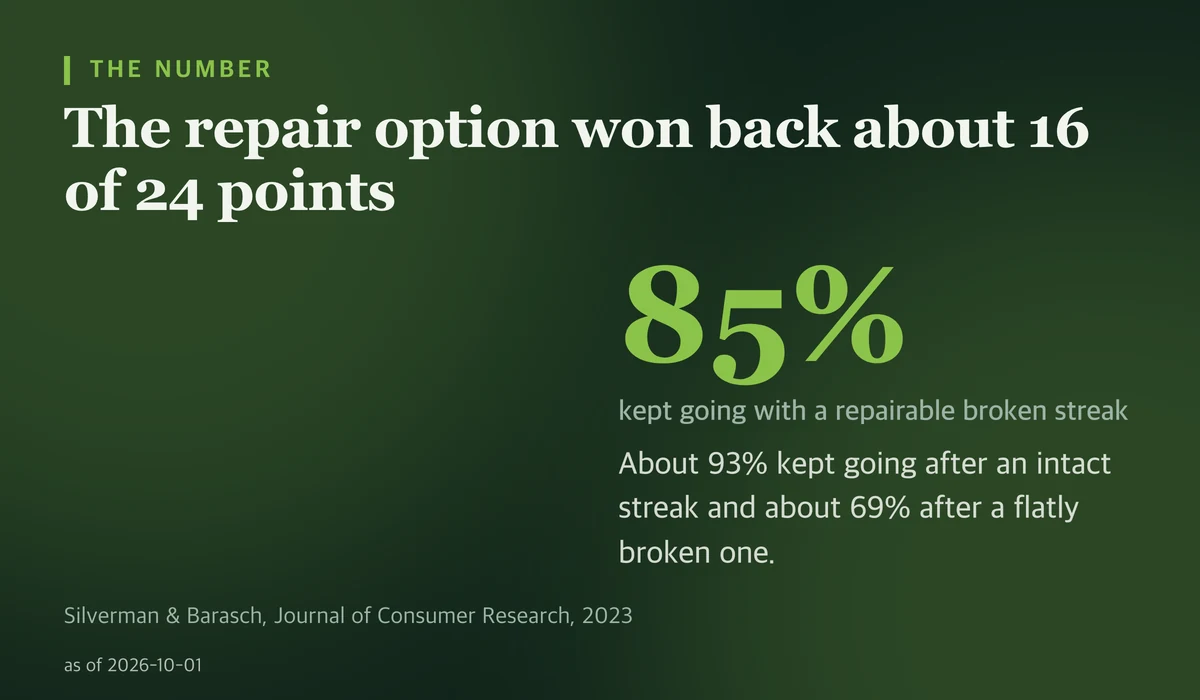
A repair rule is a way, agreed in advance, to fill a missed day so the log reads as unbroken again. In another experiment, about 93% kept going after an intact streak and about 69% after a flatly broken one. With a repairable broken streak, about 85% kept going. The break cost about 24 percentage points (93 minus 69), and the repair option won back about 16 of them (85 minus 69).
Duolingo’s streak freeze follows the same idea. Bought ahead of time with in-app currency, it lets you miss a day without losing your streak count, though the count doesn’t advance either. Duolingo reports that doubling how many Streak Freezes users could hold increased daily active learners by 0.38%.
On a paper calendar, a repair rule can be one line in the corner. A missed day gets a circle, and a circle followed by an X still counts as the chain. The blank square stops being a verdict. It becomes a step you already know how to take.
Third: Write down why
If you miss a day, write the cause in the square in plain words. The study didn’t test notes like this. What it did find is that a break caused by a participant’s own unfinished task hurt follow-through most: about 29% kept going, versus about 42% when something external broke the streak.
Many misses do have an outside cause: a late shift, a sick kid, a delayed flight. On that empty Tuesday, you’d write “sick kid” in small letters. Weeks later, the square may read as a fact about Tuesday, not a judgment about you. This isn’t a way to excuse every miss. Some days your honest note is “skipped,” and that’s worth seeing too.
The other side
Streaks are not just hype. The same research found that intact streaks raised follow-through in exercise, language learning, and games, including in the field study with actual step counts. Duolingo reports that reaching a 7-day streak makes a learner about 3.6 times more likely to complete their course. Those are the company’s own figures. The problem the research documents isn’t tracking itself. It’s the moment right after a streak breaks.
The evidence has clear limits, too. The controlled experiments used online workers doing brief, low-stakes tasks for small payments, not people building a real habit over months. The authors themselves flag this as an open question. Your year-long gym habit might react to a broken streak more strongly, or less. This research doesn’t say which.
Repair isn’t a full fix either. About 85% is still below about 93%. And if every miss can be repaired, the rule may stop meaning anything. It helps to decide in advance how often you allow a repair.
Try this today
Take the calendar off the fridge, or open your tracker app. Before you mark anything, set it up in three small steps.
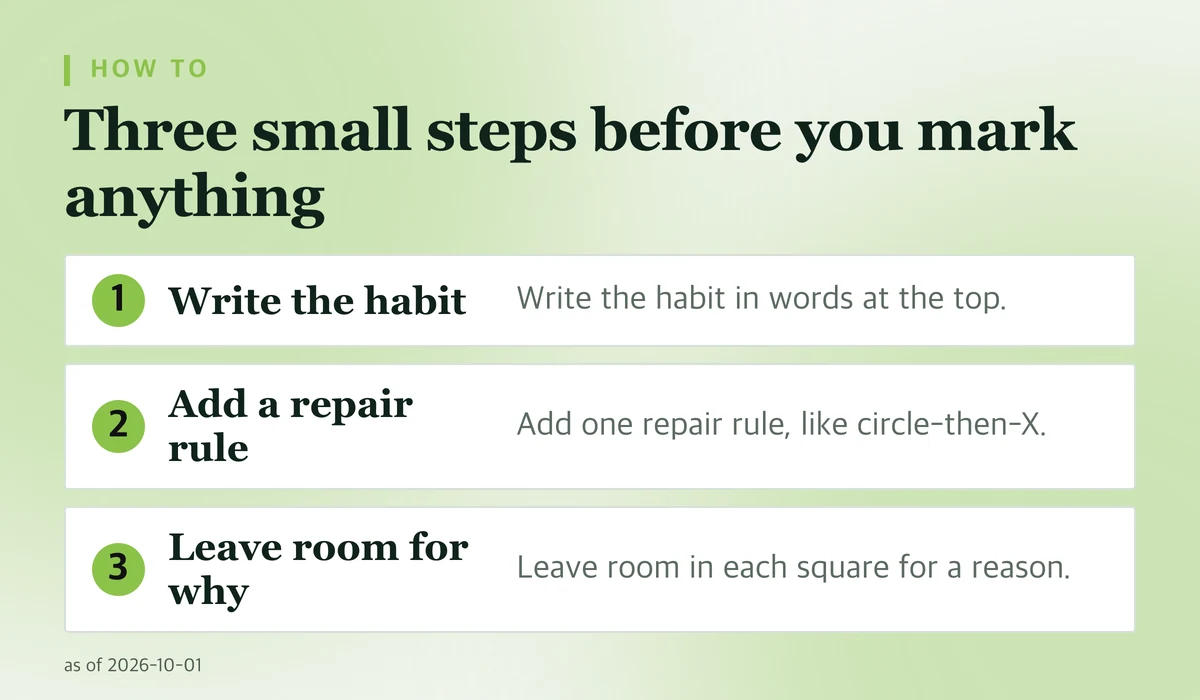
Write the habit in words at the top. Under it, add one repair rule, like the circle-then-X rule. Leave a little room in each square for a reason, in case you need it.
Sounds too simple? It is, on purpose. Do the habit once today and mark it. Try it for one day. Not forever. One day.
Tonight, ask one question: if tomorrow goes sideways, what does this page tell you to do?
A broken streak can make quitting feel logical because, by then, keeping the count has become a goal of its own, and a blank square looks like that goal is gone. A tracker that already says what happens after a miss gives that square a different meaning. It’s one missed day, with your next step written beside it.
Plan the missed day before it happens: a streak with a repair rule written in advance can survive one blank square.