At a glance
- In a randomized UK field experiment, hiding the autopay option that pays exactly the minimum cut enrollment in it from 36.9% to 9.6%, per the working-paper version.
- Total card debt showed no significant drop: the FCA paper says nudged cardholders cut manual payments by about as much as their automatic payments rose.
- The month's total paid to the card, automatic plus manual, and the balance after it say more about progress than the number on the autopay form.
In this essay
Every credit card statement carries one number that seems built to keep you paying for years: the minimum payment. It is small, it is easy to find, and it is the simplest option to put on autopay and forget. So the fix looks obvious. Take that option away, and people will pick something bigger and clear the balance sooner. If you have ever raised your own autopay above the minimum, you know the small relief of watching a larger figure leave your account each month without any effort.
A team of researchers tested that fix on real cardholders in the UK. The autopay figures grew. Total card debt showed no significant drop. Why would a bigger number on the autopay form leave the balance where it was, and which total tells you whether you are actually paying more?
Why the minimum takes the blame
The suspicion has a respectable source. In a 2009 paper in Psychological Science, Neil Stewart argued that the minimum shown on a statement acts as a psychological anchor. An anchor is a number that pulls a later judgment toward itself, even when nobody meant it as advice. On a card bill, the later judgment is how much you pay.
The stakes are real. Stewart also notes that about three quarters of credit card accounts attract interest charges. For those accounts, each month’s payment has a price attached, and an anchor that holds the payment down raises that price.
The fix follows from there. If the printed minimum pulls payments down, why not remove it from the moment people choose? Autopay is that moment. You pick an option once, and the choice repeats every month without another thought. Steer that single decision away from the minimum, and the higher payment should repeat too.
What the autopay experiment found
Guttman-Kenney, Adams, Hunt, Laibson, Stewart and Leary ran that test as a randomized field experiment with UK credit cardholders. For one group, the autopay option that would pay exactly the contractual minimum each month was hidden, and an option to pay a fixed amount was made more prominent. The results appeared in an FCA occasional paper in 2018, then as an NBER working paper in 2023, and in AEJ: Economic Policy in November 2025.
On the form, the nudge did its job. In the working-paper version, enrollment in autopay-the-minimum fell from 36.9% to 9.6%. The published version reports a different measure: after six months, the share of cardholders paying exactly the minimum was 23 percent lower. That is a relative fall, not 23 percentage points, and it counts minimum payers rather than autopay sign-ups. The FCA paper adds that automatic payment amounts in the nudged group rose by a very large amount.
The bigger automatic payments did not carry through to the balances. After six months in the published version, and seven payment cycles in the working paper, the nudge had not significantly reduced total credit card debt. The FCA paper lists what else held steady: total repayments, counting automatic and manual payments together, along with card spending, borrowing costs and debt net of payments.
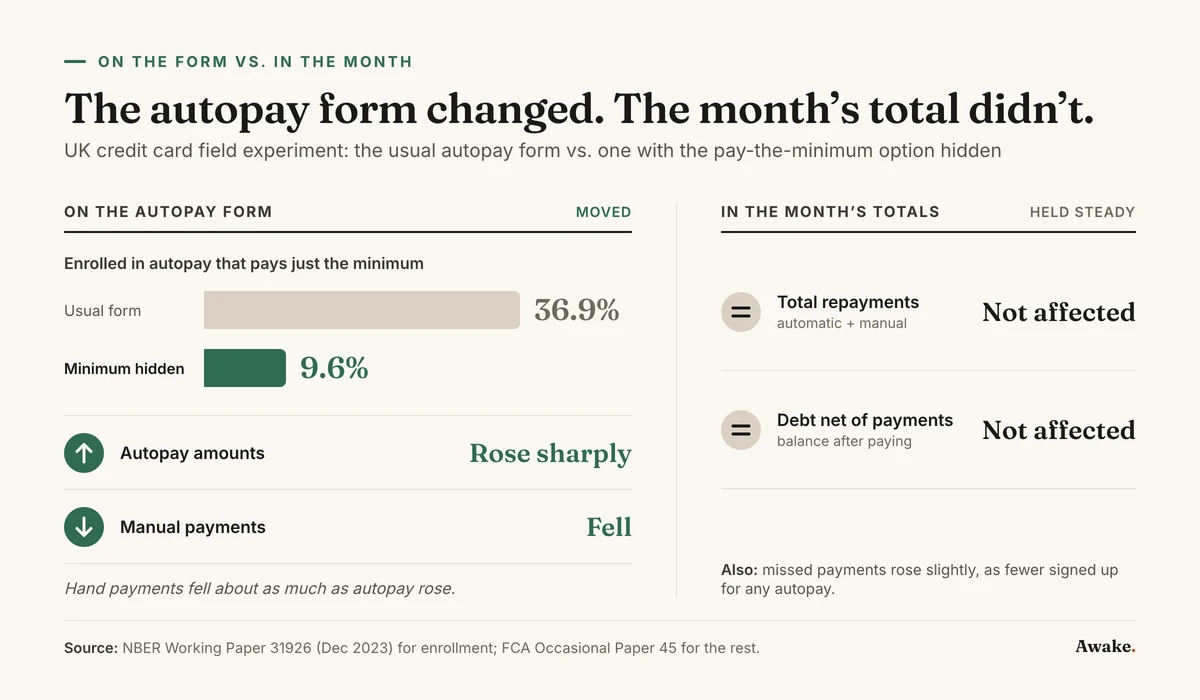
Where did the extra autopay money go? The researchers describe three things happening at once. Many nudged cardholders who chose autopay picked an amount only slightly above the minimum. Somewhat fewer signed up for autopay of any kind, and lower enrollment brought more missed payments. And nudged cardholders who stayed on autopay made fewer manual payments. The FCA puts most of the weight on that last one: people in the nudged group cut their infrequent manual payments by about as much as their automatic payments rose.
The authors’ best explanation is that cardholders frequently lacked liquid cash. That is their reading of the results, not a step they measured directly. It matches an ordinary month, though. If you can spare only so much, you can sign up for a higher autopay and then skip the extra payment you used to send by hand after payday.
In this experiment, a bigger autopay figure was mostly the same money taking a different route to the card.
What the evidence doesn’t show
Does that make the minimum harmless? Stewart’s argument concerns how a displayed number shapes the amount people choose, and the autopay experiment does not overturn it. What failed was one particular fix: hiding a single option at a single decision. A minimum printed on a bill can still pull payments toward it, and these results do not show otherwise.
The cardholders themselves were a narrow slice, too. The autopay experiment followed one UK card population for a matter of months. People who have carried a card for a decade, or cardholders in another country, might respond differently, and the experiment was not designed to tell you which way.
The limit that matters most for you is about cash. The null result describes the average nudged cardholder. If you finish most months with money to spare, the arithmetic of interest has not changed. A larger payment that is not offset somewhere else leaves a smaller balance for interest to build on. The experiment tested a change to a form. It did not test someone who decides to pay more and then checks that the total rose.
The total worth watching
If the autopay figure can climb while total repayment stays flat, it makes a poor scoreboard. The measures used to judge the nudge make a better one. The first is everything paid to the card in a month, automatic and manual together. The second is the balance left after those payments, which the FCA calls debt net of payments.
Suppose your autopay covers a set amount, and in months with cash left after payday you send an extra payment by hand. Raise the autopay and your setting looks better at once. Whether anything improved shows up a month or two later, in whether those hand payments keep arriving as well.
The minimum still has a job in this picture. As a floor on autopay, it keeps a payment going out in a month when nothing else does. Anything above that floor helps only if it adds to the month’s total.
Putting it to work
Open your card account and find the payments from the last full statement period. Add them together: the automatic payment and anything you sent by hand. Write that one total in your phone’s notes, with the balance shown after those payments.
If you decide to raise your autopay, change the setting and keep the note. When the next statement arrives, add up its payments the same way and put the two totals side by side, along with the two balances.
If the total went up and the balance came down, the higher setting reached the debt. If the total barely moved, look at the payments you made by hand. In the autopay experiment, that is mostly where the extra autopay money came from.