At a glance
- A 2025 meta-analysis found no memory advantage for unfinished tasks, the classic Zeigarnik claim.
- It did find a general tendency to resume interrupted tasks, known as the Ovsiankina effect.
- Stopping where the next step is clear, and writing it down, is one way to use that pull. It's a practice, not a tested method.
In this essay
It’s 5:52 p.m., and you’re three paragraphs from the end of a report. You push through, hit save, and close the laptop with that tidy feeling of a thing done. The next morning you open a blank document and stare at it. Nothing is waiting for you. You have to find the start all over again.
There’s a popular fix for this, and it has a name. Leave a task unfinished, the advice goes, and your mind will hold on to it, because unfinished tasks are remembered better. That’s the Zeigarnik effect. Half of it holds up less well than its fame suggests. The other half, far less famous, has held up better.
By the end, you’ll know which version of the “unfinished task” idea has evidence behind it, and how to use a deliberate stopping point to make tomorrow’s start easier.
Memory is one thing, pull is another
Picture a half-done jigsaw puzzle on the dining table. You could ask two different questions about it.
First: do you remember this puzzle better than the one you finished last month? Second: when you walk past it with your coffee, do you feel a small tug to sit down and fit one more piece?
The first question is about memory. The second is about behavior. Advice about unfinished tasks often blends them into one claim, as if remembering a task and wanting to return to it were the same thing. They aren’t, and researchers have tested them separately.
The memory version belongs to Bluma Zeigarnik. The pull version belongs to Maria Ovsiankina. Keep those two names apart, and most of the confusion clears up.
What the studies found
Zeigarnik’s paper on remembering completed and uncompleted actions appeared in 1927, in the journal Psychologische Forschung. Its famous claim, in short, was that people recall interrupted tasks better than finished ones.
A year later, in 1928, Maria Ovsiankina’s PhD thesis looked at what people do after an interruption. According to Wikipedia’s summary of her work, it showed that interrupted tasks are almost always resumed.
The two ideas then had very different careers. Zeigarnik’s name became famous. Her result traveled less well. Wikipedia’s article on the effect reports that replications in other labs, such as A. van Bergen’s 1968 thesis, found no significant recall difference between finished and unfinished tasks. Some, it says, found the reverse.
In 2025, researchers Ghibellini and Meier pooled the work on both effects in a meta-analysis published in Humanities and Social Sciences Communications. Their abstract sets up the problem plainly:
The memory advantage of unfinished tasks (Zeigarnik effect) is widely known; less well known is the related tendency to resume unfinished tasks (Ovsiankina effect).
What they found splits the idea in two. They found no memory advantage for unfinished tasks. They did find a general tendency to resume tasks. They conclude that the Ovsiankina effect represents a general tendency, while the Zeigarnik effect lacks universal validity.
Why would the famous result be so hard to repeat? The authors tie it to experimenter authority, task performance demands and task involvement. Those conditions, they say, were more common in the past and are rarer today.
One way to read this: being stopped by an authoritative experimenter, while trying hard to perform, may have made an unfinished task feel like a debt. Take that pressure away and the memory edge seems to fade. The pull to go back seems to remain. That’s an interpretation, not a finding.
Three ways to use the pull
If the memory claim doesn’t hold as a general rule, but the pull to resume does, the practical question shifts. It’s less about how to remember a task, and more about how to make going back easy.
First: stop where you know what comes next
End a work session at a point where the next move is already clear. Ernest Hemingway described this habit in A Moveable Feast, as quoted in a Kenyon Review essay:
I always worked until I had something done and I always stopped when I knew what was going to happen next. That way I could be sure of going on the next day.
You don’t need to be a novelist for this. Say you’re writing a cover letter at 10 p.m. Instead of forcing out the closing paragraph, you stop after its first sentence, while you already know what the second one says. In the morning, the second sentence is waiting. The start stops being a decision. It becomes a continuation.
Second: write the next step down
Before you stop, write the next action in one line, where you’ll see it first. This matters more once you drop the memory claim. If unfinished tasks aren’t reliably remembered better, your head may not hold the thread overnight.
Picture a budget spreadsheet at midnight. Before you close it, you type in the top cell: “Next: March groceries from the bank app.” Tomorrow, the pull to go back has somewhere specific to land. A vague tug toward “the budget” is easy to ignore. A tug toward one cell is easy to follow.
Third: keep the open loop small
Leave one small, specific thing unfinished, not the whole project. You want a loose thread to pick up, not a pile to face.
Think of a garage cleanout. Stopping with one box half-sorted on the workbench is different from stopping with the whole floor covered. The first looks like a quick job you could start with your coat still on. The second looks like a weekend. In practice, a small open loop often feels like an invitation, and a big one like a weight.
The other side
Start with the part that didn’t hold. The meta-analysis found no memory advantage for unfinished tasks. So leaving work vague and counting on yourself to “keep it in mind” has little support. That’s the habit worth dropping.
A tendency is also not a law. Ovsiankina’s thesis is described as showing that interrupted tasks are almost always resumed, but that was one early study. The meta-analysis describes a general tendency, not a rule for every person on every day. We read the abstract, not the full statistics, so we can’t say how strong the pull is. Some mornings you’ll walk right past the puzzle.
The lab is not your desk, either. In the classic experiments, the interruption came from the experimenter. Stopping on purpose, at a point you choose, is a different setup. Hemingway’s habit fits the resumption finding. It isn’t proven by it.
An open loop isn’t always a gentle pull. For some people, unfinished work follows them to bed as worry rather than drive. If a stopping point starts to feel like that, writing the next step down and closing the file may help. So may simply finishing.
And stopping mid-task only helps if the next step is clear. Stop in the middle of confusion, and tomorrow starts with the same confusion and less context.
Try this today
Pick one piece of work you’ll return to tomorrow: a report, a cover letter, a spreadsheet, a box in the garage. Before you stop today, do three small things.
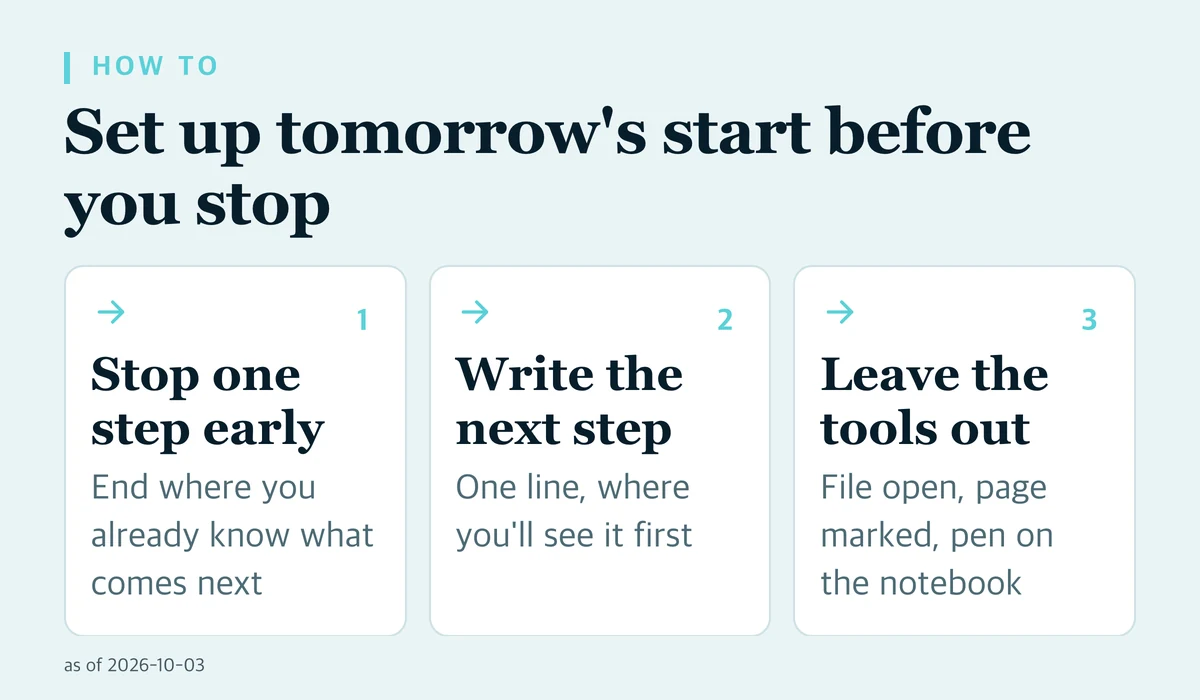
- Stop one step early. End where you already know what comes next.
- Write the next step. One line, where you’ll see it first.
- Leave the tools out. File open, page marked, pen on the notebook.
Tomorrow, when you sit down, notice the first few minutes. Did you start faster than usual, or did you still circle the desk? Either answer tells you something.
Try it for one day. Not forever. One day.
The unfinished-task idea with evidence behind it isn’t that you’ll remember what you left undone. It’s that people tend to go back to it. A deliberate stopping point, with the next step written down, gives that pull somewhere to go, and makes tomorrow’s start a little easier.