At a glance
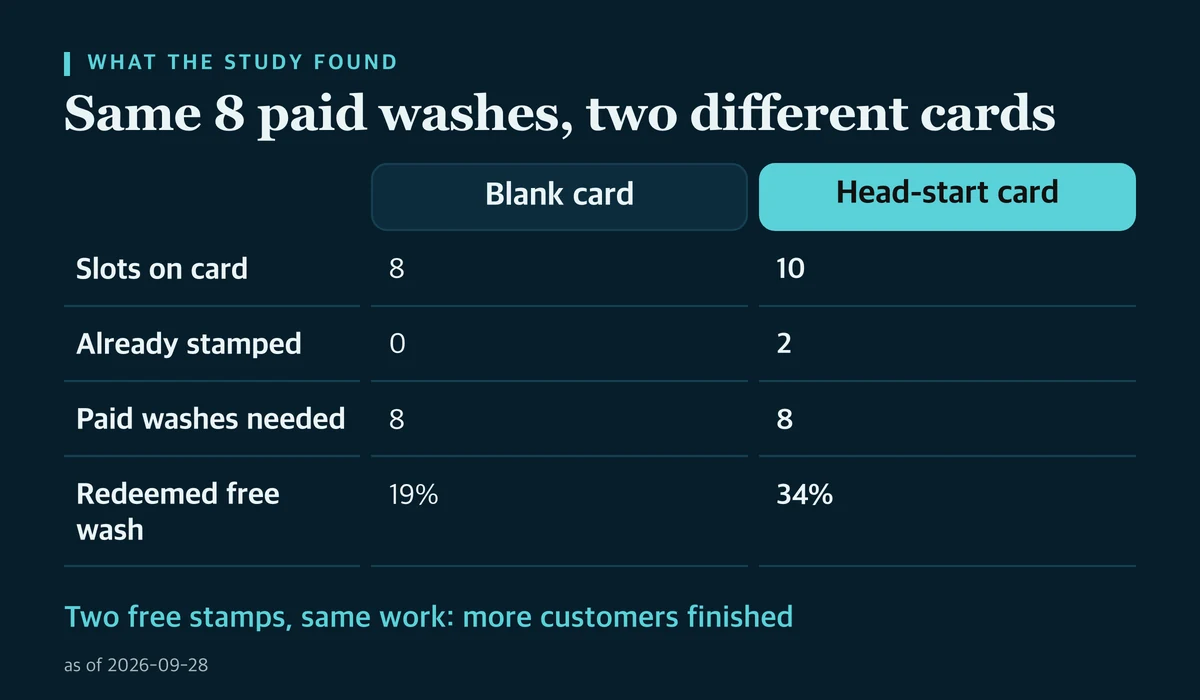
- At one car wash, 34% of customers redeemed a 10-slot card with 2 free stamps; 19% redeemed a blank 8-slot card. Both needed 8 paid washes.
- In a café study, coffee buyers bought more often as they neared a free drink, then slowed down right after getting it.
- One reading: in the middle, each step looks small next to both the start and the finish. Changing what you count may help.
In this essay
The card lives in your wallet, behind a gift card you forgot about. It has a row of boxes, and a few are stamped. You were pleased the day you got it. You’ll be pleased again when one box is left. Right now, somewhere in the middle, you barely remember it’s there.
Bigger goals follow the same curve. The first week of a savings plan feels sharp. The last chapters of a draft pull you along. But somewhere around halfway, the energy goes flat, and most people read that as a verdict on themselves. Not enough discipline. Not enough wanting it.
That verdict may be too quick. A small set of loyalty-card studies suggests the midpoint sag is partly about how you look at progress, not only how much you care. By the end, you’ll understand why motivation often sags halfway through a goal, and how to re-frame progress so the middle stops feeling endless.
Why the middle of the pool feels longest
Think about swimming laps. When you push off the wall, the wall is right behind you, and every stroke seems to count. Near the far end, you can see the tiles coming, and you speed up without deciding to. In the middle of the lane, both walls are far away. One stroke looks like the last.
Psychologists Andrea Bonezzi, C. Miguel Brendl and Matteo De Angelis gave that feeling a formal shape. Their 2011 paper in Psychological Science, “Stuck in the Middle,” proposed that motivation to act toward a goal is often higher near the very start and near the very end. It is lowest around the midpoint.
One way to read this: early on, you measure from the start, so each step is a big share of what you’ve done. Late in the game, you measure from the finish, so each step is a big share of what’s left. In the middle, one step is a small share of both. Did the work get harder? Not necessarily. It just stopped looking like it moves anything.
Sounds too simple? It is — and that makes it testable. If the dip is partly about perception, changing what people see should change what they do. Two field studies point that way.
Two cards, same eight washes
In a field experiment published in 2006, Joseph Nunes and Xavier Drèze worked with a car wash that gave loyalty cards to 300 customers. Some got a card with 8 empty slots: buy 8 washes, get one free. Others got a card with 10 slots, 2 of them already stamped. Do the arithmetic and the deals match. Ten slots minus 2 free stamps leaves 8 paid washes.
So what did two free stamps change? According to a summary of the study, 34% of customers with the pre-stamped card eventually redeemed the free wash, against 19% with the blank card. That’s a gap of 15 percentage points. The head-start customers also came back faster between visits as they neared the free wash.
A separate study by Ran Kivetz, Oleg Urminsky and Yuhuang Zheng, published in the Journal of Marketing Research, used a real café’s loyalty program. Ten coffees earned a free one. One version of the card had 12 slots with 2 already stamped, so customers still bought 10. As Chicago Booth Review reports, the head-start group finished their 10 purchases in about 12.7 days on average. The plain card took 15.6 days. That’s 2.9 days sooner.
Across a full card, the average gap between purchases shrank by about 20% from the first stamp to the last. People bought coffee more often the closer they got to the free one. Urminsky put the idea behind the head start this way:
The illusion of having already made progress would compel customers to complete those 10 purchases faster.
The behavior is what researchers measured. The reason is interpretation. One way to read both studies is that the free stamps made people feel further along from day one, so the flat stretch felt shorter. That fits the data, but the cards alone don’t prove it.
Three ways to change what you count
None of these come straight from the studies. They’re practical readings of them.
First: pick your yardstick by where you are
Before halfway, count what’s done. After halfway, count what’s left. Say you’re paying down a credit card. Early on, look at how much you’ve already cleared, because that figure grows fast in proportion. Once you’re past the middle, switch to the balance remaining, because now that’s the number shrinking fast. Each payment then looks like it moves something.
Second: stamp the boxes you’ve already earned
The car wash handed out free stamps. You can’t honestly do that for yourself, but you likely have real stamps you never counted. Your race training plan starts at week one, yet you’ve been running for weeks. You “haven’t started” the report, yet the interviews are done and the notes sit in a folder. Why start the card at zero if you aren’t at zero? Count that work as filled boxes. The card starts partly full, and the fullness is true.
Third: make the laps shorter
A long middle is a stretch with no wall in sight, so add walls. A year-long savings goal becomes a series of monthly ones. A book becomes a chain of chapters, each with its own small finish. You spend more time near a start or an end, where the studies saw people move faster. The café data also show a dip after each reward, so shorter laps bring more small dips. The bet is that several short dips are easier to climb out of than one long one.
The other side
Start with the researchers’ own data. In the café study, right after customers redeemed a free coffee, their pace slowed back down. It picked up again only as the next reward came closer. A head start, real or perceived, sped up one lap. It did not, by itself, create lasting motivation. If your goal has few natural finish lines, re-framing progress may buy you a better week, not a better year.
The trick can also backfire. Practitioner analyses of the endowed-progress effect warn that a head start handed out too close to the finish, or one that feels transparently artificial, can devalue both the effort and the reward. That matters more when you use it on yourself. You know which stamps you faked.
Then there’s scope. These are studies of car washes and coffee: small, repeated purchases with a clear prize. The car wash study covered 300 customers at one business, and the figures here come from published summaries rather than the paywalled paper. Finishing a thesis is a different kind of effort. The same pattern may show up there, but that’s an extension, not a finding. “Stuck in the Middle” is a proposed model, not a law.
And sometimes a flat middle is information. If a goal still feels empty after you change how you count it, the problem may be the goal.
Try this today
Pick one goal you’re somewhere in the middle of. Not the one you’re excited to start. The one that’s gone quiet.
On a scrap of paper, draw it as a stamp card, one box for each real step between where you began and where you’re headed. Fill in every box you’ve honestly done, including the prep work you never counted. Then decide which side of halfway you’re on. Before it, write the number of filled boxes at the top. Past it, write the number of empty ones. Put the card where you usually stall: next to the laptop, inside the notebook, on the fridge.
Try it for one day. Not forever. One day. See whether the next box looks any closer.
The middle often sags because, from there, each step can look small next to both the start and the finish. That’s partly a matter of what you count. Count honestly, from the right end, and the middle stops being an endless hallway. It becomes a card with boxes you can fill.