At a glance
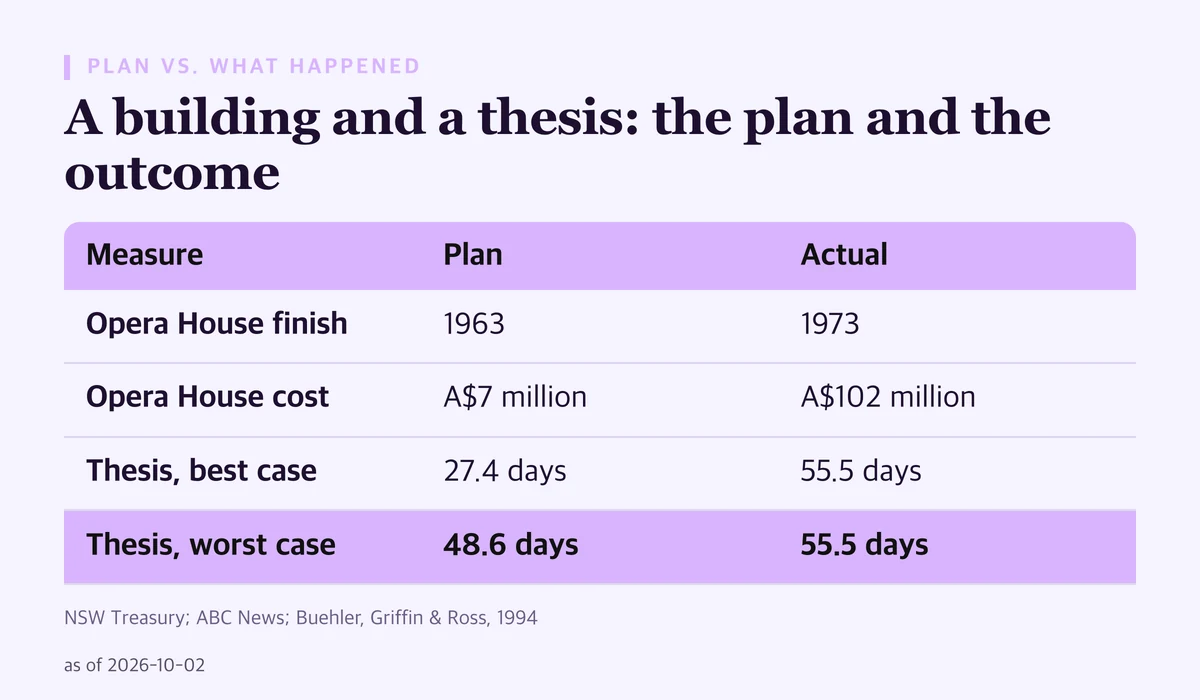
- The Sydney Opera House was budgeted at A$7 million with a 1963 finish; it opened in 1973 at A$102 million.
- In a 1994 study, honors students' theses took 55.5 days on average, longer than their average worst-case guess of 48.6 days.
- The outside view starts from how similar projects went, then adjusts, though picking the right comparison is its own problem.
In this essay
It’s Sunday night, and a report is due Friday. You open a blank note and sketch the week: research Monday, draft Tuesday, polish Wednesday, a spare day for emergencies. It looks reasonable. Every step on the list really does fit.
Then Thursday arrives, and you’re still on step two.
Most people file that under character. Not enough discipline, too many tabs open, try harder next time. But the same slide happens to careful people, large teams, and governments with engineers on the payroll. It happened to a building now on the UNESCO World Heritage List.
The usual mistake isn’t laziness. It’s where the estimate comes from. By the end of this piece, you’ll know why smart people so often underestimate their own projects, and you’ll have one simple outside-view check to run before your next deadline.
Two ways to look at a plan
Think about the drive to the airport. One way to estimate it is to picture the route: twenty-five minutes of highway, five to the terminal. Another is to remember the last five times you made that drive, lane closure and full parking garage included.
The first estimate is a story about this trip. The second is a record of trips like it.
The first approach is often called the inside view. You build the forecast from the details of your own plan: the steps, your skills, your intentions. The outside view starts with a different question. How did projects like this one usually turn out?
The inside view feels more accurate because it’s more specific, but a plan can only list the problems you can already see. A record of similar projects also holds the problems nobody saw coming.
The formal version is called reference-class forecasting, the fix Bent Flyvbjerg and Dan Gardner argue for in How Big Things Get Done. You only need the question.
A harbour, a budget, and a thesis
In 1957, the Sydney Opera House had an estimate of A$7 million and a planned finish in 1963, according to NSW Treasury. Construction began in 1959. On paper, that left four years of building.
Queen Elizabeth II formally opened the building on 20 October 1973. That’s fourteen years after construction began and about ten years after the planned finish. The final cost was A$102 million. NSW Treasury puts the overrun at 1,357% over the original budget.
Part of the delay sat in the roof. Work started before anyone had solved the geometry of the famous shells. The design team went through at least 12 versions of the shell forms between 1957 and 1963. Then they realized every shell could be cut from a single sphere with a 75-metre radius, which finally made prefabrication possible. The schedule had been written before the hardest problem had an answer.
Part of it was politics. The architect, Jørn Utzon, resigned on 28 February 1966, about seven years before the opening. He left amid disputes over payments, design authority and control with the new NSW Minister for Public Works, Davis Hughes.
You might be thinking: that’s a one-off. A strange design, a political fight. What does it have to do with your Friday report?
A 1994 study by psychologists Buehler, Griffin and Ross suggests more than you’d expect. They asked psychology students writing honors theses to predict how long the work would take. On average, the students said a best case would take about 27.4 days and a worst case about 48.6 days. The actual average was 55.5 days, longer than their own average worst case. Only about 30% finished by the date they had predicted.
The pattern shows up at scale, too. Flyvbjerg’s database has grown to more than 16,000 projects across 20-plus fields in 136 countries. In an interview with Thought Economics, he says only about 8.5% of those projects finish on time and on budget. Only about 0.5% finish on time, on budget, and deliver the promised benefits.
Those are the measurements. The explanation is a reading of them. One way to read the thesis result: a worst case imagined from inside the plan is still built from the plan. It adds a few bad days to the steps you can see. It doesn’t add the step you can’t see yet, like an unsolved roof or an architect’s resignation.
Three habits of the outside view
First: ask about the class before the case
Before you estimate a project, look at how long similar projects actually took. Say your manager asks in a Monday meeting when the new slide deck will be ready. Instead of picturing the slides, check the last three decks you built. When did you open each file? When did you send it? Now your first number comes from a record, not a story. You adjust from there, but only for differences you can name.
Second: assume your worst case isn’t the edge
Your imagined worst case may be closer to typical than it feels. You’re helping a friend move apartments, and you say, “Worst case, we’re done by six.” The thesis students’ average worst case was shorter than their average real finish. So when you give someone a deadline, put the buffer past your worst case, not inside it. The person waiting on you hears a date you’re more likely to hit.
Third: separate the solved from the unsolved
If part of a project has no known solution yet, don’t schedule it as if it did. Picture a bathroom remodel where nobody has opened the wall yet, or a feature at work that depends on a system no one has tested. The Opera House began building before the shells were solved. An honest estimate sounds different: “Two weeks for the known parts. The wall is an open question until Thursday.” It’s less tidy. It’s also less likely to fall apart in week three.
The other side
Optimism isn’t only a mistake. In 1967, the economist Albert O. Hirschman described what he called the “hiding hand.” People often underestimate how hard a project will be. They also underestimate their own creativity once they’re stuck. Sometimes the two errors cancel out, and something gets built that nobody would have dared to start with full knowledge.
Hirschman wrote about development projects, and his book came out six years before the Opera House opened. Reading the Opera House through his lens is a later interpretation, not his claim. Public lotteries, not taxes, raised the full A$102 million between 1957 and 1986, and in 2007 the building was inscribed on the UNESCO World Heritage List. Would anyone have approved it in 1957 with the real number on the table? There’s no way to know.
Hirschman himself didn’t offer the hiding hand as a reliable rule. He described these rescues as:
…stories, intricate and often nonrepeatable, [which] look more like tricks history has up its sleeve than like social-scientific regularities.
The hiding hand may explain why some overruns end well. It isn’t something you can plan around.
The outside view has its own weak spot, too: choosing the comparison. Too broad, and the number says little. “All writing projects” tells you almost nothing about your thesis. Too narrow, and there may not be enough past cases to learn from. Pick the wrong class, and the outside number can be no more reliable than the inside one.
And not every delay is a thinking error. Much of the Opera House’s delay traces to an unsolved engineering problem and a political rupture. No forecasting habit prevents a dispute with a minister. What the outside view can do is make you less surprised when something like it happens.
Try this today
Pick one task due in the next week or two. Then do three small things.
- Write down your gut estimate. Don’t fix it or argue with it.
- Find three past tasks like it. Check your calendar, your sent folder, or the dates on old files. Write down how long each one actually took, start to finish.
- Compare. If the record is longer than your gut, start from the record. Adjust only for differences you can name out loud.
Sounds too simple? It is. The math isn’t the point. The point is where your first number comes from.
Try it for one day. Not forever. One day. Run the check on one task and see whether the two numbers agree.
Smart people often underestimate their projects for a reason that has little to do with effort. They plan from the inside, from the steps they can see. A record of similar projects holds the steps they couldn’t see. A few minutes with your own history won’t change Friday’s deadline. It may make the date you promise a more honest one.