At a glance
- Van Halen's 1982 World Tour rider ran 53 typewritten pages, and its 'Munchies' section asked for M&M's with no brown ones.
- In his 1997 memoir, David Lee Roth wrote that a brown M&M backstage meant he'd order a line-check of the entire production.
- A 1981 interview framed the clause as humor, so the safety-test explanation is Roth's own account, not settled history.
In this essay
Picture the backstage catering table on Van Halen’s 1982 tour. The band’s contract asked for a bowl of M&M’s there, with one odd condition: no brown ones. For decades, that line has been told as a joke about rock-star excess.
Look closer, and a different story appears. It is the story of someone trying to answer a hard question fast: did anyone actually read the instructions? You face a smaller version of that question all the time. You send the handoff email. You share the checklist. You brief the contractor. Then you assume “got it” means “done it,” and you often find out otherwise only when something breaks.
By the end of this piece, you will know how to plant a cheap, visible check that tells you early whether the details that actually matter have been handled.
A small thing that stands in for a big thing
The idea is simple. Some details are expensive to verify. Others are cheap. When both sit in the same set of instructions, the cheap one can tell you something about the expensive one.
Picture hiring someone to repaint a room while you’re at work. You can’t inspect every inch of their prep: the sanding, the patching, the primer underneath. But you can glance at the outlet covers. If they were removed and put back straight, that took a kind of care nobody was watching for. If paint is slopped over them, you now have a reason to look harder at everything else.
So what makes a good check? The outlet cover doesn’t matter much on its own. It matters because it is easy to see and hard to get right by accident. A good check is not a test of the thing you care about. It is a test of whether someone was paying attention at all.
What the contract actually said
A touring rider is the part of a performance contract that tells a venue what a band needs. Van Halen’s rider for its 1982 World Tour ran 53 typewritten pages, according to a copy published by The Smoking Gun. It covered technical, staging, and hospitality specifications.
The demands were granular. Mental Floss points to a clause specifying a $100 fine if salt and pepper were not provided in shakers. Another required the tuning room to stay within 5 degrees Fahrenheit of the stage temperature. And in the “Munchies” section, among the snacks, was a request for M&M’s with a warning: absolutely no brown ones.
Here is where the record turns into explanation. In his 1997 memoir, Crazy from the Heat, singer David Lee Roth wrote that the candy was a signal, as Tim Ferriss recounts. If Roth walked backstage and saw a brown M&M in the bowl, he would order a line-check of the entire production. In his telling, a brown M&M was a sure sign the venue hadn’t read the contract, and that a technical error was waiting somewhere in the setup.
Roth tied the story to a show in Pueblo, Colorado. By his account, venue staff missed the rider’s weight specifications, and the stage setup sank through the arena floor. A 2023 investigation turned up a Pueblo Chieftain newspaper report of stage-weight floor damage from a Van Halen show on March 30, 1980.
One way to read this: the candy line cost the venue almost nothing to follow. The weight line cost a lot to ignore. If the same crew worked through the whole document, the cheap line offered a window onto the expensive ones.
How to build your own brown M&M
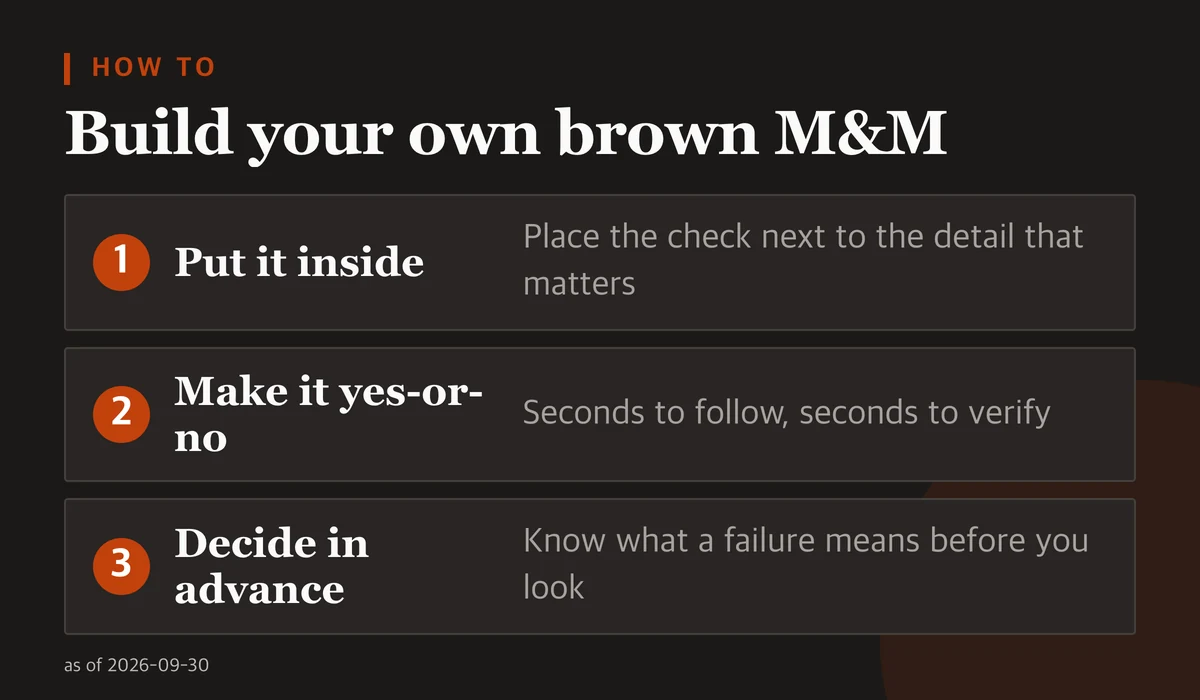
First: put the check inside the thing that matters
A check like this works only if it lives in the same place as the details you care about. The candy line sat inside the same contract as the staging and weight specs, not in a separate note. Say you’re handing a new hire a setup guide for a client account. Put your check in the section with the billing settings, not on page one where everyone reads. Now a pass tells you something about the part that can actually hurt you.
Second: make it cheap, visible, and yes-or-no
The check should take seconds to follow and seconds to verify. A bowl of candy either has brown ones or it doesn’t. Picture a shared spreadsheet for a family reunion. Halfway down the instructions, you add: “Once you’ve filled in your dietary needs, mark your row green.” Scanning for green takes you one glance. You don’t need to read every cell to see who read the notes.
Third: decide in advance what a failure means
Roth’s rule, as he described it, wasn’t “note the brown M&M.” It was “line-check the entire production.” The signal came with an action already attached. Suppose the babysitter hasn’t initialed the allergy note on the fridge. You don’t just point to the note. You walk through the whole list together, because now you know the list wasn’t read. Without that decision made ahead of time, a failed check is easy to shrug off.
The other side
The tidy version of this story has real cracks, and they are worth taking seriously.
First, the purpose. The safety-test explanation comes from Roth’s memoir and interviews from 1997 onward. In a 1981 interview, drummer Alex Van Halen described the clause very differently:
All right, everybody has to have a little sense of humor, yes, it’s true. Look, if there’s brown M&M’s in our bucket, we won’t play.
He mentions humor, not compliance. Was it a joke, a test, or a joke that later got a better story? The record doesn’t settle it. Roth’s explanation is best read as his own account.
Second, the timeline. The 2023 investigation found evidence that the brown M&M clause was already in the band’s rider before the Pueblo show. So the popular retelling, in which the clause was created because of that floor, doesn’t hold up well. The details and cost of the Pueblo damage also rest largely on Roth’s own retellings.
Third, the check does nothing by itself. A bowl of candy can’t order a line-check. Someone with authority had to notice, care, and act. If you plant a check and never look at it, you’ve added a line to your instructions and nothing more.
And a clean bowl proves less than it seems. Passing a check like this suggests someone was paying attention at that moment. It doesn’t tell you every other detail is right. The check helps you decide where to look harder. It is not permission to stop looking.
Try this today
Pick one handoff you’re making today. A delegated task, instructions for a contractor, a shared doc for a group trip.
Find the one detail that would be expensive to get wrong. Next to it, not at the top, add a small, specific request that’s easy to follow and easy to see. “When you’ve confirmed the delivery address, reply with its zip code.” “Once you’ve checked the dates, add ‘OK’ to the doc title.” Then write down, for yourself, what you’ll do if the signal doesn’t come back: go through the whole thing together, not just that one line.
Try it for one day. Not forever. One day. Just notice what comes back and what doesn’t.
Sounds too small to matter? That’s the point. The check is cheap on purpose. It won’t catch everything, but it can give you an early answer to a question that usually arrives late. That is the whole method: one small, visible check, placed next to what matters, that tells you early whether the details that actually matter have been handled.