
At a glance
- Read held at least 95 stocks. His largest position was roughly 6% of his estate, and one holding, Lehman Brothers, was wiped out in 2008.
- Spending less than you earn, spreading money widely and holding for a long time are habits anyone can practice.
- U.S. returns in his era were near the top of 16 countries studied, and stories like his get told partly because they ended well.
In this essay
The story comes around every few years, usually in a group chat. A janitor in a small Vermont town dies at 92 and leaves close to $8 million. Someone adds a fire emoji. Someone else writes, “See? Anyone can do it.”
Then the chat moves on, and two lazy lessons stay behind. One says wealth is only discipline, so if you aren’t rich, you weren’t disciplined enough. The other says the story is a fluke, so there’s nothing in it for you. Both skip the useful part, which is sorting.
The man was Ronald Read. His story is real and fairly well documented. But it mixes two kinds of ingredients. So which part do you copy? By the end, you’ll see which parts of his story are repeatable principles and which parts are luck and survivorship you should not count on.
The neighbor’s tomatoes
Picture a neighbor who grows the best tomatoes on the street. You ask how. They tell you about the soil, the watering, the spacing between plants. All of that you can copy.
What they don’t mention is the weather. They had a long, warm summer with steady rain. You might plant the same seeds, the same way, and get a cold, wet year.
There’s a second thing they can’t tell you. You only asked because their tomatoes were good. Nobody knocks on the door of the neighbor whose garden got blight, even if that neighbor did everything the same way.
So any success story has three layers. There’s what the person did. There’s the weather they happened to get. And there’s the fact that you heard about it at all. Only the first layer travels. The useful move is to peel the layers apart before you copy anything.
The man with 95 stocks
Here is what was reported. Read died in June 2014, at 92. According to TODAY’s report, he worked for about 25 years as a gas-station attendant and mechanic, then 17 years as a part-time janitor at J.C. Penney in Brattleboro. His estate was worth close to $8 million. His stepson and neighbors said they had no idea he had any money.
He left $4.8 million to Brattleboro Memorial Hospital and $1.2 million to Brooks Memorial Library. That’s $4.8 million plus $1.2 million, or about $6 million of an estate near $8 million.
The portfolio itself is the more useful part. A summary of the Wall Street Journal’s reporting describes at least 95 different stocks, mostly dividend payers, bought and held over decades. Much of it sat as paper certificates in a bank safe-deposit box, alongside a modest brokerage account. His first trade on record was 39 shares of Pacific Gas & Electric, bought on January 13, 1959, for $2,380.
His largest position at death was Wells Fargo, worth $510,900. Next came Procter & Gamble at $364,008 and Colgate-Palmolive at $252,104. And not every pick worked. He held Lehman Brothers, whose shares were wiped out in the September 2008 bankruptcy.
That’s the fact layer. Now the interpretation. One way to read this is as a story about stock picking. The numbers point somewhere else. His biggest holding, $510,900 out of close to $8 million, was roughly 6 percent of the estate. One holding went to zero, and dozens of others carried on. This doesn’t look like a man who found a few winners. It looks more like a man who owned many things and waited.
The part you can copy
Three habits show up in the record. None of them required a high salary. Read’s jobs were at a gas station and a department store.
First: spend less than you earn, for a long time
The principle is plain. Money you don’t spend is the only money you can invest.
Think of the end of a pay period. There’s rent, groceries, a streaming service you forgot about, a delivery order on a tired night. Whatever is left is the raw material. Read’s neighbors didn’t see a rich man. One way to read that is that little of what he earned went to things other people could see.
What changes when you practice this isn’t your whole lifestyle overnight. It’s the size of the gap between what comes in and what goes out. That gap is what the other two habits work on.
Second: spread it wide
The principle: no single bet should be able to sink you.
Imagine opening your retirement account and noticing that one company makes up a big slice, maybe because it’s your employer’s stock. Everything feels fine until that company has a bad year. Then what? Read owned at least 95 companies. When Lehman Brothers collapsed, it was one loss among dozens of holdings, and the rest of the portfolio kept going.
What changes is how much any single mistake costs. You will probably pick some losers. Read did. Spreading your money is what lets a loser be a bad day instead of a ruined decade.
Third: hold for decades, not months
The principle: compounding needs years more than it needs brilliance.
For a sense of scale, the Motley Fool reports that about $1 put into the S&P 500 in 1950, with dividends reinvested, grew to roughly $100 by 1990. That’s about 9,900 percent in total, or about 11.9 percent a year over four decades. This is the market’s return, not Read’s own account, but it shows the backdrop he invested in. Read’s first recorded trade came in 1959, and he was still holding stocks when he died in 2014.
Now picture the midnight version of investing. The market drops, the app is open, and your thumb hovers over “sell.” Not tapping it is the whole skill. What changes when you commit to time is that you make fewer decisions, and fewer decisions mean fewer chances to make a panicked one.
The other side
Now the weather, and the question of who gets heard.
Start with survivorship. Nassim Taleb has criticized frugal-millionaire narratives like The Millionaire Next Door on exactly this point. His argument is that if you studied people who went bankrupt, you would likely find the same traits: frugality, patience, a willingness to take risks. Failures aren’t studied or celebrated, so only the survivors’ habits get written down as a formula.
Think about who is missing from the group chat. Someone who lived just as carefully as Read but picked worse stocks, got sick, or needed the money early doesn’t become a news story. Who would write that one up? The stories you hear are not a fair sample of what saving and investing usually produce.
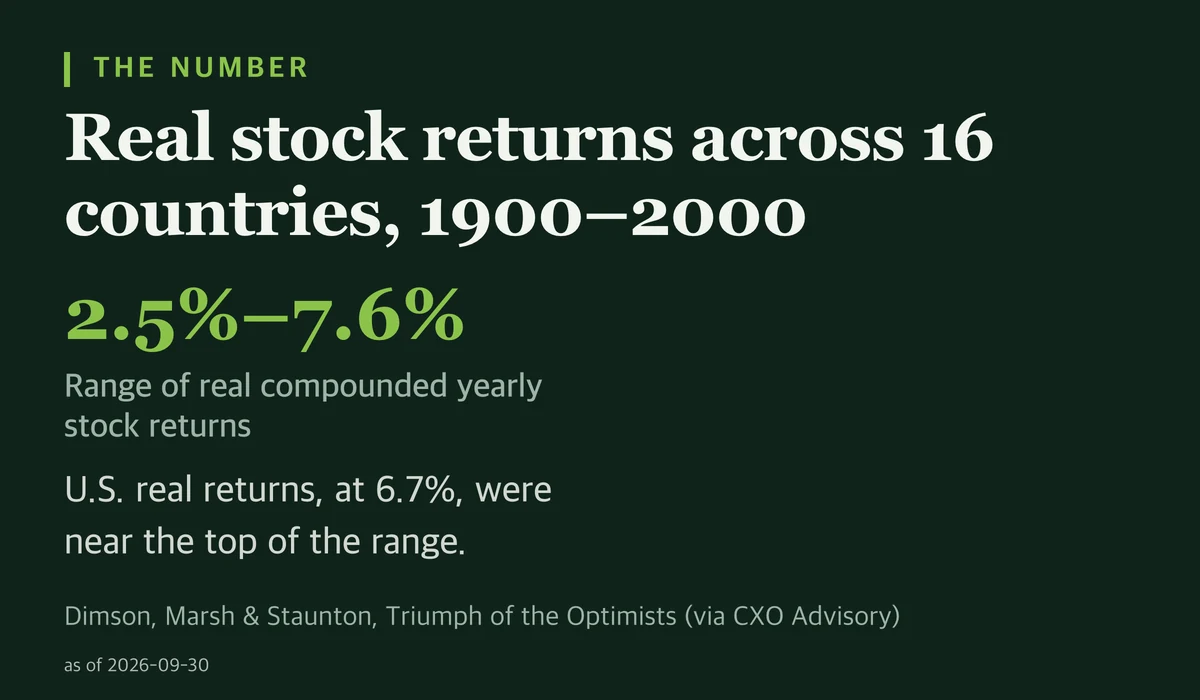
Then the weather. Read invested in a historically unusual market. In a study of 16 countries from 1900 to 2000, Dimson, Marsh and Staunton found real compounded stock returns ranging from about 2.5 percent to 7.6 percent a year. U.S. real returns, at 6.7 percent, were near the top of that range. Over the same century, the U.S. share of world stock markets rose from about 22 percent to 46 percent. That tailwind was real. It may not repeat, for today’s investors or in other markets.
Even the habits have limits. Read’s outcome depended on broad diversification and a holding period measured in decades. That runway is hard for most people to match. Some start later, or need the money sooner.
And there’s a cost the balance sheet doesn’t show. A life built around spending very little is a trade. Read made it. You might reasonably make a different one and still be doing fine.
None of this makes the habits useless. It means they can improve your odds without deciding your outcome.
Try this today
Tonight, take a scrap of paper or open a notes app. Draw a line down the middle.
On the left, write the things you control: how much you set aside each month, how many different things your savings are spread across, how long you plan to leave them alone. On the right, write what you don’t: what markets do over the next thirty years, whether you stay well, the era you happen to live in.
Then pick one item from the left column and look at it honestly. If it’s spreading, find your largest single holding and divide it by your total. Read’s biggest was roughly 6 percent of his estate. You don’t have to match that number. You just have to know yours.
Try it for one day. Not forever. One day. You aren’t changing your plan. You’re only sorting it.
That sorting is the real lesson in Ronald Read’s story. Spending less, spreading wide and waiting are the parts you can repeat. The century he invested in, and the fact that his story ended well enough to reach your group chat, were never his to control. They aren’t yours to count on either.