
At a glance
- Divide 72 by a yearly rate to estimate how many years it takes something to double. The rule appears in a book printed in Venice in 1494.
- It works on savings, debt, fees and inflation alike, and shows how gaps between rates widen with time.
- It is an approximation that assumes a steady rate. Real returns vary, and inflation and taxes shrink real growth.
Venice, 1494. A friar and mathematician named Luca Pacioli publishes a thick book for merchants, full of arithmetic, geometry and a new way of keeping accounts. Somewhere in its pages sits a single sentence of advice. It tells a trader how to work out, in his head, how long it takes money to double.
More than five centuries later, that sentence still works on a phone calculator. It is called the Rule of 72. This essay explains what it says, why it works, and where it quietly breaks. By the end, you’ll be able to look at any rate in your life, whether savings, debt, fees or inflation, and see what time does to it.
One sentence from a merchant’s handbook
Pacioli’s book, the Summa de arithmetica, ran to 616 pages. It was the first printed book on algebra written in everyday Italian rather than Latin. It is best known for the first printed account of double-entry bookkeeping. But it also contains this:
In wanting to know of any capital, at a given yearly percentage, in how many years it will double adding the interest to the capital, keep as a rule [the number] 72 in mind, which you will always divide by the interest, and what results, in that many years it will be doubled.
Notice what’s missing. Pacioli does not explain the rule or prove it. That suggests merchants were already using it before him. He probably wasn’t inventing a trick. He was writing down one that worked.
How the rule works
The rule is simple. Divide 72 by the yearly rate, and you get the rough number of years it takes something to double.
The U.S. Securities and Exchange Commission uses this example on its investor education site: at 9% a year, money doubles about every 8 years, because 72 divided by 9 is 8.
Why 72? The honest answer is that it’s convenient. It divides cleanly by 2, 3, 4, 6, 8, 9 and 12, so the arithmetic is easy in your head. It’s also close to the true mathematical answer. For continuous growth, the exact number to divide by is about 69.3, which comes from the natural logarithm of 2. For growth added once a year, 72 happens to be most accurate around 8%.
Pacioli’s rule anticipated the logarithm by over a century, as one mathematician has pointed out. That’s a remarkable thing for a merchant’s rule of thumb.
What the rule shows about time
The real value of the Rule of 72 isn’t precision. It’s that it turns a percentage, which feels abstract, into a number of years, which you can picture.
First: small rates are slow, and that’s worth knowing
The Federal Reserve Bank of St. Louis gives a clear comparison. At 2% a year, it takes 36 years for money to double. At 12%, it takes six years. Over the same 36 years, $5,000 growing at 2% becomes about $10,200. At 8%, it becomes about $79,840.
The point isn’t that one rate is available to you. It’s that the gap between rates widens with time, far more than intuition suggests.
Second: the rule works on things you owe, too
The rule doesn’t care which side of the ledger you’re on. A credit card charging 24% a year, with nothing paid off, doubles the balance in about three years. That’s the same arithmetic, pointed the other way.
It works on prices as well. When U.S. inflation hit 8.6% in May 2022, one analysis used the rule to show that money’s buying power would halve in roughly 8 to 8½ years at that pace.
Third: small fees compound quietly
Fees follow the same logic. The SEC works through an example: $100,000 growing at 4% a year for 20 years. With a 0.25% yearly fee, it ends near $208,000. With a 1.00% fee, near $179,000.
These fees may seem small, but over time they can have a major impact on your investment portfolio.
The other side
The Rule of 72 is a rough guide, and it’s easy to trust it more than it deserves.
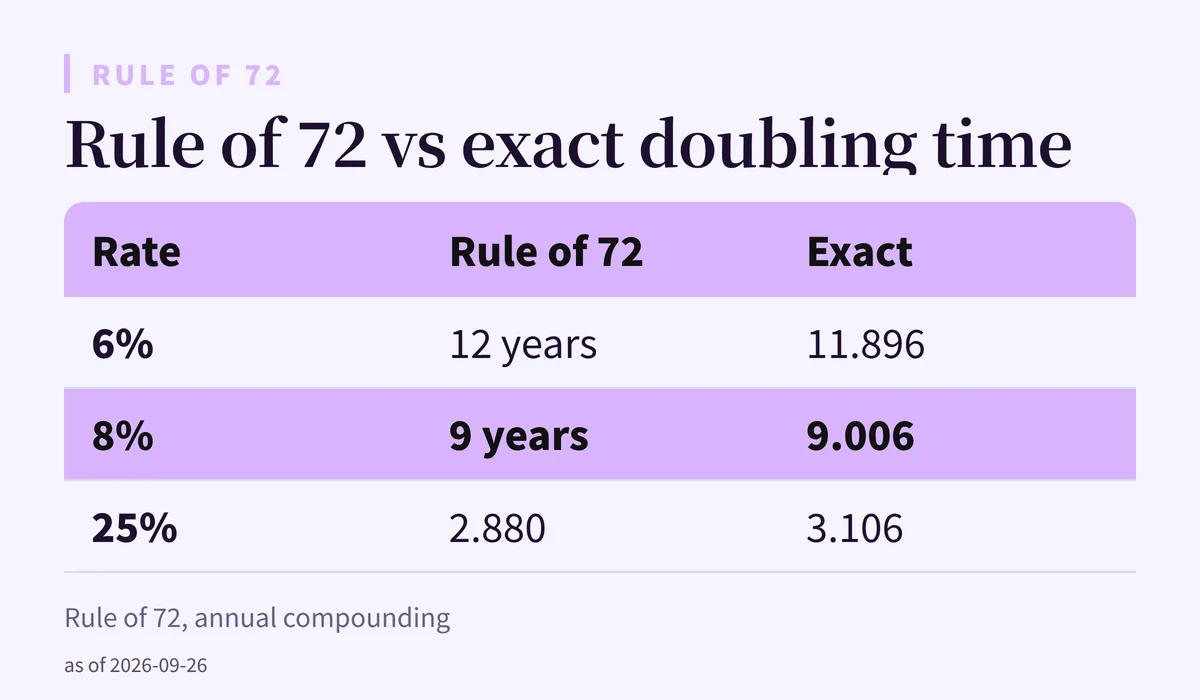
It is an approximation. Near everyday rates it’s close. At 6%, the exact doubling time is 11.896 years against the rule’s 12. At high rates it drifts. At 25%, the true figure is 3.106 years against 2.880.
It also assumes a steady rate every year, and real life doesn’t offer one. The SEC notes that large-company stocks, as a group, have lost money on average about one out of every three years. An “average” rate hides those years. A doubling time built on an average can be badly wrong for any one person.
And it describes nominal growth. What matters for your life is real return: what’s left after taxes and inflation. Money that “doubles” while prices also rise may buy less than you expect. Past results, as every regulator repeats, don’t predict future ones.
So treat the rule as a lens, not a forecast. It helps you see time. It doesn’t tell you what will happen.
Try this today
Take five minutes and a calculator. Find three rates that already shape your money:
- The interest rate on your savings account.
- The interest rate on any debt you carry, such as a credit card.
- The yearly fee on any fund or account you pay into, if you have one.
Divide 72 by each rate and write down the number of years. For the debt, that’s how fast an untouched balance would double. For the fee, the result is roughly how many years it takes that fee to cost you half of what you would have had without it, a reminder that small percentages have long reach.
You don’t need to act on the numbers today. Just look at them side by side. That’s the view a Venetian merchant had in 1494: a percentage turned into years, and years turned into something you can finally see.