At a glance
- Paying by card or phone separates the pleasure of buying from the feeling of paying. Researchers call that link coupling.
- An MIT auction from the late 1990s found card bidders offered about twice as much, but later studies found a far smaller effect.
- You don't need cash. You need one moment where spending and paying meet again, such as instant alerts or a weekly look.
You’re at the coffee counter. The total comes up, you tap your phone, and the machine chirps. The whole thing takes less than a second. You barely register the price. Now imagine counting the same amount out in notes and coins, watching the pile in your hand get smaller. Same coffee. Same price. A different feeling.
Researchers have a name for that feeling: the pain of paying. This essay explains where it comes from, what one famous experiment found, and why the latest evidence tells a more modest story than the headlines. By the end, you’ll know how to put a little of that useful pain back into your spending, without carrying cash everywhere.
A small pain with a job to do
In 1998, the economists Drazen Prelec and George Loewenstein described a quiet mental habit. They called it coupling: the degree to which consuming something calls payment to mind, and the other way around.
Some ways of paying keep the two tightly linked. Cash is the obvious one. You feel the money leave at the moment you get the thing. Other methods loosen the link. A credit card separates the pleasure of buying from the moment you pay, sometimes by weeks.
Their example is the taxi meter. Every tick reminds you what the ride is costing, and that reminder makes the ride less enjoyable. The pain is unpleasant. But it also has a job. It acts as a brake, a built-in signal that says: this costs something.
The Celtics experiment
The most quoted evidence comes from an auction run among MIT business students in the late 1990s. They could bid in a sealed auction for tickets to a sold-out Boston Celtics game. Half were told they would pay in cash if they won. The other half were told they would pay by credit card.
According to MIT course materials describing the study, the average bid was $29 in the cash group and $61 in the card group. Prelec summed it up in an interview:
It suggests that the psychological cost of spending a dollar on a credit card is only fifty cents.
When the work was published in 2001, Prelec and Duncan Simester reported that the card premium could be large, up to 100%, and that it showed up for other items too, including Red Sox tickets.
A brain-imaging study from 2007 offers a possible mechanism, though it did not compare cash and cards. When people saw prices that felt too high, activity rose in the insula, a region linked to unpleasant feelings, before they decided whether to buy.
Why the feeling matters more now
The pain of paying mattered less when most payments were made in cash. That has changed.
In the Federal Reserve’s latest diary of payment choices, American consumers made 47 payments a month on average. Sixteen were by credit card, 15 by debit card, and six in cash. Cards made up about two-thirds of all payments. Cash is still around: 76% of people carried some, and it is used for about 1 in 7 payments. But the default moment of paying is now a tap, not a count.
If coupling acts as a brake, most of us now drive with a lighter one.
Not everyone feels it the same way
Researchers at Carnegie Mellon built a scale to measure how much people feel the pain of paying. Across 13,327 people, about 24% were “tightwads” who feel too much of it and spend less than they would like. About 15% were “spendthrifts” who feel too little. The largest group, 60%, were neither.
That matters for what comes next. The goal is not to maximise the pain. It is to feel roughly the right amount, at the right moment.
The other side
Here is where the story needs a correction. The famous “twice as much” result came from one auction among MIT business students, decades ago, bidding on sports tickets. Later work has been less dramatic.
In 2021, a team ran four studies with a total of 692 people and did not replicate the credit card effect at all. They suggested the effect in the literature may be inflated, or fading.
Then, in 2024, a large meta-analysis pulled together 392 results from 71 papers, covering 11,257 participants in 17 countries. It did find a “cashless effect”, but a small one, with an effect size of 0.135. The effect had weakened over time between 1978 and 2022. It was stronger for showy purchases and close to zero for tips and donations.
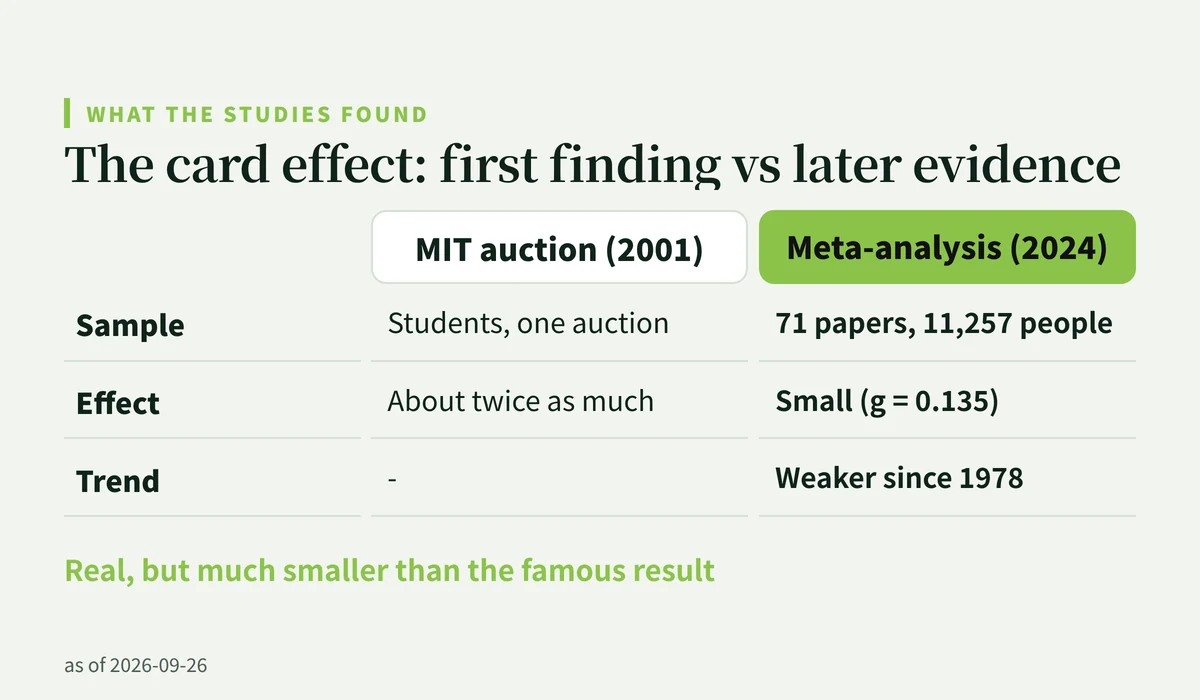
So the honest version is this. Paying by card probably does make spending feel a little easier for many people, some of the time. It does not double what everyone spends.
None of this is a reason to fear your card. It is a reason to know where your brake is.
Try this today
You don’t need to switch to cash. You need a moment of coupling, a point where spending and paying meet again. Pick one:
- Turn on instant alerts. Set your banking app to notify you of every card payment. The ping is a small, modern version of counting notes.
- Name the category. Choose one kind of spending that tends to drift, like takeaway food or small online orders. For the next seven days, write each purchase in a note on your phone as it happens.
- Hold a Sunday count. Once a week, look at the total for that one category. Just look. Don’t judge it yet.
Try it for one week. Not forever. One week.
The coffee will still take a second to pay for. But you’ll have given yourself back the thing the tap removed: a brief, useful moment of noticing what it cost.