
At a glance
- In 1847 Ignaz Semmelweis made medical students wash their hands, and deaths in his clinic fell to the level of the midwives' ward.
- His idea was resisted partly because it threatened doctors' identity, and partly because his best data went unpublished for years.
- When evidence stings, ask what being wrong would cost you, and whether you're rejecting the evidence or the messenger.
Someone shows you a number that says you’ve been doing something wrong for years. Maybe it’s a spreadsheet from a colleague. Maybe it’s a friend pointing out a pattern in how you argue. Your first reaction arrives before you’ve read the details. It’s not curiosity. It’s a small, hot wish for the number to be mistaken.
That reaction has a name. It is named after a doctor in Vienna in the 1840s. This essay tells that story, then turns it around. The usual version is about closed-minded doctors. The fuller version is also about the man who was right, and how he made it harder for anyone to agree with him. By the end, you’ll have two questions to ask yourself the next time evidence stings.
A reflex with a name
It is sometimes called the Semmelweis reflex. One recent paper defines it as “a human behavioral tendency to stick to preexisting beliefs and to reject fresh ideas that contradict them (despite adequate evidence).”
The key phrase is “despite adequate evidence.” The reflex is not about weak arguments. It’s what happens when the argument is strong and the conclusion is uncomfortable.
Two clinics, one question
Vienna General Hospital had two maternity clinics. The First Clinic was run by doctors and medical students. The Second was run by midwives. The numbers were stark.
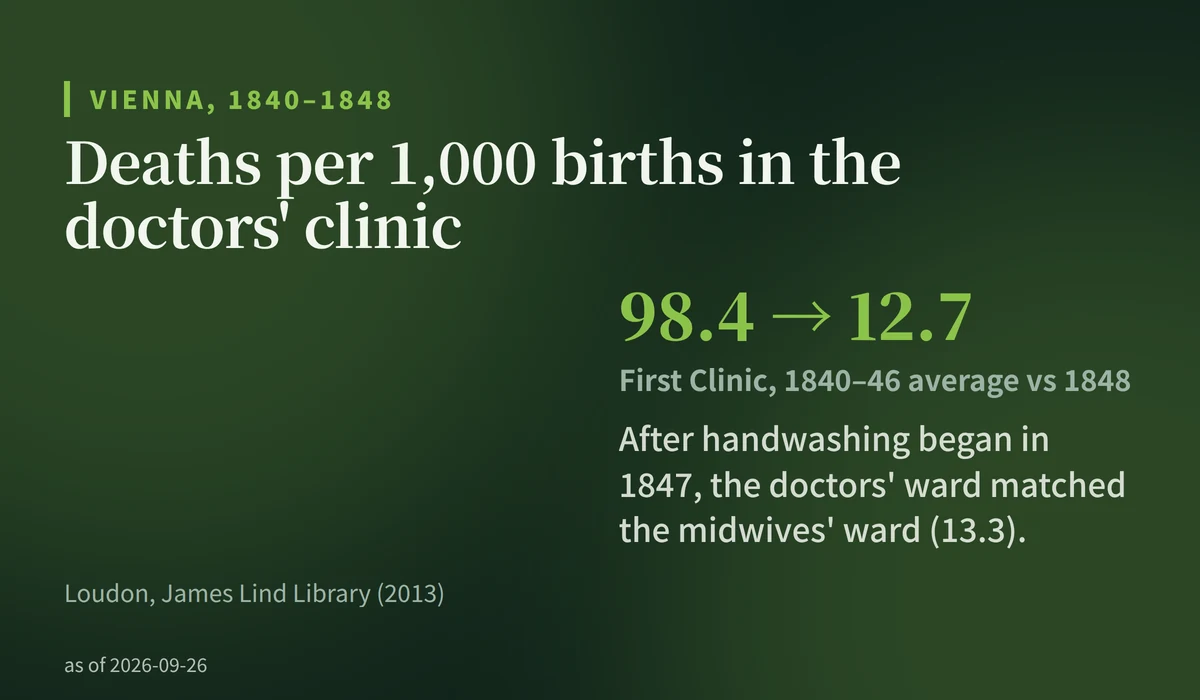
Between 1840 and 1846, the First Clinic lost 98.4 mothers for every 1,000 births. The Second lost 36.2. Roughly 10% against 4%. A young doctor there, Ignaz Semmelweis, later calculated that in 1846 the First Clinic’s rate was five times the Second’s.
The clue came from a death. In March 1847, his colleague Jakob Kolletschka was cut by a scalpel during an autopsy and died. The findings looked just like those of the mothers dying in the First Clinic. Semmelweis reasoned that doctors were carrying something from the dissecting room to the delivery room on their hands.
In May 1847, he made students wash their hands in chlorinated lime before entering the ward. It was a common chemical, the kind used to whiten paper and clean stables. By 1848, the First Clinic’s rate had fallen to 12.7 per 1,000. The midwives’ clinic stood at 13.3. The doctors’ ward was now as safe as the midwives’.
Why the evidence didn’t win
You might expect that result to change medicine overnight. It didn’t. And the reasons are more useful than “the doctors were arrogant.”
First: the idea threatened who they were
Accepting Semmelweis’s finding meant physicians admitting that their own hands had caused deaths. It also meant admitting that the midwives’ ward was safer. That’s not a small update to a belief. It’s a threat to identity and status.
This is the core of the reflex. We don’t just weigh evidence. We weigh what it would cost us to be wrong.
Second: the best evidence stayed in a drawer
The first published report, written by a colleague in 1847, showed an average death rate of 3.04% for the early months. That figure was muddied by one unusual case. The much stronger 1848 result, 1.27%, was not published until Semmelweis’s own book, dated 1861. He waited about 13 years to make his full case, even though friends urged him to publish.
Critics weren’t only rejecting the idea. They were rejecting the version they could see. A professor in Copenhagen wrote:
His views appear too unclear, his observations too volatile, and his experience too uncertain to deduce scientific results therefrom.
Third: tone decided who listened
When the book finally came, it ran to more than 500 pages and included passages attacking his critics. Being right and being persuasive turned out to be different skills. He had the first. He struggled with the second.
After he left Vienna and his opponents ran the clinic, the First Clinic’s rate climbed again, to 9.1% in 1854. Antiseptic surgery eventually spread through Joseph Lister, who published his method in 1867, building on the work of Louis Pasteur.
The other side
It’s tempting to cast this as a hero against fools. Historians push back.
Semmelweis claimed one cause explained every case, but he had no mechanism to show how it worked. Germ theory, which would supply that mechanism, came later. His idea also left gaps. It couldn’t easily explain why some mothers in the midwives’ clinic still died. One philosopher of science argues he “was not the excellent reasoner he has been assumed to be,” and that some of his peers’ doubts were a reasonable response to flawed arguments.
So both things are true. The reflex was real, and so was the poor case. That’s the uncomfortable lesson. When good evidence is rejected, it’s usually a mix of the listener’s fear and the messenger’s failures. You can only control your side of it, whichever side you’re on.
Try this today
The next time you feel that hot wish for a number to be wrong, stop before you answer. Ask two questions, silently or on paper:
- What would it cost me if this were true? Not the facts. The feeling. Would it mean you’d been careless, or that someone you disagree with was right?
- Am I rejecting the evidence, or the way it was delivered? A rude colleague can still have a correct spreadsheet.
If you’re the one holding the evidence, flip the questions. Show your best data first. Explain how it works, not just that it does. Leave out the parts that attack people.
Try it once this week. Not as a rule for life. Once. You’ll have noticed the reflex in action, and that’s the part the doctors of Vienna never got to see.
Ask what it would cost you if this were true, before you decide it isn't.