At a glance
- In one small 2002 study, students who also wrote when and where they'd exercise reported weekly exercise at 91%, versus 38% for the control group.
- Across 94 tests, if-then plans had a medium-to-large average effect (d = 0.65) — a better guide than any single best-case result.
- At one workplace, writing a date and a time lifted flu shots by 4.2 points; writing a date alone gave a 1.5-point rise that wasn't significant.
In this essay
It’s Sunday night, and you’ve just promised yourself that this is the week you start exercising. You mean it, too. Then Monday arrives with a full inbox, and the promise slides quietly to next week.
Most of us read that slide as a motivation problem, so we try to want it more. Research on exercise points somewhere else. In one well-known study, persuasion made people intend to exercise more, yet they didn’t actually exercise more. What moved behavior was a single written plan about when and where.
By the end, you’ll know how to write that plan precisely enough to test it by tonight. You’ll also know the situations where it won’t help, because the research has limits worth knowing.
The decision you keep making twice
Picture the departure board at an airport. A flight doesn’t leave when the pilot feels ready. It leaves at 7:40 from Gate 12, because that was settled long before anyone boarded. Nobody has to decide again.
Most personal goals work the other way. “Exercise more” has no time and no gate. So every day, you face the same question: is today the day? You answer it when you’re tired, busy, or distracted, and “later” usually wins.
Psychologists call the alternative an implementation intention. It’s a plan in if-then form: when situation X shows up, I will do Y. The goal doesn’t change. What changes is when the deciding happens. You make the choice once, in advance, and hand it to a cue you’ll meet anyway.
The numbers are worth a careful look.
What the experiments found
In a 2002 experiment by Milne, Orbell and Sheeran, university students in the United Kingdom were split into three groups. One group got no special message. A second read persuasive material about the dangers of inactivity. A third read the same material and also wrote down exactly when and where they would exercise in the next week.
According to the study’s abstract (Milne, Orbell and Sheeran, 2002), the persuasion changed minds. It raised how threatening students found inactivity, their sense that they could cope, and their intentions to exercise. It did not significantly raise exercise itself.
The results, as summarized by James Clear, make the gap plain. A week later, 38% of the control group reported exercising at least once a week. The motivation-only group came in at 35%. The group that got the same motivation and also wrote a plan reported 91%. That’s 53 points above control (91 minus 38).
One way to read this: the students weren’t short on wanting. They were short on a decision that had already been made.
That’s one study, though. For the wider picture, Gollwitzer and Sheeran’s 2006 meta-analysis pooled 94 independent tests with more than 8,000 participants. The average effect on goal attainment was d = 0.65, which researchers describe as medium-to-large. A later paper gives the 95% confidence interval as 0.6 to 0.7. The analysis also split the effect in two: d = .61 for getting started, and d = .77 for not being derailed once started.
So does it work? On average, across many studies, yes. But the average, not the 91%, is the better guide to what you can expect.
The most useful real-world test came from a workplace. In a 2011 field experiment by Milkman, Beshears, Choi, Laibson and Madrian, employees were reminded about an on-site flu clinic. Among those who got only the reminder, 33.1% were vaccinated. Employees prompted to write down the date they planned to go reached 34.6%, a 1.5-point rise that was not statistically significant. Those prompted to write both the date and the time reached 37.3%. That’s 4.2 points above control (37.3 minus 33.1), and it was statistically significant.
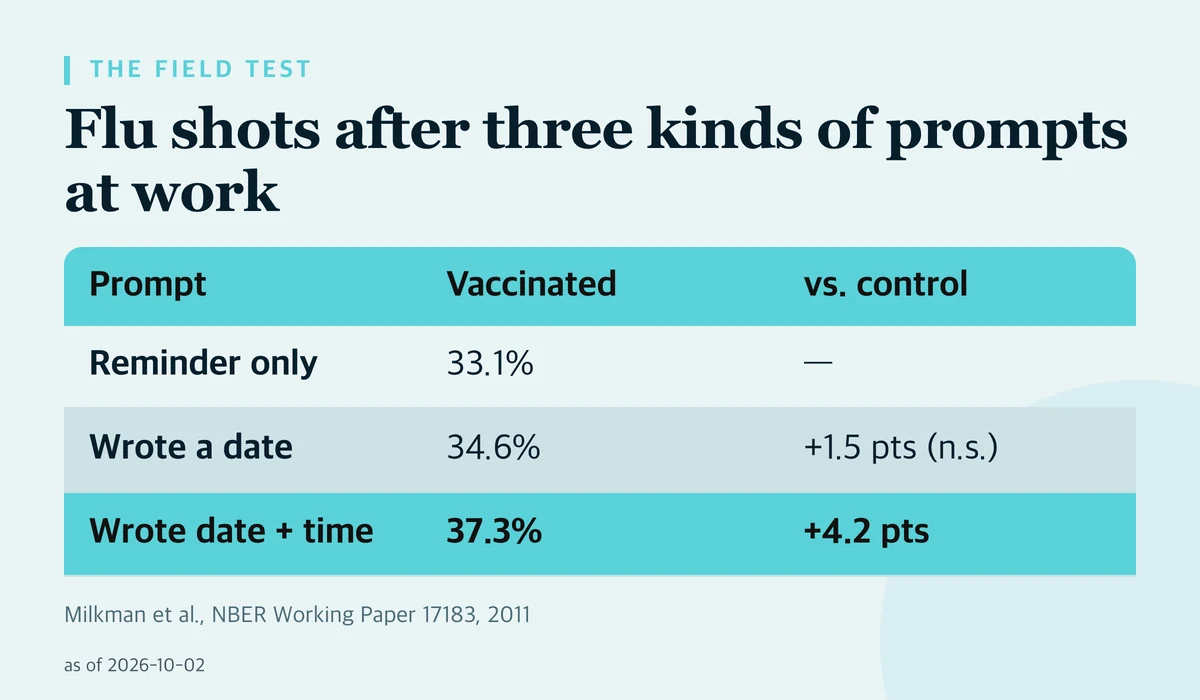
Four points is modest. But look at what produced it. Not a stronger message — just one more detail in the plan: the time.
Three rules for a plan that runs
First: name a moment, not a day
A moment is a time specific enough that you’d notice missing it. “This week” isn’t one. “Tuesday” barely is. “Tuesday at 7:15 a.m., after I pour my coffee” is. In the flu study, a date alone didn’t move the rate significantly; a date plus a time did. With a moment, you no longer have to carry the goal around all day. You only have to notice the moment when it comes.
Second: tie it to a place you already pass through
The original exercise plan asked for when and where. Pick a spot your day already includes: the front hallway when you get home, the parking lot at work, the kitchen counter after dinner. “When I walk in the front door, I’ll put on my running shoes before I sit down.” The place does the reminding. In terms of the meta-analysis, this is aimed at getting started (d = .61) — though the studies didn’t test place cues on their own.
Third: write a backup line for the likely snag
Most plans break in a predictable spot. A coworker suggests drinks after work. It rains. The meeting runs long. Write one extra if-then for the snag you already expect: “If it’s raining, then I’ll do the workout in the living room.” This is aimed at the other half of the meta-analysis: staying on track once you’ve started, where the average effect was d = .77. The backup line is one way to apply that finding; it wasn’t tested as a tactic of its own. Either way, the snag stops being a fresh decision. It already has an answer.
The other side
Start with the headline number. The 91% comes from one small study of university students, using self-reported exercise over a short follow-up. It is not a large, independently replicated field trial. When the idea was tested in a real workplace, the fuller plan moved vaccination by about 4 points, not tens of points. The weaker plan, a date with no time, didn’t clear statistical significance at all.
Second, more plans aren’t better. In experiments by Dalton and Spiller published in 2012, if-then plans improved follow-through for people assigned one daily goal. They didn’t help people assigned six daily goals over the same five-day workweek, each with its own plan. Planning that sharpens one commitment can dilute effort when it’s stacked six deep.
Third, a plan can’t supply what isn’t there. One sentence can’t open an appointment slot, make an option affordable, or make you care about a goal you don’t really want. It helps with a narrower gap: forgetting to start, or getting knocked off course. And writing a plan once is not the same as a practiced habit. The sentence can get you to the first try. It doesn’t do the repeating for you.
Try this today
Pick one goal. Just one, given what Dalton and Spiller found.
Write a single sentence with three parts: a moment, a place, and an action. “At 6:30 p.m., when I close my laptop at the kitchen table, I will put on my shoes and walk around the block.” Then add one backup line for the snag you expect most: “If it’s raining, I’ll stretch in the living room instead.”
Put the sentence where the moment happens: a sticky note on the laptop lid, or on the bathroom mirror. Tonight, check two things. Did the moment arrive? Did you act on it?
Try it for one day. Not forever. One day.
That’s the whole method: a moment, a place, an action, and one backup, written down where you’ll see it. It’s precise enough that you’ll know by tonight whether it ran. And if it didn’t, you’ll know where to look: too many goals at once, a goal you don’t actually want, or a barrier no sentence can remove.
Don't decide again tomorrow. Tonight, write when and where for one goal, and let that moment do the deciding.