
At a glance
- In the 2010 data, life evaluation kept rising with income, while emotional well-being showed no further progress beyond about $75,000.
- A 2021 study of 1,725,994 in-the-moment reports found happiness rising as steeply above $80,000 as below it.
- A 2023 joint paper found a plateau near $100,000 only for the least happy 15%. A 2024 critique says that split was assumed, not estimated.
In this essay
A spreadsheet at midnight. One column holds your current salary. The next holds the offer you’re weighing. And somewhere in your head sits a number you once read: $75,000. Past that, the story goes, more money stops making you happier. So you end up asking a strange question. Is the raise even worth it, if happiness has already flatlined?
Most people who repeat that number have never seen where it came from, or what happened to it later. It was challenged in 2021. Then the researchers who disagreed worked through the data together in 2023. By the end, you’ll know what that research actually says about income and happiness, why each doubling matters more than each raise, and where money may stop being the thing to fix.
Two questions that sound like one
The 2010 study by Kahneman and Deaton starts with a distinction most of us skip. There are two different questions someone could ask about your life.
The first is a report card: looking back, how your life is going overall. Researchers call this life evaluation. In the 2010 study, people placed themselves on a ladder from 0, the worst possible life, to 10, the best possible life.
The second is a weather log: how you felt yesterday, and how much joy, stress, or sadness was in it. This is emotional well-being.
The two can drift apart. You can give your life a high grade and still have a tense, joyless Tuesday. That gap matters, because the famous ceiling was only ever about the weather log.
One more idea makes the rest of the story readable. The researchers measured income on a log scale. On a log scale, what counts is not how many dollars you add. It’s how many times you multiply.
Three papers, one number
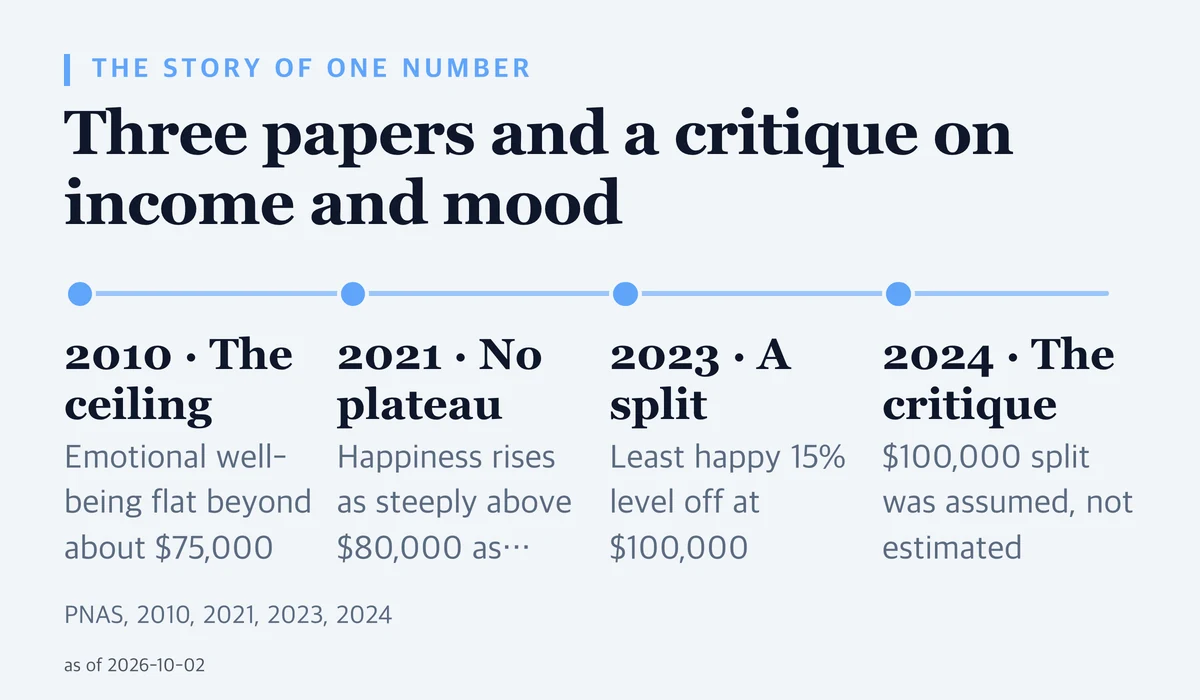
Kahneman and Deaton analyzed more than 450,000 responses to the Gallup-Healthways Well-Being Index, a daily survey of 1,000 US residents, covering 2008 and 2009. Life evaluation kept rising with log income, and they found no limit. Emotional well-being was different. It showed no further progress beyond an annual income of about $75,000.
Their summary had two halves. High income buys life satisfaction but not happiness. And low income is associated with both low life evaluation and low emotional well-being. The second half rarely made the headlines. The first half traveled as a ceiling.
In 2021, Killingsworth tested the idea with a different tool. Instead of asking about yesterday, a smartphone app pinged people at random moments and asked how they felt right then. He gathered 1,725,994 of these reports from 33,391 employed US adults. Experienced well-being rose with log income, and the slope above $80,000 was as steep as the slope below it. No plateau.
So which study was right? Rather than trade rebuttals, Killingsworth and Kahneman used Kahneman’s own method, adversarial collaboration. Two researchers who disagree work through the question together. Barbara Mellers joined as a neutral facilitator.
Their 2023 paper restated the original finding this way: the 2010 measure of emotional well-being rose, then flattened somewhere between $60,000 and $90,000. Then it looked past the average, at different slices of Killingsworth’s data.
Researchers found the flattening in one group only. For the least happy 15% of people, happiness rose quickly at lower incomes, then leveled off abruptly at $100,000 to a near-zero slope. That $100,000 cutoff is itself disputed, as the last section explains. For the happiest roughly 30%, the pattern ran the other way. Above $100,000, their happiness rose faster with log income than it had at lower incomes.
One way to read this: the ceiling and the climb may not be rival facts about everyone. They may be facts about different people.
What you can take from it
First: think in doublings, not dollars
Because happiness in these studies tracks log income, the useful unit is the proportional change, not the dollar amount.
Picture two people in two performance reviews. One goes from $50,000 to $60,000. The other goes from $500,000 to $510,000. Both are $10,000. For the first, that’s a fifth of current pay. For the second, it’s a fiftieth. Same check, very different step.
The same logic runs further up. Going from $50,000 to $100,000 is one doubling. A step of the same size on a log scale would take another full doubling, not another $50,000. So a raise that feels smaller than the last one may simply be smaller, measured the right way.
Second: know which question you’re answering
Life evaluation and moment-to-moment mood are separate measures, and income may relate to them differently.
Think of Sunday evening, when you check your bank app and feel settled about where things stand. That’s the report card. Now think of 3 p.m. on Wednesday, in a meeting you dread. That’s the weather. A job that pays more might lift the first and do little for the second.
The data can’t tell you which it will be for you. What changes is the question you bring to a decision. Are you trying to feel better about your life overall, or about your ordinary afternoons? Those can call for different trade-offs.
Third: notice when the problem isn’t money
For the least happy group, the 2023 authors proposed an explanation. Roughly 15 to 20% of people frequently experience negative feelings, and the miseries that remain for them, like heartbreak, bereavement, or clinical depression, are not relieved by higher income.
Imagine someone with a solid salary who has just lost a parent. A promotion arrives. It’s good news, and it doesn’t touch the grief. Pushing harder at work as the fix would aim at the wrong target.
This doesn’t mean money is irrelevant to hard days. In the 2010 data, low income went along with lower scores on both measures. The point is narrower. Sometimes the source of the bad days sits where a raise doesn’t reach, and the more useful lever is people, time, or professional support.
The other side
Start with the biggest limit. All three studies are correlational, built on surveys and experience sampling, not experiments. They show that income tracks with happiness. They don’t show that raising someone’s income causes their happiness to rise.
The 2023 resolution has its own critics. In 2024, Rohrer and Wenz argued that the $100,000 threshold was not independently estimated from Killingsworth’s data. It was carried over from Kahneman and Deaton’s earlier study, then used to split the data before comparing slopes. In their view, that approach assumes away the possibility of unobserved confounding.
They raise a second problem. Describing results for “the unhappy group” assumes that people keep the same rank in the happiness distribution as their income changes. Rohrer and Wenz call that implausible, since money may relieve some people’s problems more than others’. If they’re right, the neat split between the least happy and everyone else is less certain than it sounds.
Then there’s scope. Both the 2010 and 2021 datasets are US-only. Killingsworth’s app users were employed adults. So the dollar figures don’t automatically transfer to other countries, to places with a different cost of living, or to people who aren’t working.
None of this erases the basic pattern. Across these studies, more income generally went with higher scores, on a log scale. But the exact location of any ceiling, and who hits it, is still being argued over.
Try this today
Pick one money decision on your list today. An extra shift, a job posting, a side project you’ve been weighing. Then run it through three quick checks.
First, size it against what you have. Compare the extra income with what you make now, and note whether it’s a small slice or a big one, closer to a fiftieth or closer to a fifth.
Second, name which question it answers: your report card, how life is going overall, or your weather, how ordinary days feel.
Third, if a bad feeling is pushing the decision, ask where that feeling comes from. It might be something money can reach, like a tight month. Or it might be loss, loneliness, or exhaustion that a bigger paycheck may not touch.
Write the three answers in a phone note before you decide. Just this one decision, just today.
The research doesn’t say money stops mattering at $75,000. In these studies, income tracked with how people rated their lives and, for most, with how their days felt. It moved in steps measured by multiplying, not adding. And for some of the hardest days, the cause may sit somewhere money doesn’t go. Knowing which kind of day you’re having is a quieter question than how much you earn. It may also be the more useful one.