
At a glance
- Google "diet" searches, student gym visits, and goal contracts rose after landmarks like a new week, month, semester, or birthday.
- Called "the first day of spring," March 20 was picked as a start date by 26% of people, versus 7% when it was "the third Thursday of March."
- The lift is highest right after a landmark, and anticipating one can reduce effort now, so commit early and tie goals to routines.
In this essay
The note on the fridge says “Monday.” It went up on a Wednesday. By Friday it had turned into a quiet permission slip: nothing needs to happen until then.
You probably know some version of this. You wait for a clean starting line, like a Monday, a January, or a birthday, and let the days before it slide. Sounds like a bad habit? Partly. The instinct behind it is real. Researchers have measured bumps in goal-directed behavior right after these calendar moments. What gets missed is how quickly the bump fades, and what the waiting can cost.
This Thursday happens to be October 1, the first day of a month. By the end, you’ll know which calendar moments researchers have linked to a measurable lift in effort, what the data suggests about how that lift fades, and one way to lock it in before it does.
A new page, not a new person
Picture a paper notebook. When the page you’re on is full of crossed-out lines, it’s easier to turn to a clean page than to keep writing in the margins. Your handwriting didn’t change. The page did.
The researchers Dai, Milkman, and Riis proposed that the calendar works a little like that. Their idea is that a new week, month, or year opens a new “mental accounting period.” Past slip-ups get filed under an earlier version of you. You step back, take a big-picture view, and the new period feels like a cleaner start.
They called the pattern the fresh start effect. Aspirational, goal-directed behavior spikes right after temporal landmarks: the start of a week, month, year, or semester, a birthday, or a holiday.
Why would a date change anything? Notice the word “proposed.” The mental-accounting idea is the researchers’ explanation. The pattern it explains comes from data, and the data is where this gets concrete.
What the searches, the gym, and the contracts showed
A 2014 paper in Management Science pulled together three field studies.
The first looked at Google searches for the word “diet.” Searches rose at the start of each new week, month, and year, and after federal holidays. As Knowledge at Wharton reported, the weekly rise alone was about three times the size of the spike caused by a New York Times report on a promising new diet pill. The ordinary turn of a week outdid a headline.
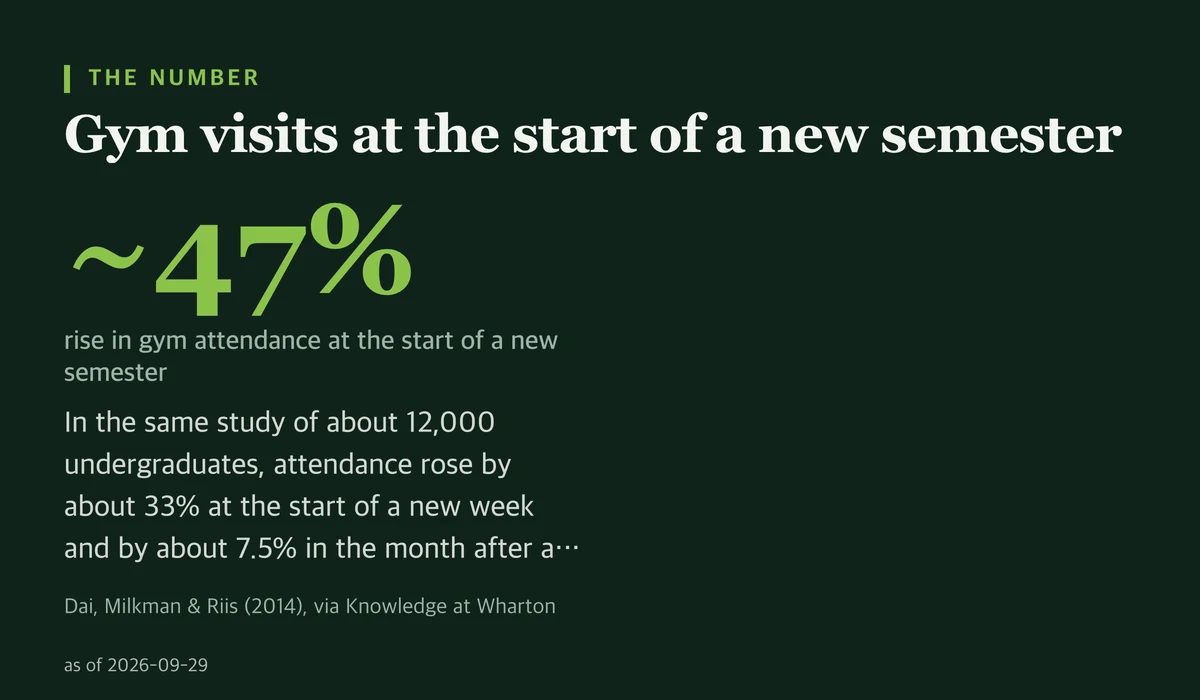
The second tracked gym visits by about 12,000 undergraduates. Attendance rose by about 33% at the start of a new week and by about 47% at the start of a new semester. In the month after a student’s birthday, it rose by about 7.5%.
The third used stickK.com, a site where people sign binding commitment contracts toward a goal. The study covered 66,062 contracts made by 43,012 users. According to Wharton’s summary, new contracts more than doubled at the start of a new year. They also rose sharply at the start of weeks and months and right after holidays.
A 2015 follow-up made the idea sharper. In an experiment described by the Association for Psychological Science, people chose a date to start pursuing a goal. When March 20 was described as “the first day of spring,” 26% picked it. When the same date was described as “the third Thursday of March,” 7% did.
Notice which label lost: a Thursday. Notice, too, that it was the same Thursday. One way to read this is that a landmark isn’t only on the calendar. Part of it lives in how you describe the day.
Three ways to use a starting line
First: Name the landmark you already have
A landmark helps when you notice it and call it one. This year, October 1 lands on a Thursday. On a work calendar, it’s just the end of the week, the day of some recurring meeting. Written as “the first day of October,” it’s the start of a month, one of the landmarks in the search data. What changes is the question you ask. “Should I wait for Monday?” becomes “What starts on the first?”
Second: Spend the boost on commitments, not intensity
Use the first days after a landmark to set up things that will still be there when the motivation isn’t. In the search data, interest was highest right after each landmark and declined over the rest of that week, month, or year. So on Thursday morning, the energy might say: run five miles. A steadier use of it is booking Saturday’s class, setting a weekly reminder, or signing a commitment, the way the stickK users did. The studies didn’t test this tactic directly. It follows from the shape of the data. The motivation fades on its schedule. The booking stays.
Third: Tie the start to something ordinary
Link the new goal to routine actions that already support it, not only to a picture of a new you. A later study in Organizational Behavior and Human Decision Processes found a problem with landmarks, covered in the next section. That problem was weaker when people were reminded of the everyday actions already backing their goal. Say the goal is eating better. The dramatic version is “new diet starting October 1.” The ordinary version is remembering that you already pack lunch twice a week. What changes is that the goal no longer depends on one special day going perfectly.
The other side
The fresh start effect shows up clearly in the data. It also has real limits.
It’s short. As the search data showed, the lift is front-loaded and fades before the next landmark arrives. A calendar can help start a goal. These studies don’t show it keeping one going.
It measures starts. The three field studies tracked searches, gym visits, and sign-ups. They show when effort rises. On their own, they don’t show whether the goals were reached.
And waiting for a landmark can backfire. A separate study found that merely anticipating an upcoming landmark can undermine motivation on a goal right now. People began to see their current self and their post-landmark self as two different people. They optimistically expected the future self to pick up the effort, which licensed less effort in the meantime. That lost effort was not reliably made up after the landmark arrived.
That’s the fridge note from the opening. “Start Monday” can be a plan. It can also be a pass to coast until Monday. And if Monday goes badly, what stops the next note from saying “next Monday”? The study didn’t test that loop. It’s still easy to recognize.
So the honest scope is narrow. A landmark is a useful spark for starting. It’s a poor reason to wait.
Try this today
Before Thursday arrives, take three small steps.
Tonight, write the goal next to a date, and name the date as a beginning: “October 1, the first day of the month.” Not “Thursday.”
Then do the smallest version of it today anyway. Ten minutes, one page, one walk around the block. The current you doesn’t get a pass until Thursday.
On Thursday, spend the lift on one thing that lasts: a booking, a reminder, or a plan attached to something you already do every week.
Try it for one day. Not forever. One day. Notice whether Thursday feels different once it has a name.
Now you know which calendar moments researchers have tied to a lift in goal-directed behavior: a new week, month, year, or semester, a birthday, a holiday. You know that simply calling a date a beginning made people more likely to pick it. You know the lift is front-loaded and fades before the next landmark. And you have one way to lock it in: commit while the boost is high, and tie the goal to ordinary days that don’t need a landmark at all.
A landmark is a good reason to start and a poor reason to wait.