
At a glance
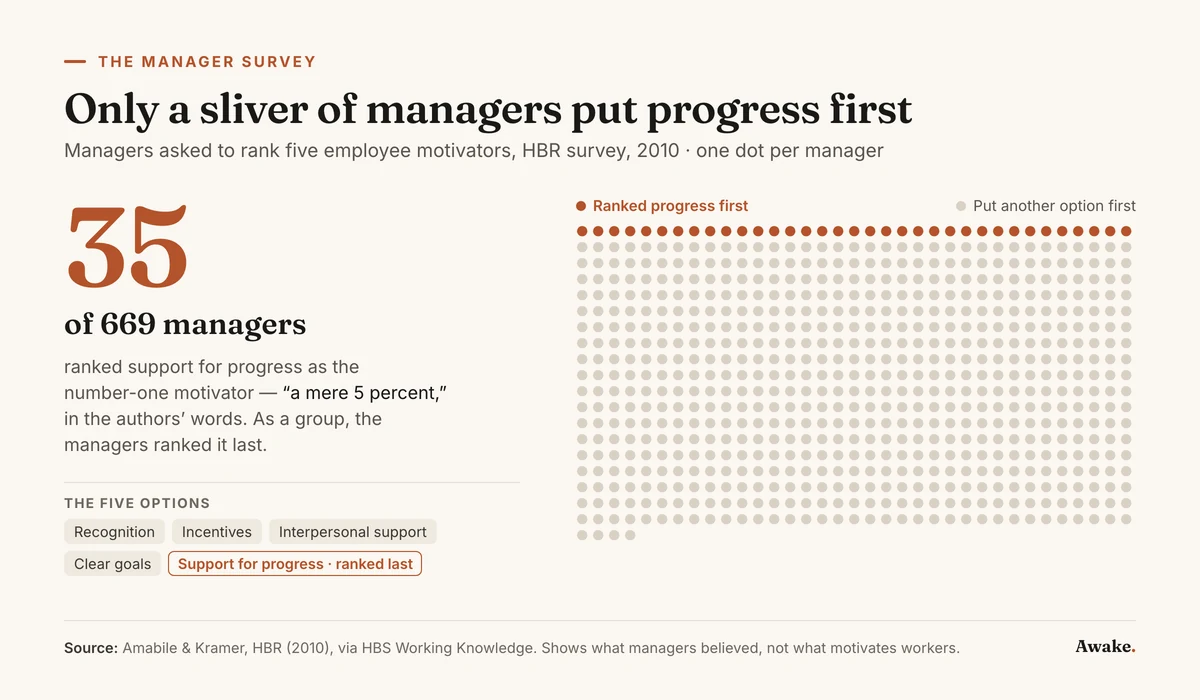
- In the authors' 2010 survey, only 35 of 669 managers ranked progress as the top motivator; as a group they put it last of five.
- Diaries from 238 employees at seven companies (about 12,000 entries) led the authors to conclude that progress in meaningful work had the most prominent positive effect on inner work life.
- The diaries show progress and good days occurring together, not proof that one causes the other, and the authors found setbacks weighed two to three times more.
In this essay
Nobody said anything about the spreadsheet you finally untangled today. No reply to the draft you sent at lunch, no “nice work” in the team chat, and by evening the day feels like it didn’t count. So you file it under a belief most people hold: drive runs on outside fuel. Praise, a bonus, a manager who notices. Without those, why would anyone want to try again tomorrow?
Most managers would side with you. When researchers Teresa Amabile and Steven Kramer asked 669 of them to rank five things that motivate employees, progress came last. The same researchers had collected daily diaries from people doing the work, and those diaries pointed somewhere else. What did roughly 12,000 entries tie to the better workdays, why did so few managers see it, and how can you notice a day’s progress without overstating what the study proved?
Twelve thousand evenings, written down
Amabile and Kramer’s diary study followed 238 white-collar employees at seven companies. Each person filled in a daily diary for the length of a project, which sometimes ran as long as nine months. That produced about 12,000 diaries. The researchers read them for the day’s events and for what the authors call inner work life: the mix of emotions, perceptions and motivation people carry through a workday.
Two results matter here. First, small things carried weight. By the authors’ count, 28 percent of small events of all kinds had a major impact on inner work life, as coded from the participants’ own entries. Second, one kind of event stood out on the positive side. In the authors’ summary, making progress in meaningful work had the most prominent positive effect on emotions, perceptions and motivation.
Progress, in their sense, is not a promotion or a finished product. Their 2011 Harvard Business Review article argues that the best way to motivate creative work is to help people take a step forward every day. Its summary adds: help them see their own progress. In everyday terms, that might be a test that finally passes, or a client question you can now answer.
What the diaries establish is a pattern across hundreds of people over months: good inner work life and forward steps tended to show up on the same days. What they can’t establish, at least from the pages that describe them, is which came first. The Working Knowledge Q&A with the authors says nothing about statistical tests or confidence levels.
Why the managers ranked it fifth
The manager survey was a separate study, published in HBR in 2010. Managers were given five options: recognition, incentives, interpersonal support, clear goals and support for making progress. As a group, they ranked support for progress last as a motivator, and third of five as an influence on emotion. Only 35 of the 669 put it first, which the authors called “a mere 5 percent.”
It is worth being fair to those managers, because their answer is the one most people would give. Recognition and incentives are things a manager can see and hand out. A bonus has a date; praise has an audience. Progress happens inside the work, a paragraph or a fixed bug at a time, and it rarely travels beyond the desk where it happened. Sometimes it doesn’t even reach the person who made it, when the day ends with a long list of what is still undone.
That is an interpretation, not a finding. The survey captured what managers believed, ranked against a fixed list of options. Still, it shows how a group of experienced people could look past the very thing the diaries kept returning to.
The same gap can sit inside one person. If a day with no praise feels wasted to you, you are scoring your own week the way most of those 669 managers scored their staff’s. The diaries suggest the better days were being built inside the work, one step at a time, whether or not anyone said a word.
What the diaries add to “small wins”
The popular version of this research is a slogan: celebrate small wins. The authors’ findings are more specific, and the details change what you would actually do with them.
Progress has to be in work you care about
The authors’ site describes the goal as forward momentum in meaningful work, and the qualifier matters. Clearing your inbox is movement. Finishing the paragraph of a grant proposal that finally says what you mean is movement in something you care about. On a busy Tuesday, both feel productive, but only the second matches what the authors describe. Knowing the difference tells you which step to count when you look back at your day.
Setbacks weigh more than wins
In the same Q&A, the authors say the effect of setbacks on inner work life was “two to three times stronger” than the effect of progress. A morning spent finally getting a model to run, followed by an afternoon email saying the data source has changed, would probably end in an entry about the email. That suggests removing one obstacle may be worth as much to you as noticing one win. A quiet day with fewer setbacks may do more than a day with an extra celebration.
Small is enough
That 28 percent figure was about small events. The study did not need a launch or a promotion to find events with a major impact. Can something as minor as a colleague answering the question you were stuck on really shape your afternoon? That is the scale of event the study was tracking. Waiting for a milestone before you let yourself register progress means ignoring most of the material the diaries were made of.
What the evidence doesn’t show
The biggest limit is direction. A diary records progress and mood on the same evening, so it cannot rule out that a good mood makes people notice and write down their progress more readily. The pages describing the study don’t say whether this was tested. “Progress lifts motivation” and “motivated people see more progress” would leave similar traces in a diary.
The sample has edges too. These were knowledge workers on projects. An earlier diary study from the same research, published in Leadership Quarterly in 2004, used dozens of employees on creative projects, a different and smaller group. If your job is shift work, routine tasks or manual labor, nothing in these sources supports stretching the finding to you; a step forward there may look very different. The Working Knowledge Q&A also doesn’t say how representative the 238 were.
The manager survey has its own constraint. Five preset options shape any ranking, and the 5 percent is a share of respondents, not a measure of what motivates anyone. Finally, the diary study did not intervene. No experiment in this material tests whether deliberately tracking your own progress raises motivation, so the suggestion below is an inference from a correlation and is offered as one.
One thing to try
Before you close the laptop tonight, write one line in a notebook or a phone note: what moved forward today in the work you care about? Keep it concrete. “Rewrote the pricing section to match the new plan” is a line. “Worked on the deck” is not.
If nothing moved, write down what stopped it instead. Given how much heavier setbacks weighed in the diaries, that line may be the more useful one, and clearing it can be your first task tomorrow.
This note has not been tested, and it won’t settle whether progress causes good days. It borrows the one habit every participant shared: a daily record of the day. About 12,000 of those records led two researchers to a motivator that only 35 of 669 managers put first. The spreadsheet you untangled today goes on that line, whether or not anyone mentioned it.