
At a glance
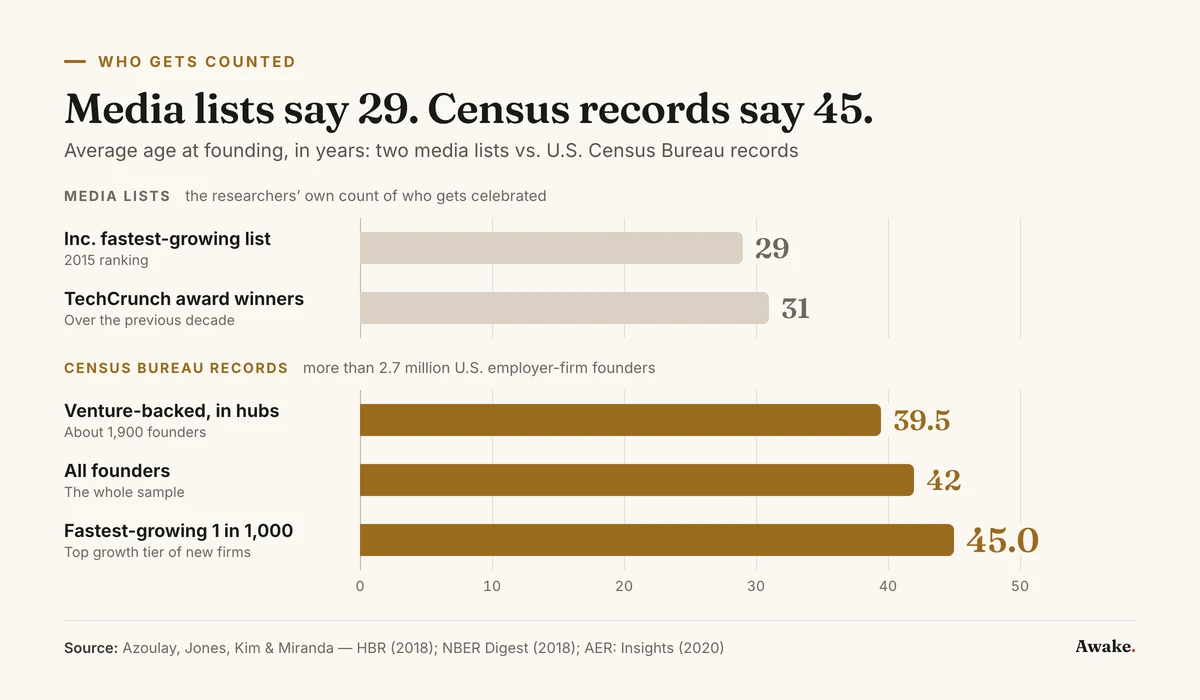
- In Census records on more than 2.7 million U.S. founders, the 1 in 1,000 fastest-growing new firms had founders averaging 45.0 at founding; all founders averaged 42.
- Media lists the same authors examined averaged 29 and 31; even venture-backed founders in entrepreneurial hubs averaged 39.5 in the Census data.
- In the working paper, three or more years in the same broad industry went with about twice the rate of reaching the top tier, an association rather than a proven cause.
In this essay
Every year the lists come out, and every name on them arrives with an age. Twenty-six, founder and CEO. Twenty-nine, just closed a funding round. Read them in your forties, from a desk inside someone else’s company, and the conclusion seems to write itself. The companies that take off are started by people in their twenties, and your window closed while you were busy getting good at a job. Nobody has to say it to you out loud. It settles in quietly, like a running count of birthdays.
A team of economists checked that count against government records instead of magazine pages. What did the largest study of founder ages find, why does the young-founder picture still feel so true, and which part of the older founders’ edge can you build on purpose, at any age?
The short answer: nearer 45 than 25
The largest count drew on U.S. Census Bureau records covering more than 2.7 million founders whose companies went on to hire at least one employee. Among the 1 in 1,000 new ventures that grew fastest, founders averaged 45.0 at founding. Across all founders in the data, the average was 42. The study, by MIT economist Pierre Azoulay and three co-authors, appeared in American Economic Review: Insights in 2020.
Their 2018 working paper says the findings “strongly reject common hypotheses that emphasize youth as a key trait of successful entrepreneurs.” A summary from the National Bureau of Economic Research puts it more plainly: more successful entrepreneurs launch in their 40s than in their 20s.
The short answer has a second part. The same data link the fastest growth to years spent inside one industry. Age makes those years possible, but it does not hand them over automatically.
Why the lists look so young
Years inside one industry rarely make a headline, which is part of why the lists look so different. The same four economists showed the gap in a 2018 Harvard Business Review article. Looking at media lists, they found that founders who won TechCrunch awards over the previous decade averaged 31 at founding. Founders of the fastest-growing startups on Inc. magazine’s 2015 list averaged 29. Those two figures come from the authors’ own look at who gets celebrated, not from Census data.
Lists like these are picked by editors and judges, and they are probably where you encounter most founders in the first place. When did you last read a profile of a company started at 45 by someone who had spent years running operations in the same trade? The gap doesn’t prove the lists are biased. It does show that the founders who get covered and the founders who grow fastest look like different crowds.
Investors carry a version of the same picture. The HBR article cites Paul Graham, quoted in a 2013 New York Times piece, describing an age cutoff of 32 in investors’ heads. The NBER summary reports the authors’ argument that early-stage finance appears biased against the founders most likely to have successful exits. So the young-founder image isn’t something you invented. It is what the most visible corners of the startup world keep showing you.
What the extra years held
An investor cutoff of 32 raises the obvious question: isn’t technology the exception, the one field where youth really wins? The authors checked. The age pattern looked similar in high-technology sectors, in entrepreneurial hubs and among companies with successful exits. Ventures in computing and wireless telecom, the fields most associated with dorm-room founders, had founders averaging 38.5 to 40.8.
Next, the paper looked at experience. In the working-paper version, founders with three or more years in the same broad industry reached the 1-in-1,000 tier at about twice the rate of those with none. Broad means the coarse sectors the Census uses. The published abstract adds that prior experience in the specific industry predicts much higher rates of success. Both describe a pattern in the records, not a tested cause.
Azoulay puts the extreme version bluntly:
I like to say there is no such thing as a 25-year-old biotech entrepreneur.
In biotech, the training alone takes years. Most industries ask for less, and the records still point the same way.
The years that felt like the delay, spent learning one industry on someone else’s payroll, are the part of this record that tracked with the fastest growth.
Where this breaks down
“Tracked with” is a careful phrase, and it has to be. Azoulay has said the study documents a pattern and cannot pin down why it exists. Experience, intellectual capital and business connections may each contribute, and those explanations can overlap. Age may partly stand in for things that pile up alongside it, such as savings, contacts and a reputation.
The outcome being measured is also extremely rare. Azoulay has stressed that the 45 figure applies to the top tenth of the top 1 percent, among U.S. employer firms only. A higher relative chance at older ages does not make success likely at 45, or at any age. Most startups still fail. What the data undercut is narrower: the belief that the rare outcomes stop happening somewhere around thirty.
Selection matters too. People who start a company at 45 are not a random sample of 45-year-olds. Some may have waited until they had savings, a tested idea or a first customer. Nobody assigned founding ages by lottery, so the study cannot say what would happen if one particular person started a decade earlier or later.
The youth picture also holds some truth in one corner. Venture-backed founders in entrepreneurial hubs, about 1,900 of them, averaged 39.5, and those in New York averaged 38.7, the youngest group the NBER summary describes. If your mental image is of venture-funded companies, real ages do run younger, though still nearer 40 than 25.
The largest limit concerns the experience itself. The finding attaches to years in the same industry, and nothing in these sources shows an edge from age by itself. If you turn 45 and launch in a field you have never worked in, you sit outside the group the experience finding describes. This data gives you no head start over a newcomer of any age.
Two readers, one list
A newcomer to an industry and a veteran of one can be the same age, scrolling the same list. Say you have spent eleven years in commercial freight, first dispatching trucks, then running a team. Next to a page of twenty-six-year-olds, those years look like lost time.
Next to the Census results, they look like the experience that, in the working paper, went with about twice the rate of reaching the top tier. You know which shipments go missing and why, which forms customers dread, and which fixes the big carriers keep promising. None of that is a company yet. It is knowledge an outsider would need years to collect.
Now say you spent those same years in hospital billing and want to start a meal-kit brand because the idea feels exciting. Same birthday, same list. In this data’s terms, though, the meal-kit plan starts with no industry years at all. A problem inside hospital billing, one you have watched up close, would start with your years already counted.
Your first step
That count can start tonight. Open a blank note and title it with the industry you have spent the most years inside. If your time is split across several, pick the one you know best, not the one that sounds most promising.
Under the title, list the problems you have watched people in that industry work around. The spreadsheet everyone keeps because the official software can’t do the job. The monthly phone call that exists only because two systems don’t talk to each other. The question every new hire asks in their first week. Write until you run dry.
A long list is a rough sign that you carry the kind of knowledge the study linked to faster growth. It is not a business plan, and nobody has tested lists like this one. A short list is useful too. It means the years the study counted are still ahead of you, in a field you get to choose, and they can start at twenty-five or at fifty.
Then set the note beside the next founder list you scroll past. The list prints ages; on Inc.’s 2015 ranking, the founders averaged 29. The note keeps the count that went with the fastest growth in records on more than 2.7 million founders: years spent close enough to one industry’s problems to name them.