
At a glance
- A 2016 study of Nokia's 2005–2010 decline describes fear at two levels: top managers feared competitors and shareholders, middle managers feared bosses and peers.
- That fear kept bad news from traveling upward, so leaders saw an overly hopeful picture and neglected long-term innovation.
- Fear isn't the whole story. Technology choices, Symbian's limits and rival ecosystems mattered too, and Nokia survived as a network-equipment company.
In this essay
The weekly status meeting starts at nine. Your project is three weeks behind, and you know it. When your turn comes, you say, “Mostly on track. A few loose ends.” Nobody asks a follow-up question. The meeting moves on, and you feel a small wave of relief.
That moment is easy to shrug off. Harmless, right? It is also, according to one of the most detailed studies of a corporate collapse, a close cousin of how a world-leading company lost its lead. The popular story about Nokia is that it got lazy and arrogant at the top. The researchers who interviewed its people describe something different: fear, spread across several levels, quietly shaping what people said out loud.
By the end, you’ll know why fear, more than complacency, is what usually stops successful people and companies from changing, and how to spot it in your own work.
Complacency doesn’t look. Fear looks away.
From the outside, complacency and fear produce the same result. Nothing changes. That is why they are so easy to confuse. Inside, they work in opposite ways.
A complacent person stops checking. They believe things are fine, so they don’t look closely. A frightened person does look. They see the problem clearly, and then decide it is safer not to mention it. The information exists. It just doesn’t travel.
Picture a road trip. A friend is driving, already tense about traffic. You’re holding the map, and you realize you missed the exit twenty minutes ago. You could say so. Instead you say, “It’s just a little further.” Your friend isn’t careless. They’re steering by what you tell them.
Organizations run on that kind of passenger report. Leaders decide using what reaches them from below. When fear softens those reports, the picture at the top drifts, always in a hopeful direction. Smart, alert leaders can’t fix a problem that was edited out on the way up.
What researchers found inside Nokia
In 2007, Nokia held half of the global market share, according to INSEAD’s summary of the research. So how does a company that dominant lose its place so fast?
The researchers Vuori and Huy set out to understand that. Their study, published in Administrative Science Quarterly in March 2016, examines Nokia’s rapid downfall over the 2005–2010 period. According to INSEAD’s summary, it drew on 76 interviews with top and middle managers, engineers and external experts.
Here is what the authors report. Top managers were afraid of external competitors and shareholders. Middle managers were mainly afraid of internal groups, including their superiors and peers. INSEAD’s summary adds a telling detail: the middle managers feared losing social status, not losing their jobs.
Those two fears fed each other. Middle managers became less willing to pass bad news upward. Per INSEAD’s summary, they reported unrealistically short timelines for Symbian development. Top managers pressured the people below them without fully revealing how severe the outside threats were. They also read the messages coming up in biased ways. INSEAD describes “pluralistic silence” in meetings, where critical information stayed unshared.
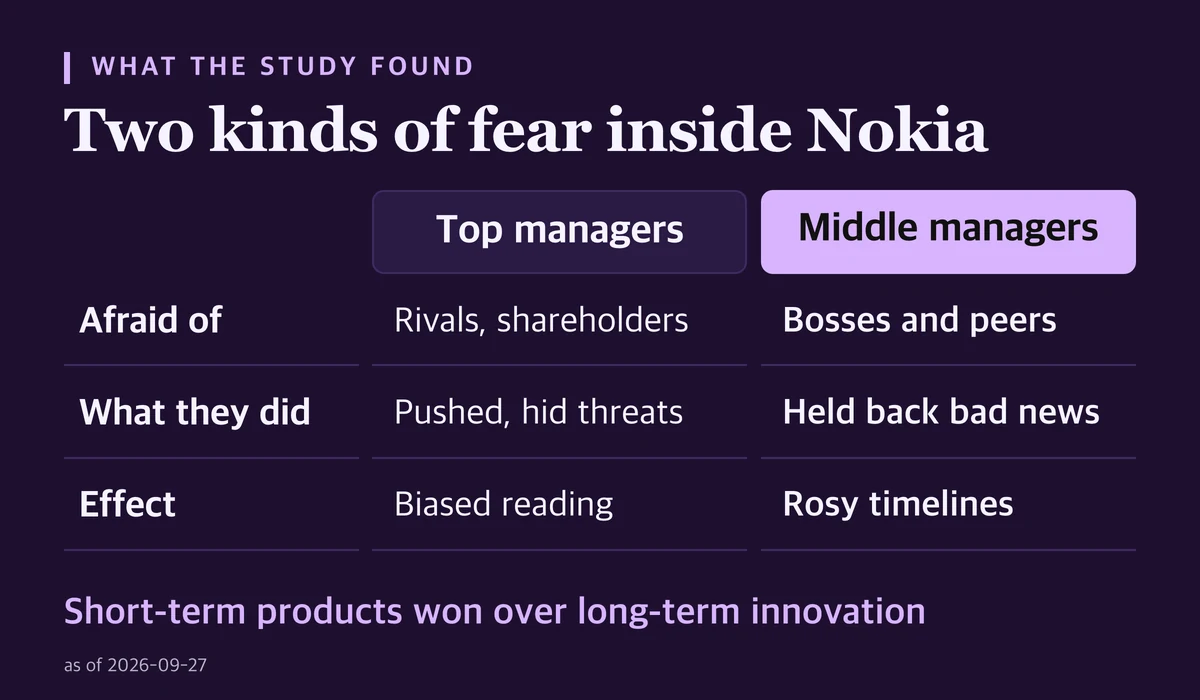
The result, the authors argue, was an overly optimistic view at the top of the company’s technological capabilities, and neglect of long-term investment in innovation. They call it “temporal myopia”: short-term product innovation at the expense of long-term development. The delays showed up in the products. Per INSEAD’s summary, the N97 launched a year later than planned, and the 5800 touchscreen phone was about one and a half years late because of software issues.
In February 2011, CEO Stephen Elop wrote in an internal memo that Android had just taken Nokia’s leadership position in smartphone volumes. In September 2013, Nokia announced the sale of substantially all its Devices & Services business to Microsoft for EUR 5.44 billion. About 32,000 people were expected to transfer.
One way to read this: nobody at Nokia had to be lazy for this to happen. Enough people only had to be a little afraid, in slightly different directions.
Three places fear hides in ordinary work
You probably don’t run a phone company. But the same pattern shows up in much smaller rooms.
First: the shrinking estimate
When people fear how they’ll look, their estimates shrink. Your manager asks when the report will be done. The honest answer is two weeks. “Friday” comes out instead, because two weeks sounds slow. Once you notice this, an honest estimate stops feeling like a confession. It becomes information the other person needs to plan.
Second: the silent room
Silence in a meeting is not agreement. The team lead on a video call asks, “Any concerns?” Eight muted squares stay still. Ten minutes later, the real concerns appear in private messages. If you run meetings, this changes how you hear silence. It’s a question still waiting for an answer, not a yes.
Third: pressure without the picture
When people in charge are scared, they often push harder and explain less. A café owner hears that a big chain is opening two doors down. The staff get told to “step it up,” but never see the numbers causing the worry. Everyone works faster at the wrong things. People can’t solve a problem they aren’t shown.
What makes this hard is how reasonable each move feels at the time. Staying quiet looks like tact. A trimmed timeline looks like ambition. Is that fear, or just good manners? Often it’s both. And the feared cost, a raised eyebrow or a moment of looking less capable, tends to feel bigger before you speak than after.
We suffer more often in imagination than in reality.
The other side
Fear is not the whole story, and it would be unfair to pretend it is.
A later study by Lamberg, Lubinaitė, Ojala and Tikkanen, published in Business History in 2021, takes a deliberately different path. The authors argue that key choices in technology and organizational design jointly made up sufficient cause for Nokia abandoning mobile phones. They focus on choices instead of attributes such as fear or hubris. In their reading, you don’t need emotion to explain the outcome.
There were hard structural limits, too. Managers quoted in INSEAD’s summary said building a new operating system takes years, which is why they stayed with Symbian. Elop’s memo framed the threat as bigger than any single phone:
Our competitors aren’t taking our market share with devices; they are taking our market share with an entire ecosystem.
A braver culture might still not have closed that gap in time. The Vuori and Huy study also rests on interviews about events people were looking back on. Memory after a collapse is not a neutral record.
And losing phones was not the end of Nokia. The company kept NSN, its network business, along with HERE and Advanced Technologies. In 2015, it agreed to buy Alcatel-Lucent in a deal valued at $16.6 billion, becoming a major network-equipment supplier. So the fair claim is narrower. Fear was one real force among several, and it helps explain why warnings didn’t travel. It doesn’t explain everything.
Try this today
Before your next update, whether it’s a meeting, an email or a quick check-in, run one small experiment.
- Find the soft spot. Ask yourself: what would you say if you weren’t worried about how it sounds? That’s usually the sentence you’re leaving out.
- Say it plainly, with a date. “The draft will be ready next Thursday, not this Friday.” Add what you need, if anything.
- If you lead people, change the question. Instead of “Any concerns?”, ask “What are we most likely to be wrong about?” Then wait longer than feels comfortable.
Try it for one day. Not forever. One day.
Nokia’s story suggests that successful people and companies rarely stall because they stop caring. More often, fear quietly edits what gets said, on the way up and on the way down. The sign to watch isn’t whether people are working hard. It’s whether bad news can travel. At your next nine o’clock meeting, you get to decide whether it does.