
At a glance
- The 10,000-hour figure was a group average from a 1993 Berlin violin study. Ericsson writes that half of the top group hadn't reached it by age 20.
- A 2014 meta-analysis of 88 studies found deliberate practice explained 26% of performance variance in games, 21% in music and less than 1% in professions.
- A 2019 replication found the “good” violinists had logged more practice than the “best” by age 18, though the gap was not statistically significant.
In this essay
The practice log sits open on the music stand, a column of tally marks running down the page. One mark per hour. You add tonight’s, close the notebook, and feel a little closer to good. Somewhere past the marks is a finish line most of us have heard of: 10,000 hours, and you’re an expert.
It’s a comforting idea. Effort goes in, skill comes out, and the math is simple. The trouble is that the study behind the number never drew that line, and the researchers who checked later found something messier. By the end, you’ll know what the famous practice studies actually measured, how much practice seems to explain, and how to tell useful practice from time merely logged.
An average, not a finish line
In 1993, Anders Ericsson, Ralf Krampe and Clemens Tesch-Römer studied violin students in West Berlin. In Peak, his 2016 book with Robert Pool, Ericsson recounts that the “best” students had averaged about 10,000 hours of practice by age 20. By age 18, the same students had averaged about 7,400 hours.
Malcolm Gladwell’s 2008 bestseller Outliers turned the age-20 figure into the “10,000-Hour Rule.” Ericsson writes that Gladwell chose it because it was a round number, not a scientific threshold. Had the book used age 18, the rule would have been about 7,400 hours.
Think of a class average. If the top students in a class average an A-minus, that tells you something real about them as a group. It doesn’t mean each of them earned an A-minus, or that an A-minus is the price of admission. Some scored higher. Some scored lower.
The violin number worked the same way. Ericsson writes that half of the ten violinists in the top group had not reached 10,000 hours by age 20. The figure was a group average, not a gate each of them walked through.
The hours needed also vary hugely by task. Ericsson describes an early memory experiment in which a subject named Steve Faloon became the best digit-string memorizer in recorded history after about 200 hours of practice.
There is nothing special or magical about ten thousand hours.
What happened when researchers checked
So if 10,000 isn’t the number, how much does practice matter? Two later studies tried to put a size on it.
In 2014, Macnamara, Hambrick and Oswald pooled 88 studies in a meta-analysis published in Psychological Science. They asked how much of the difference in performance between people deliberate practice could account for. As the Association for Psychological Science reported, the answer depended heavily on the field: 26% in games, 21% in music, 18% in sports, 4% in education and less than 1% in professions. Across all domains combined, it was about 12%.
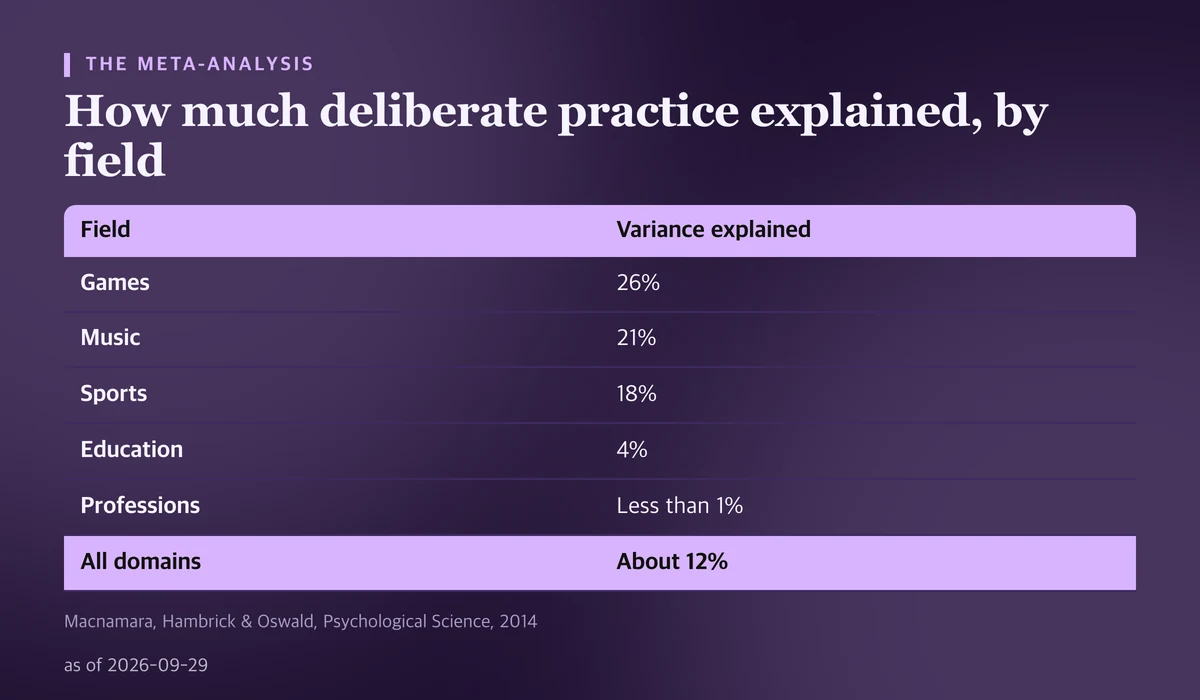
Put the other way, most of the variance was not explained by practice as those studies measured it. That’s the part the popular rule leaves out.
In 2019, Macnamara and Maitra went back to the violin study itself. They repeated it directly with 39 conservatory violinists at the Cleveland Institute of Music, 13 in each group — best, good and least accomplished — under double-blind conditions. Researchers found that by age 18, the “good” group had averaged 9,844 hours of practice and the “best” group 8,224. In other words, the better players had logged fewer hours on average, though the gap between those two groups was not statistically significant. Across all three groups, accumulated practice explained about 26% of the variance in performance. The authors state plainly that they “did not replicate” the original study’s key result.
One way to read this: practice matters, but it is one factor among several. Two people can log similar hours and land in different places, and the hours alone won’t tell you which is which.
Deliberate practice is unquestionably important, but not nearly as important as proponents of the view have claimed.
What makes an hour count
If hours are a rough measure, what’s a better one? The research doesn’t hand you a checklist, and experts still argue about definitions. But the argument points somewhere useful: not every hour is the same kind of hour. Here are three questions we find helpful. They’re a practical reading of the debate, not a scientific formula.
First: is there one target?
Useful practice aims at one named weakness, not the whole skill. Say you’re learning guitar, and every evening you play a favorite song top to bottom. The easy parts get most of your time, because there are more of them. The few bars that always fall apart get one pass, like everything else. Looping just those bars, slowly, is a different kind of hour. What changes: afterward, you can say whether the hard part got better.
Second: will you know soon if it worked?
Useful practice tells you quickly whether you got it right. Rehearsing a presentation in your head feels productive, but your head is a generous audience. Record it on your phone, watch the opening, and you’ll hear every “um” and see where you rushed. What changes: you catch mistakes while they’re small, instead of repeating them until they feel normal.
Third: is it a little hard?
Useful practice sits just past what you can do comfortably. The weekly pickup game you always win, the spreadsheet formulas you know by heart — those hours keep a skill warm, and that has value. They rarely stretch it. What changes: the session often feels worse while you’re in it, and that can be a sign it’s doing something.
The other side
Does all this mean practice barely matters? No. And the numbers above aren’t the last word either.
Ericsson rejected the meta-analysis’s low figures. He argued that it counted things as deliberate practice that his original five-criteria definition didn’t, such as attending lectures or unsupervised solo study. Measure a looser kind of practice, and you’d expect it to explain less. So the dispute is partly about what the words mean, and the percentages alone don’t settle it. That argument is still open.
The 2019 replication has limits too. It was one study of 39 violinists at one conservatory.
It also helps to know what “variance explained” measures. It describes differences between people — why one player outperforms another. It isn’t a measure of whether your own practice makes you better than you were last month. Even the critics call practice “unquestionably important,” and 21% in music is not a small share for one factor.
What the research pushes back on is narrower: the idea that hours alone are the whole story, and that a fixed number makes anyone an expert. What fills the rest is still being argued about.
Try this today
Pick one skill you already spend time on: an instrument, a language, a sport, or a work skill like writing. Before your next session, open the notebook where the tally mark would go and write three short lines instead.
- The target. One specific thing you’re trying to fix. Not “practice Spanish,” but “order lunch without switching to English.”
- The check. How you’ll know, during the session, whether it’s working. A recording, a timer, a person who will correct you.
- The stretch. One part that’s slightly harder than you’d normally choose.
After the session, add one more line: what changed. Try it for one day. Not forever. One day. Then compare it with an ordinary logged hour.
Here’s what you now know. The famous violin number was a group average among one study’s top students, not a threshold each of them crossed. Later studies suggest practice accounts for a real but partial share of the differences between people — from under 1% to about a quarter, depending on the field and how practice is defined. And the gap between useful practice and time merely logged often shows up right in the notebook: whether the hour had a target, a way to check, and a little stretch. The tally marks can stay. They just aren’t the score.