
At a glance
- In the first Save More Tomorrow run, participants' average saving rate rose from 3.5 percent to 13.6 percent over 40 months.
- The design asks for one early decision about future raises, repeats it with each raise, and lets people opt out at any time.
- Across nine 401(k) plans, a 2024 NBER paper found much smaller effects from automatic enrollment and auto-escalation.
In this essay
The raise shows up on a Friday. The pay stub is a little bigger, and for a week it feels like progress. A month later, the extra money has quietly become a nicer grocery run, one more subscription, a few more dinners out. Saving more was the plan. It was going to start next month.
The usual fix is to cut what you spend today. Skip the coffee. Trim the takeout. That asks you to feel a small loss every week, and it often doesn’t last.
There is a different design, and it has been tested. In 1998, a midsized U.S. manufacturer offered its employees a plan to save from raises they hadn’t received yet. By the end of this piece, you’ll know why committing future raises can work better than cutting today’s spending, and what that one experiment can and can’t tell you about your own saving.
Write the list before you’re hungry
The idea behind the plan fits in one line. Money you haven’t started spending is easier to set aside than money you already live on.
Think about grocery shopping. Write the list at home after dinner, and it’s sensible. Walk the aisles hungry, and the cart fills with things that were never on any list. Same person. Different moment.
Payday is the aisle. The money is right there, and every dollar already has a job. Asking yourself to save more at that moment feels like taking something away.
A raise that hasn’t arrived is different. No habit depends on it yet. Deciding its future months ahead is like writing the list at home. Sounds too simple? It is, and that’s the point. The plan doesn’t ask you to be stronger on payday. It asks you to decide earlier, when deciding costs less.
What happened at one factory
Economists Richard Thaler and Shlomo Benartzi called the plan Save More Tomorrow. They reported its first run in the Journal of Political Economy in 2004.
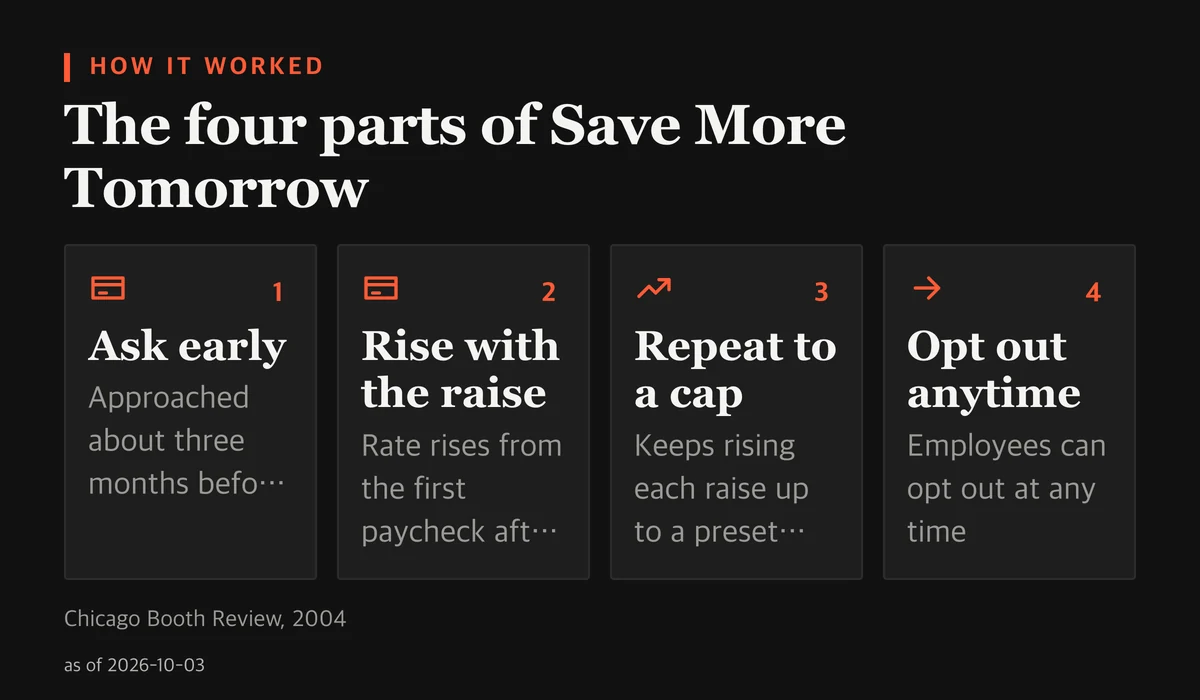
The setup had four parts, according to a Chicago Booth Review summary. Employees were approached about raising their contributions about three months before a scheduled pay increase. Contributions went up starting with the first paycheck after a raise. The rate kept rising with each raise until it reached a preset maximum. And employees could opt out at any time.
The company isn’t named in the published sources. Of 207 eligible employees, 162 joined, or 78%.
Researchers found that average saving rates for participants rose from 3.5 percent to 13.6 percent over 40 months, across four annual raises. Divide 13.6 by 3.5 and you get about 3.9, so the average rate nearly quadrupled. And 80 percent of those enrolled stayed in the plan through the fourth pay raise.
One way to read this: the plan asked for discipline once, not every payday. People made one decision, early, and the schedule carried it forward. Staying in took no effort. Leaving took a step.
Similar ideas later showed up in law. In the U.S., the Pension Protection Act of 2006 encouraged automatic enrollment with automatic escalation in 401(k) plans. As the Federal Reserve Bank of Minneapolis described it, typical contributions start at 3% and rise to 4% the next year, and so on up to a set maximum. The legal cap is 10% of salary. The UK took a related route with automatic enrolment into workplace pensions. There, the minimum total contribution is 8% of qualifying earnings: 5% from the employee plus 3% from the employer.
Three ways to use future money
First: decide before the money arrives
Make the saving decision before the raise, not after it lands. The original plan approached people about three months ahead.
Picture a yearly review in March. In December, you sit at the kitchen table with your benefits login open. No new money exists yet. You decide what share of the next raise goes to retirement savings, and you write it down, or set it in the plan if your employer allows that.
What changes is who makes the call. It’s the calm person at the kitchen table, not the one looking at a bigger paycheck and a list of things they’ve been putting off.
Second: let the default repeat it
Turn one decision into a rule that repeats on its own. A choice you make every payday is a choice you can lose every payday.
If your plan offers automatic increases, it may be a setting a few clicks into the benefits site. Few people had switched it on in data cited by Chicago Booth Review in 2013. There, 2,268,726 of 20,628,702 contributing participants were in an automatic escalation program, a utilization rate of 11 percent.
What changes is the number of negotiations with yourself. Why make the same hard choice every year when you could make it once?
Third: keep the exit open
Make leaving easy, so saying yes feels safe. In the original plan, employees could opt out at any time.
Imagine the month the car needs brakes and a dentist bill arrives too. A plan that locks you in is a plan you’d hesitate to start. A plan you can step out of is easier to agree to on a quiet evening in December.
An open door didn’t mean most people walked through it. In the original study, those who withdrew did not reduce their contribution rates to the original levels. They only stopped future increases. For automatic enrollment plans more broadly, the same 2013 Booth Review piece put average opt-out rates at about 10 percent. What changes is the cost of saying yes, and the open door may be part of why so many joined.
The other side
You don’t have to take one factory as proof about your own life. The first study covered 207 eligible employees at one midsized manufacturing firm in 1998, and the authors’ calculations come from that single setting.
Later versions looked weaker. According to Chicago Booth Review, later implementations used smaller increases, 2 to 3 percent a year, and less personalized enrollment, which proved less effective than in-person enrollment.
The larger test came across many plans. A 2024 NBER working paper by Choi, Laibson and colleagues studied nine 401(k) plans. It found steady-state saving rates rose by only 0.6% of income from automatic enrollment and 0.3% from default auto-escalation. Only 40% of people with an auto-escalation default escalated on their first escalation date. More opted out later, as employees left jobs and withdrew balances. The paper’s title puts it plainly: smaller than we thought?
Then there’s debt. If you save more in a 401(k) but borrow more elsewhere, are you ahead? A U.S. Army study, summarized by Boston College’s Center for Retirement Research, found that little of the saving induced by automatic enrollment was offset by more debt. Credit card debt did not increase. The effects on car and home loans were ambiguous, so some offset there can’t be ruled out.
And the plan has a quiet requirement: raises. If your pay stays flat, there is no future increase to commit. Save More Tomorrow is a nudge. It shapes a decision. It doesn’t create the money.
Try this today
Open your calendar. Find the month your pay usually changes: a yearly review, a contract renewal, a step on a pay scale. Count back about three months and set one reminder there.
In the reminder, write one sentence: When my pay goes up, part of the increase goes to savings first. Choose the part now, while it’s still hypothetical.
That’s all. You don’t cut anything today. You don’t open a budget spreadsheet. Try it for one day. Not forever. One day. Notice how different it feels to decide about money that isn’t here yet. If your plan offers automatic increases, look at that setting too. Just look.
Committing a future raise can work better than trimming today’s spending for a plain reason. The decision is made early, about money you haven’t started living on, and a default can repeat it for you. What the factory experiment can tell you is that the design of a choice matters. What it can’t tell you is how far it will move your own number. The later results across many plans were far smaller, and nothing gets committed if the raise never comes.