
At a glance
- Raters of 1992 Olympic footage scored bronze medalists happier than silver right after the event: 7.1 vs. 4.8 on a 10-point scale.
- Silver medalists' words leaned toward 'I almost'; bronze medalists' leaned toward 'at least I.'
- A 2005 Sydney study found average happiness followed the finishing order and pointed to expectations; a 2020 study again found bronze smiling more.
In this essay
A glass-walled meeting room, 4 p.m. on a Thursday. Your manager slides a letter across the table. You got the raise. It’s just smaller than the one you pictured on the drive in, and by the time you’re back at your desk, the gap is all you can think about.
Nothing in the letter changed on the walk back. What changed was the thing you set it next to. Most of us do this after a job offer, a test score, an apartment we didn’t get. And we often don’t notice which way the comparison runs.
Olympic athletes do it too, and in 1992 a TV network caught it on tape. By the end of this, you’ll recognize which direction your comparisons run after a win or a loss. You’ll also know how to choose the comparison that leaves you better off, without lying to yourself about what happened.
The version that almost happened
You miss a train by one minute. The result is the same as missing it by twenty: you’re on the platform, waiting for the next one. But the one-minute miss stings more, because the version where you made it is so easy to picture.
Psychologists call this counterfactual thinking: comparing what happened with something that almost happened. It runs in two directions. An upward comparison starts with “I almost” and points at a better outcome. A downward one starts with “At least” and points at a worse one.
Which one shows up first may not be random. Psychologists Medvec, Madey and Gilovich proposed that the mind reaches for the nearest alternative, the line you only just crossed or just missed. For a silver medalist, that line is gold. For a bronze medalist, it’s fourth place and going home with nothing. If they were right, the athlete who finished higher might feel worse. They tested it in a 1995 paper.
What the cameras caught in Barcelona
The Cornell team used NBC’s coverage of the 1992 Barcelona Olympics. One tape showed the moment 23 silver and 18 bronze medalists learned where they’d finished. Another showed medalists on the podium. Twenty Cornell undergraduates rated each athlete’s reaction on a 10-point scale running from “agony” to “ecstasy.”
Right after the event, bronze medalists averaged 7.1 and silver medalists 4.8, a gap of 2.3 points. On the medal stand the gap narrowed but held: 5.7 against 4.3.
You might suspect an easy explanation. In sports like wrestling, boxing and basketball, the bronze medalist has just won a match and the silver medalist has just lost one. So the researchers set those sports aside. Bronze still rated higher: 6.7 against 5.0 right after the event.
Maybe the silver medalists simply expected more? The team checked Sports Illustrated’s pre-Games predictions. As a group, silver medalists had finished better than predicted, while bronze medalists landed almost exactly where they were expected to. The silver medalists still looked less happy.
A second study listened to what the athletes said. Raters who didn’t know who had finished where scored NBC interviews with 13 silver and 9 bronze medalists. Silver medalists’ comments leaned toward “I almost”; bronze medalists’ leaned toward “at least I.”
A third study dropped the outside raters. At the 1994 Empire State Games in New York, 115 medalists in swimming and track described their own thoughts right after competing. Silver medalists again reported more “almost” thinking than bronze medalists did.
One way to read this: many of the silver medalists weren’t reacting to silver. They were reacting to gold, the version that almost happened.
The paper ends with an older case. Abel Kiviat lost the 1,500 meters at the 1912 Stockholm Olympics to Britain’s Arnold Jackson by a tenth of a second. He was 91 when he told the Los Angeles Times:
I wake up sometimes and say, ‘What the heck happened to me?’ It’s like a nightmare.
Catching the direction
The studies describe a reaction, not a technique. What follows is one way to use them, a practice rather than a proven fix.
First: finish the sentence that’s already forming
After a result, a sentence often starts forming before you’ve decided anything. It begins with “I almost” or “At least.”
Picture the apartment you applied for and lost to another applicant. “I almost had it” lands differently from “At least I know what that neighborhood costs now.” Or a half-marathon finish: “I almost hit my goal” versus “At least I ran the whole way.”
What changes? The feeling stops posing as a verdict on the result. It becomes a clue about which line you’re standing next to.
Second: set the expectation before the result arrives
The expectation you bring can shape the result you feel. The 2005 follow-up found that pre-Games predictions affected how happy athletes looked, on top of where they actually finished.
So before you open the grade portal, the offer email or the quarterly numbers, write one line: what do you honestly expect? Not a hope and not a worst case. Your real guess.
What changes? Afterward, you have a fixed point to compare against, one you picked while calm, not whichever line happens to be nearest when the news lands.
Third: send “almost” to next week
An upward comparison isn’t the enemy. “I almost got the promotion” carries information: how big the gap was, and what might close it. The trouble starts when it replays as a judgment on the past, the way Kiviat’s did long after 1912.
On Sunday evening, open a note with two lines. Next to “At least,” write something true about this week. Next to “Almost,” write one concrete step for next week.
What changes? The “almost” moves from the 3 a.m. replay onto your calendar. Both sentences stay true. Each one just gets a job.
The other side
The tidy version, bronze always beats silver, doesn’t hold everywhere. In a 2005 follow-up, McGraw, Mellers and Tetlock ran a similar videotape study on the 2000 Sydney Olympics, this time including gold medalists and athletes who didn’t medal. Twenty-six Ohio State undergraduates used the same 10-point scale. On average, happiness followed the finishing order: gold 7.9, silver 6.6, bronze 6.3, no medal 4.3. So silver came out 0.3 points above bronze, not below it.
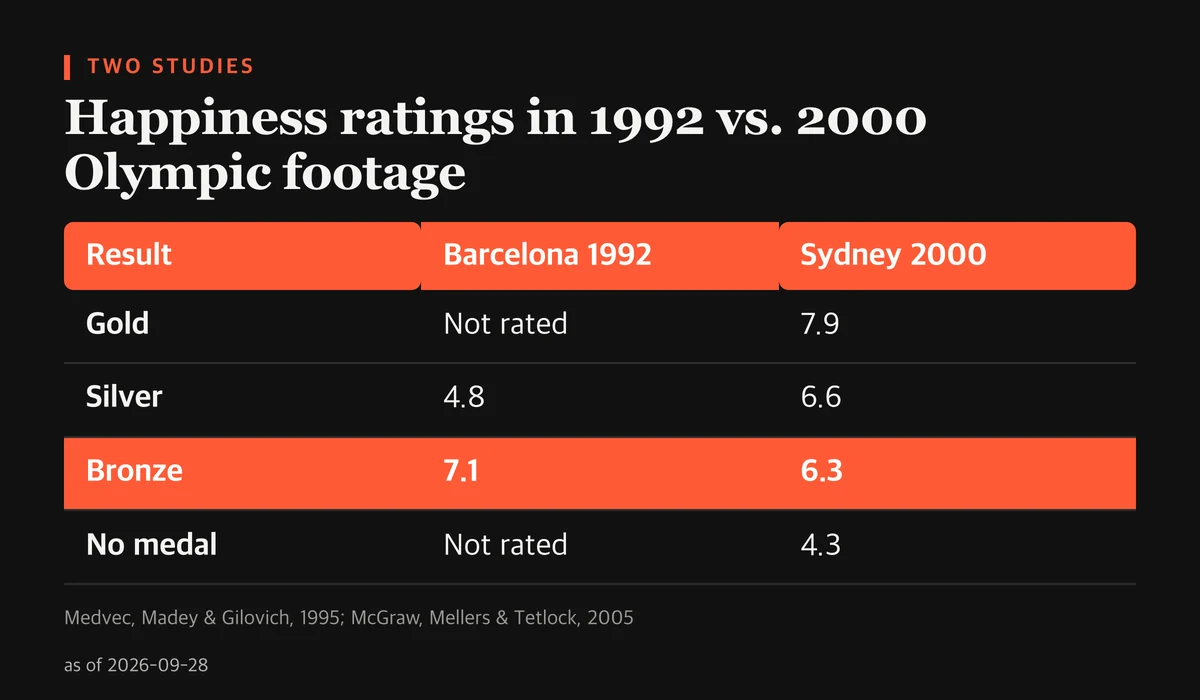
Their reading is that where you finish matters most, and expectations adjust it. In their analysis, actual finish was the stronger predictor, but the gap from pre-Games predictions counted too. A bronze medalist nobody expected to medal could out-smile a silver medalist who was expected to win gold. So “always compare downward” is too simple a lesson.
The original pattern hasn’t vanished, though. A 2020 study ran facial-expression software, not human raters, over medal-stand photos. It covered 413 athletes across 142 events and 67 countries, at five Olympic Games from 2000 to 2016. Bronze medalists were more likely to be smiling than silver medalists. The authors found support for both explanations: the nearest line and the expectations.
A sharper limit cuts against this essay’s own advice. McGraw and colleagues note that the 1992 athletes were at their career peaks and would keep competing. On a motivational account, they “should” have compared upward to fuel their training. If they compared downward anyway, the first comparison may be closer to a reflex than a choice. You may not get to pick the first sentence that forms.
And the samples were small. The interview study rested on 9 bronze medalists. Read these findings as a strong hint about how people react, not a law.
Try this today
Pick one result from today. An email reply, a workout, a number on a dashboard. Small is fine.
- Write what you expected before it came in. If you can’t remember, write your best honest guess.
- Write two sentences that are both true: “I almost ___.” “At least ___.”
- Give each one a place. The “at least” is for tonight. The “almost” becomes one step on tomorrow’s list.
Try it for one day. Not forever. One day.
You won’t stop the first comparison from showing up. For the silver medalists in Barcelona, it seemed to arrive on its own. But you’ll be able to tell which way it runs: “I almost” pointing up, “At least” pointing down. Because both sentences are true, choosing the one that leaves you better off tonight isn’t lying to yourself. The letter says the same thing it did in the meeting room. The comparison you carry back to your desk is the part you can choose.
After any result, finish both true sentences, 'I almost…' and 'At least…', then choose which one you need next.