At a glance
- In a 2020 experiment with roughly 2,000 U.S. adults, people paid to use social media less for three weeks kept using less after the payments ended, which the authors read as habit.
- Of those offered a tool to set their own daily app limits, 89 percent set one, and the group offered it reduced use significantly and persistently compared with the control group.
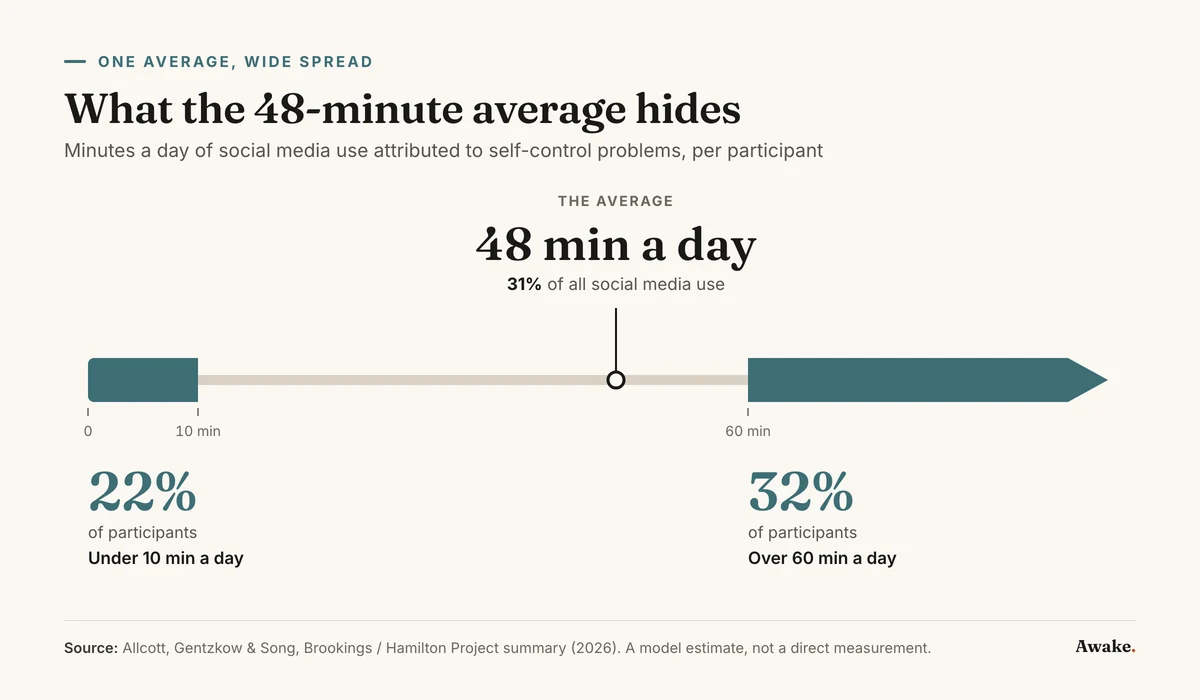
- The authors' model attributes 31 percent of use (48 minutes a day on average) to self-control problems; for 22 percent of people it was under 10 minutes, for 32 percent over 60.
In this essay
It’s late, the video is funny, and nobody is making you watch the next one. That is the honest case for the evening scroll: you like it, and it asks nothing of you. When someone suggests you cut back, your reply comes easily. If you really wanted to stop, you’d just stop.
In 2020, economists Hunt Allcott, Matthew Gentzkow and Lena Song put that belief to a test with roughly 2,000 American adults. If people already scrolled exactly as much as they wanted, a paid cut-back should have ended when the payments did. A limit people set on themselves should have changed little. Neither prediction held. So how much of an evening’s scrolling is actually chosen that evening? The answer runs through three findings: what today’s use did to tomorrow’s, why a self-set limit cut use, and what the study’s 31 percent figure does and doesn’t mean.
A short answer in two parts
The study, published in the American Economic Review in 2022 as Digital Addiction, separates two forces that the just-stop view lumps together.
The first is habit. In the economists’ sense, a habit is a link between days: how much you use today shifts how much you want tomorrow. The second is self-control. In economics, a self-control problem is a gap between what you would choose for later and what you do once later arrives. On a quiet Sunday afternoon, half an hour of scrolling a night sounds like plenty. Late on a Tuesday, a different version of you is holding the phone.
The “addiction” in the title is the authors’ name for those two forces together. It is an economic definition, not a medical one.
So here is the short answer. On the authors’ reading, part of each day’s scrolling was carried over from earlier days, and part was more than people would have picked in advance. Their model attributes 31 percent of social media use to self-control problems made worse by habit. In a 2026 summary written for Brookings and the Hamilton Project, they put that at 48 minutes a day on average.
A paid break, and a limit of their own
Both parts of that answer rest on two offers, each made to participants chosen at random. Because chance decided who got an offer, those who got one and those who didn’t started out alike on average. Differences that showed up later can be traced to the offers themselves. Use was tracked on six platforms: Facebook, Instagram, Twitter/X, Snapchat, web browsers and YouTube. Participants were aged 18 to 64.
The first offer was money. Some participants were paid to reduce their social media use for three weeks. If someone paid you to scroll less for three weeks, you probably would, and that alone says little about habit. The real test came afterward. Once the payments ended, use stayed lower.
Temporary incentives to reduce social media use have persistent effects, suggesting social media are habit forming.
In the same summary, the authors describe the mechanism: using less today made it easier to use less tomorrow, which they call a key signature of habit formation. That is their reading of the persistence. The experiment paid people to cut back, so it tested the link in one direction only. Run in reverse, the same link would mean a long scroll tonight makes tomorrow’s easier to start.
The second offer was a tool for setting daily limits on their own social media apps. Nobody handed participants a number; each person chose one. Why would that matter? If every evening’s scroll were simply what people wanted, a cap they picked themselves would sit slack and change nothing.
Compared with the control group, though, people offered the tool “significantly and persistently reduced use,” in the authors’ words. The control group had the same apps and, on average, the same reasons to cut back. What it lacked was a limit set ahead of time. Those offered the tool also said they would pay to keep it after the study, though that was a stated willingness, not money anyone spent.
Someone who scrolls only because they enjoy it has little use for a lock on the app. Of the adults offered one, 89 percent set a limit.
The limits of the findings
The 31 percent is not something anyone watched happen. The authors arrived at it by combining the experimental results with an economic model. The two offers produced measured effects; the 31 percent is an estimate, and it is only as sound as the model’s assumptions.
It is also an average, and averages hide people. By the authors’ account, self-control problems added less than 10 minutes of excess use a day for 22 percent of participants. For another 32 percent, they added more than 60 minutes. For the first group, the just-stop view was close to accurate. For the second, it was far off.
Feeling better was the quieter part of the result. According to the authors’ summary, the reductions modestly improved overall well-being and lowered addiction-related behaviors, such as using social media to distract from anxiety. Both measures were self-reported. If you cut back hoping to feel transformed, this study points to a smaller lift than that.
The participants were American adults who agreed to take part in a research study, and the findings describe them as a group. Nothing in those findings can tell you which end of the spread you sit on.
Choosing tonight’s number at lunch
The limit finding is about timing. The tool let people make the evening’s choice before the evening arrived.
On an ordinary weekday, that earlier moment might be the walk back from lunch, or the minute in a parked car before you head inside. Nothing on the screen is pulling at you then, and your night is far enough away that “how much?” gets a calm answer. Which of your two selves should set the number: the one at lunch or the one in bed?
Phones now carry a version of the study’s tool. On an iPhone it sits under Screen Time as App Limits; on Android it is part of Digital Wellbeing as app timers. Whether these settings work as well as the tool in the experiment was not tested. They do the same basic job, though: they hold a number you chose earlier and bring it back when the time runs out.
Your first step
Some time today, while your evening is still hours off, pick the one app you open most in bed.
Before you check anything, write down how many minutes you would want to spend on it tonight. Then open Screen Time or Digital Wellbeing and find last week’s daily average for that app. The gap between the two numbers is not the study’s measure. It is a rough hint of which end of the spread you are on.
Set an app limit at the number you wrote first, not the one on the report, and leave it on.
If the report ran well past your number, the limit settles tonight’s question before the evening starts. In the paid group, using less one day made using less the next day easier, so a shorter scroll tonight may make tomorrow’s a little shorter too. If the two numbers were already close, you may sit near the low end of the spread, and the limit will rarely interrupt you.
Set tonight's limit while the evening is still far off; in the experiment, less use one day made less use the next day easier.