At a glance
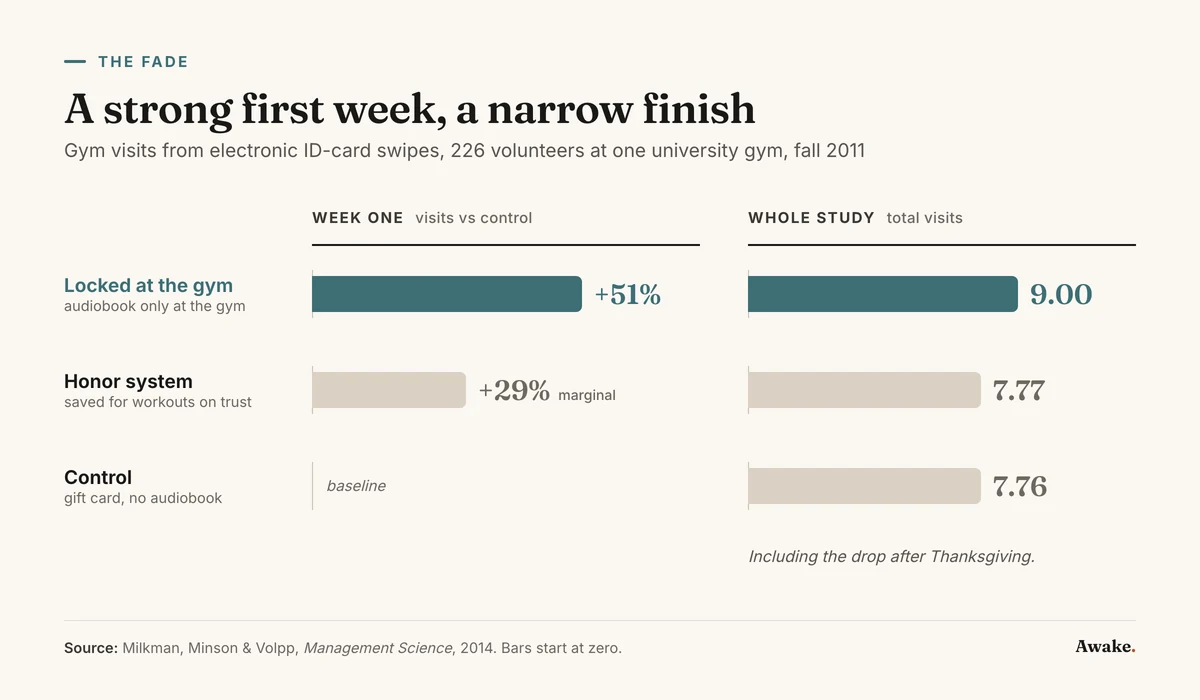
- In a 2011 university study, audiobooks heard only at the gym raised first-week visits 51% over controls; the honor system managed a marginal 29%.
- Afterward, 61% opted to pay for gym-only access to an iPod. That was a survey answer, not a purchase.
- The effect shrank week by week and vanished after the Thanksgiving closure; a larger 2020 study without a lock found a smaller benefit.
In this essay
The gym bag has been sitting by the door since Sunday, and you already know what you’ll tell yourself tonight. You’re tired. Tomorrow you’ll be more disciplined. Underneath sits a belief that feels too obvious to question: a habit you dislike has to be endured, and enduring takes a supply of willpower you keep failing to find.
In the fall of 2011, three researchers tested a gentler idea at a university gym. What if the dreaded task came packaged with something people already wanted, and the wanted thing was available nowhere else? Their experiment speaks to three things: how to pair a pleasure you crave with a task you avoid, why a lock did better than a promise, and where the arrangement came apart.
A story kept in a gym locker
Katy Milkman came up with the idea as an engineering graduate student, when she noticed the gym was far easier to face with an enjoyable audiobook playing. She called it temptation bundling: tie something you want right now to something you keep putting off. She later wrote about it in her book How to Change.
With co-authors Minson and Volpp, she tested it on 226 students, faculty and staff at a large northeastern U.S. university who answered recruitment ads in September 2011. Most were undergraduates, 86% in all, and each was paid $100. They were split into three groups of about 75.
The first group got audiobooks on a loaned iPod that stayed in a monitored locker at the gym. The only way to hear the next chapter was to show up. The second group got audiobooks on their own iPods, with encouragement to save them for workouts on their honor. The control group got a $25 Barnes & Noble gift card. Visits weren’t self-reported; they came from electronic swipes of ID cards.
Would a story be enough to change behavior? In the first week, the locked-iPod group visited the gym 51% more than the control group. The honor-system group’s rise was 29%, an estimate the authors could call only marginally significant. The details are in the full paper, published in Management Science in 2014.
Why the locker beat the promise
Both groups had audiobooks and the same gym. So why would a lock matter? One plausible answer is where the decision sat. The honor-system group had to win a small argument every evening: listen now on the couch, or save it for the treadmill. The locked group settled that argument once, on the day they accepted the locker.
That is an interpretation; the study didn’t measure anyone’s inner arguments. What the data show is narrower. Among mostly undergraduate volunteers at one gym, a physical lock produced a bigger early jump in card swipes than self-restraint did. They don’t show whether a lock would do the same for a parent with a long commute, or for you.
The most revealing number came at the end. Participants were asked about paying for gym-only access to an iPod, and 61% opted to pay. The average stated amount was $6.91 for one month of restricted access, across 211 valid responses. These were answers on a survey, not purchases, from people who had just been paid $100 to take part.
Even as a survey answer, it points somewhere the willpower story never looks. A majority of these people, after living with the setup, were willing to pay to make their own evenings less free.
Building a bundle of your own
The study tested one pairing, audiobooks and gym visits. Extending it to other chores is an untested step, so treat what follows as a reasonable bet rather than a finding.
Choose a pull you already feel
The pleasure has to be something you crave now, not something you think you should enjoy. If you reach for a true-crime podcast every time traffic stalls, that podcast has pull. A lecture series you’ve meant to start for a year probably doesn’t; pairing it with folding laundry hands you two chores instead of one. With a real craving attached, the task borrows wanting you already have, so you aren’t manufacturing motivation from nothing.
Put the lock outside your head
The pleasure should be hard to reach anywhere except the task. Keep the next season of your show only on an old tablet that stays plugged in beside the ironing board. Leave your good earbuds zipped inside the gym bag instead of on the nightstand. In the study, this was the one thing separating the 51% group from the 29% group. Setting it up feels fussier than making yourself a promise. The promise was the weaker version.
Where it stops working
That 51% was the study’s best moment, and it came in week one. After that, the locked group’s advantage shrank by about 0.07 visits per week for every week the study ran, and the honor-system advantage faded too. Then the gym closed over Thanksgiving break.
Thanksgiving break eliminated our intervention’s effectiveness.
Before the holiday, across 7 weeks, the locked group added 0.31 visits per week over control. Over the whole study, total visits were 9.00 for the locked group, 7.77 for the honor system and 7.76 for control. Measured from start to finish, the honor-system group ended up almost level with people who got a gift card.
The sample adds its own limits. It was 226 volunteers, mostly undergraduates, at a single university, and the study ended after about nine weeks. Would the effect have returned in January? Nobody tested it. The researchers also counted gym entries rather than exercise, so a swipe followed by sitting on a bench looks the same in the data as a hard workout. The authors called their paper just one investigation of temptation bundling.
A much larger 2020 field experiment by Kirgios, Milkman, Duckworth and colleagues gave the idea a harder test. In a four-week exercise program with about 6,800 participants, audiobooks plus encouragement to bundle raised the chance of working out in a given week by roughly 10–14%, according to the published summary. Encouragement added only a modest benefit over handing out audiobooks alone; the authors suggest the free audiobook already hinted at the strategy.
That study never locked anything to the gym, so it doesn’t overturn the locker result. It does suggest the benefit is smaller and less certain beyond one campus gym. Milkman has described tools like this as making change easier, though not necessarily easy.
Start here
Tonight, choose one story you would happily stay up late for: the next audiobook in a series you’re hooked on, or the podcast you usually save for long drives. Then pick the single task it will belong to.
Put the story where it can’t follow you. Download it to one device and leave that device, or the only headphones that work with it, inside the gym bag by the door. If your task is the dishes, the old phone lives on the windowsill above the sink and nowhere else.
Before you zip the bag, write one line on a sticky note: the date of your next likely break, such as a trip or a holiday, and the first day you’ll be back. The study tested no fix for breaks, so this is a guess. It is aimed at the exact point where the locker stopped working.
The researchers’ strongest week rested on three things: a story people wanted, a lock that settled the choice, and a gym that stayed open. You can arrange the first two before bed tonight. The sticky note is for the third.
Keep the thing you crave where only the dreaded task can reach it, and decide your first day back before the next break.