
At a glance
- In a 2016 working paper on one Canadian province, each C$1,000 more in a lottery prize went with 2.4% more bankruptcies among the winner's close neighbors.
- Neighbors who filed held more visible assets, such as houses, cars and motorcycles, but not more cash or pensions, and had taken on more secured debt.
- The rise is relative to the neighbors' existing bankruptcy rate, the motive is inferred rather than measured, and lenders' choices played a part.
In this essay
A neighbor’s new truck is their business. That is the sensible view, and it sounds hard to argue with. Their raise doesn’t land in your account. Their new kitchen doesn’t add a line to your card statement. If seeing it stings, the sting is a mood, and moods pass. Comparison, in this view, is a feelings problem with a feelings fix: look away, stop scrolling, count what you have.
A group of economists tested that view against bankruptcy records. They used lottery prizes, because chance sets the size of a prize, not ambition or family money. The question is narrow enough to check: when one household on a short block suddenly has more money, what changes in the debts of the households around it, and what shows up on their paperwork?
Why comparison gets filed under mood
The case for keeping comparison in the mood column is tidy. Money moves through accounts, and accounts have owners. A neighbor’s balance can’t touch yours unless you let it. If you overspend after watching theirs rise, that was your choice.
The view is also hard to test, which helps it survive. People who live near richer neighbors differ from other people in many ways. They may earn more themselves, live in pricier cities or have relatives who help. If they borrow more, who can say whether the neighbors had anything to do with it?
Robert H. Frank argues the other side. In Falling Behind, he describes “expenditure cascades,” in which spending by those at the top pushes middle-income households to spend more. It is an argument about whole societies, though, and those are easy to wave off. A society is not the house three doors down.
To test it at the scale of a street, you would need a neighbor whose income jumped for no reason connected to the block. A lottery draw supplies that.
Thirteen households and a prize set by chance
The lottery draw is the core of a study by Agarwal, Mikhed and Scholnick. They took lottery-prize records from one Canadian province, which the paper leaves unnamed, and matched them to federal bankruptcy records from the Office of the Superintendent of Bankruptcy Canada. The neighborhoods were tiny. In the 2016 working paper, they averaged about 13 households.
Chance set the dollar size of each prize. That matters for the logic. If bankruptcies nearby rise with the size of the win, the neighbors’ own jobs and incomes are hard to blame. None of those decided how much the winner took home.
The headline result in that 2016 version: each C$1,000 increase in a lottery prize was associated with a 2.4% rise in subsequent bankruptcies among the winner’s close neighbors. Mother Jones, summarizing the paper, reported no increase among neighbors slightly farther away. The published version, in the Review of Financial Studies in 2020, points the same way. In the Philadelphia Fed’s summary, the dollar size of one neighbor’s win increases later borrowing and bankruptcies among the others.
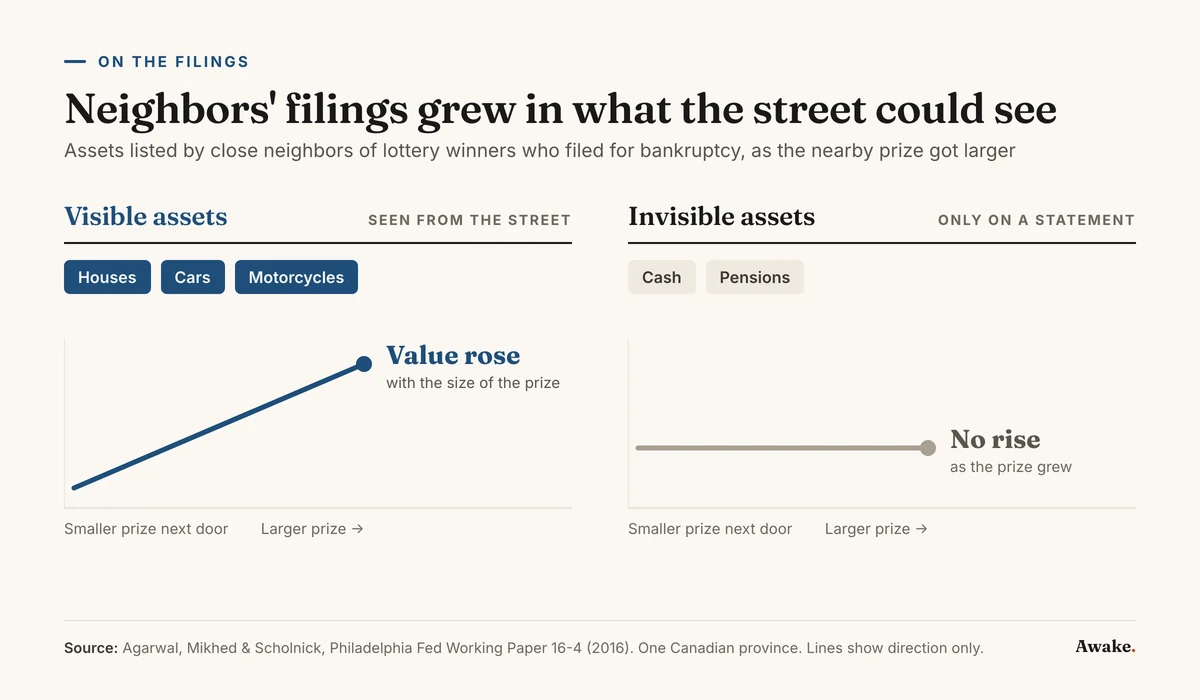
The filings say more than the counts do. People who file for bankruptcy list what they own and what they owe. Among neighbors who filed, larger prizes nearby went with higher values of visible assets: houses, cars, motorcycles. Their invisible assets, cash and pensions, did not rise. In the published version, filers had taken on more secured debt, the kind backed by something like a house or a vehicle, but not more unsecured debt.
A Dutch study points to the same kind of spending. Kuhn, Kooreman, Soetevent and Kapteyn used the Dutch Postcode Lottery, which picks a postal code at random each week and gives participants there cash and a new BMW. Next-door neighbors of winners who hadn’t played had significantly higher car consumption than other non-participants.
A bankruptcy filing has no line for envy. It does have lines for the house and the car, and on these filings those lines grew with the size of the prize next door.
What the evidence doesn’t show
Those growing lines are easy to over-read, so the size of the effect comes first. A 2.4% rise sits on top of the neighbors’ existing bankruptcy rate, and that baseline isn’t given in the summaries this piece draws on. It does not mean most neighbors of a winner go bankrupt. It describes a shift in odds across many blocks, not the fate of any one street.
The 2.4% figure also belongs to the 2016 working paper. Whether the published 2020 version reports the same size of effect isn’t something the available summaries confirm.
Next is the motive. The authors read the pattern as conspicuous consumption, spending meant to be seen. The records are consistent with that reading, but they show what filers owned and owed, not why. Motives weren’t measured.
Then there are the lenders. Every secured loan on those filings needed someone to approve it, and lenders extended additional credit to low-risk borrowers but not high-risk ones. The authors see this as consistent with local lenders using soft information to limit their risk. So the result is partly about who was offered credit, not only about who wanted more. Were the neighbors chasing the winner, or were the lenders making it easy to try?
Finally, the reach of the result. It comes from one province and its lottery records. The Dutch study adds a second country, but the finding cited here is about car consumption, not debt or bankruptcy. And both are about neighbors, not about what happened to the winners themselves.
The column that grows
For the neighbors who filed, the change showed up as a mix of assets: more of what could be seen from the street, no more of what sat in a bank or a pension. The mood test, asking whether a new truck next door stings, may be checking the wrong place. A more useful check is whether your own visible column is growing while the other one stands still.
That check looks ordinary in practice. A coworker parks a new SUV in the lot. A few weeks later, an email arrives saying you’re pre-approved for a vehicle loan, or that your home equity could fund a renovation. Approval can feel like a verdict that the purchase fits. The lender pattern above is a reminder of what approval measures. A yes tells you how a lender sees your risk. It says nothing about why you want the thing.
Frank’s cascades describe this at the scale of a whole society. The postal-code study brings it down to a short block, where a neighbor’s driveway is in plain view. Which of the things you own could a neighbor see from the sidewalk, and which could only you see on a statement?
Your first step
Start with the paperwork the filers had to produce, in a much smaller form. Pull up your most recent statement for any loan backed by something you own, such as a car loan, a mortgage or a home equity line. Then pull up your savings and retirement balances.
On one sheet of paper, draw two columns. Head the first “Seen from the street” and list what each of those loans paid for. Head the second “Only on a statement” and write your savings and retirement totals now, beside what they were a year ago if you can find it. Next to the most recent item in the first column, write the name of anyone whose purchase was on your mind when you made it. Leave it blank if no one was.
The study didn’t test this exercise; it only borrows the study’s two categories. No rule comes after it. If the first column has grown and the second hasn’t moved, you are looking at the same shape the Canadian filings showed. Whether that shape needs changing is a call only you can make with the sheet in front of you.
The question about the short block has a plain answer in that province. Each C$1,000 more in a neighbor’s prize went with 2.4% more bankruptcies among the close neighbors. Their filings listed more in houses, cars and motorcycles, alongside more secured debt, and no more in cash or pensions. The prize money never entered their accounts, but it still showed up in what they borrowed against.