
At a glance
- NEFE, often cited as the source of the '70% go bankrupt' figure, says it isn't its research and can't be confirmed.
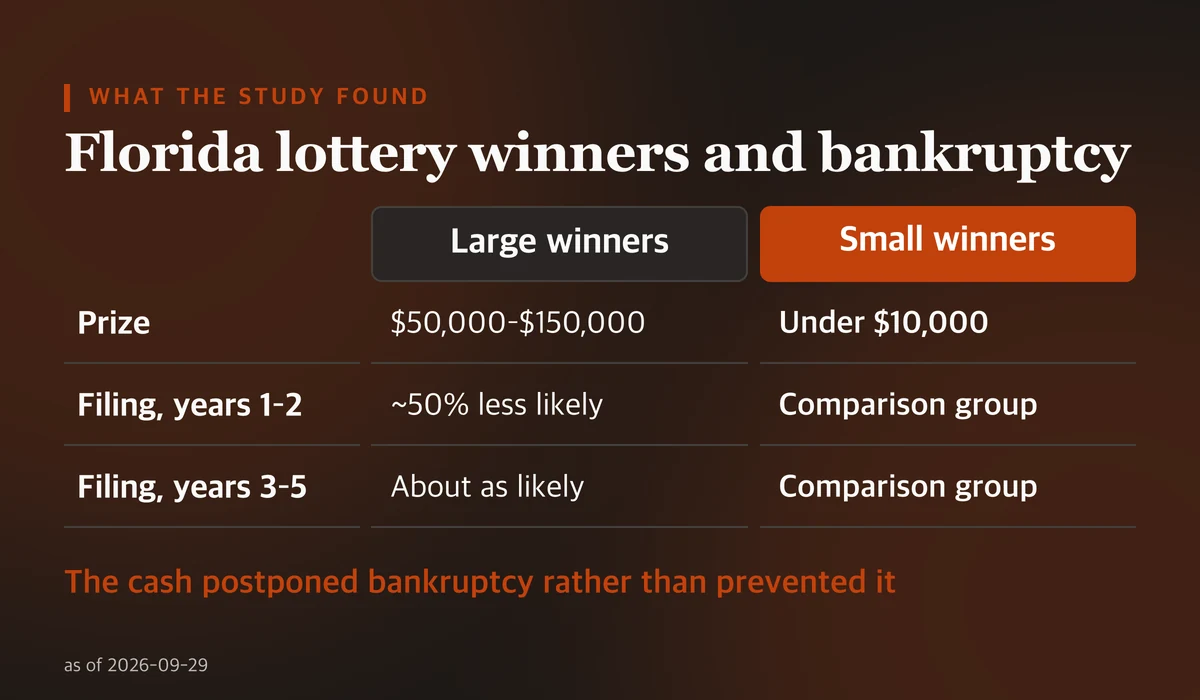
- In Florida, $50,000–$150,000 winners were about 50% less likely than under-$10,000 winners to file for bankruptcy in the first two years, but about as likely by years three to five.
- Swedish lottery data show household wealth fading only slowly after a win, so the Florida pattern shouldn't be read as the fate of every winner.
In this essay
The group chat lights up on a Tuesday morning. Someone has posted a screenshot of a record jackpot. Under it comes the reply everyone has seen before: “Doesn’t matter. 70% of lottery winners go bankrupt anyway.”
Nobody asks where the number comes from. It sounds right. It fits a story people enjoy, where sudden money ruins anyone who wasn’t ready for it.
But that number has no research behind it. There is real research on what happens after a windfall, and it tells a quieter, more useful story. It applies to a tax refund, a year-end bonus or a raise as much as to a jackpot. By the end, you’ll know what the lottery studies actually found, and why a lump sum, on its own, may not fix the habits behind money trouble.
A bucket in a leaky tub
Picture a bathtub with the tap running and the drain partly open. The water level is your bank balance. The tap is what you earn each month. The drain is what you spend.
Now someone empties a bucket into your tub. The level jumps, and it looks like a different tub. But your tap and your drain haven’t changed. If more was flowing out than in before the bucket, the level starts falling again the next day. It just falls from higher up, so you take longer to notice.
That’s the whole frame. A windfall changes the level. Your habits set the flow. One is an event. The other is a system that runs every day.
Sounds too simple? It is, and that makes it testable. If the picture holds, a lump sum given to people already losing water should buy time more than it changes direction. Florida gives one way to check.
Where the 70% came from, and what Florida showed
Start with the famous number. It is often credited to the National Endowment for Financial Education, a U.S. nonprofit. In 2018, NEFE published a statement about it.
This statistic is not backed by research from NEFE, nor can it be confirmed by the organization.
According to NEFE, the figure traces back to one unnamed participant’s remark at a think tank on life-changing events that NEFE convened in 2001. The number was “made independently and without verification from NEFE.” One remark at one meeting became a fact people repeat.
So what does happen? Researchers Hankins, Hoekstra and Skiba looked at it directly. Their 2011 paper, “The Ticket to Easy Street?,” in the Review of Economics and Statistics, matched about 35,000 winners of Florida’s Fantasy 5 lottery, from April 1993 to November 2002, to Florida bankruptcy filings. About 2,000 of those winners filed for bankruptcy within five years of winning.
Set that beside the myth: about 2,000 of 35,000 is nowhere near 70%. But it isn’t a replacement statistic. Filing for bankruptcy isn’t the same as going broke.
The useful part is the comparison. The authors split winners into “large” ($50,000 to $150,000) and “small” (under $10,000). Note that even “large” here is not a jackpot. The idea is that the draw, not character, decides who lands in which group. That lets the size of the prize do the explaining.
Researchers found that in the two years after winning, large winners were about 50% less likely than small winners to file for bankruptcy. The money helped, at first. By three to five years after winning, large winners were about as likely to file as small winners. Among winners who did eventually file, the big winners had net assets and debt not backed by collateral similar to the small winners who filed. The paper’s own conclusion is that the cash “only postpone[s] bankruptcy rather than prevent[s] it.”
That’s what the data show. One way to read it, and this is interpretation: for people already headed toward trouble, the bucket raised the level but left the drain alone. The authors themselves go a step further. They write that “skepticism regarding the long-term impact of cash transfers may be warranted” for financially distressed people generally, not only lottery winners.
What to do before the next lump sum
You may never win a lottery prize. You probably will get a refund, a bonus or a raise. None of the ideas below come straight from the study. They’re practical readings of it.
First: know your monthly gap before the money lands
Your gap is what you bring in during a normal month minus what you spend. Before your bonus hits, open your banking app and look at last month. Your paycheck in. Rent, the card payment, the phone bill, the takeout, the streaming services out. If your gap is negative, divide what actually lands in your account, after tax, by your monthly shortfall. The answer is how many months the bucket buys you. The bonus stops being a fresh start and becomes a clock you can read.
Second: decide where a raise goes before the first bigger paycheck
A raise is different from a bonus. It changes your tap, not just your level, which makes it more powerful. Yet it is also easy to absorb. Your first bigger paycheck arrives, and your lunch order gets a little nicer, your phone upgrade a little closer. Where does the extra go, three months later? Often you never decided. So decide on the day you hear about the raise. Set up an automatic transfer for part of the difference. Then the higher tap raises your level instead of quietly widening the drain.
Third: give part of the windfall a job that shrinks the drain
Some uses of a lump sum sit on top of the water. Others change your flow. If you pay off a balance that carries a monthly minimum payment, you lower what goes out every month after. A trip is gone when you get home. Neither choice is wrong. But if your gap from the first step is negative, which one will still be working in a year? Usually the one that shrinks the drain.
The other side
The strongest challenge comes from Sweden. Cesarini, Lindqvist, Notowidigdo and Östling studied Swedish lottery winners in a 2017 paper in the American Economic Review. Their estimation sample covered 247,275 prize observations, about 200,937 individuals, across three lottery programs with a combined prize pool of about $650 million. They tracked outcomes for up to ten years.
That paper is mainly about work, not bankruptcy. But it reports, with a figure in its online appendix, that household wealth “dissipates slowly with time since winning the lottery.” Winning did reduce pretax earnings by about 1.1% of the prize amount per year, for more than ten years. That came mainly from winners working somewhat fewer hours, not from going broke. In a broad group of lottery players, the money wasn’t quickly blown; it wore down slowly.
Then there’s selection. The Florida filers are a subgroup: people who ended up filing at all. Their similar debts may partly reflect that financially fragile people stay fragile with or without a windfall. That’s not the same as saying windfalls fail to help the typical winner. And the data are aggregate. They don’t show that any particular winner proved the pattern.
Finally, the bathtub picture is a frame, not a measurement. The Florida study didn’t record anyone’s habits. And not all money trouble is a leak. Sometimes it’s one large spill, like a lost job or an unexpected bill. Then a lump sum may be close to the right fix.
Try this today
Tonight, open your banking app and pick last month. On a sticky note, write two numbers: everything you took in, and everything you spent. No categories, no judgment. Just the two totals.
If your spending is bigger, add one line underneath. Take the next lump sum you expect, a refund or a bonus, and divide the after-tax amount by your gap. That’s how many months your bucket buys. If a raise is coming instead, compare the monthly increase after tax with your gap: does it close it or not? Stick the note where you’ll see it when the money arrives.
Try it for one day. Not forever. One day.
The famous 70% came from one unverified remark. The real research is quieter. In Florida, a bigger win meant about half the bankruptcy risk for two years, and then the gap closed. In Sweden, across a much broader group, wealth faded only slowly. One reading fits both: a lump sum changes the level, and on its own it may leave the habits behind money trouble where they were. A jackpot or a bonus can buy you time. A raise can change the flow, if you decide where it goes first. What happens to the flow decides what that time is for.