
At a glance
- Over three-quarters of US taxpayers get a refund; one study points to inertia as a major driver.
- A refund can feel like a bonus because it lands as one lump, in its own mental account.
- At a 0.37% savings rate the loan costs little; with card debt at 22.15%, it costs far more.
In this essay
It’s a weekday morning in late February, and your banking app lights up: a federal tax refund just landed. For a moment it feels like found money. You start planning a dinner out, or finally fixing the rattle in the car. Then someone in the group chat says what personal-finance people love to say: “That’s just an interest-free loan you gave the government.”
Both reactions miss something. The refund isn’t a gift. It was your money all along, held back from your paychecks a little at a time. But calling it a simple mistake skips over why so many people end up with one, and why some of them want it that way.
By the end, you’ll understand why a tax refund feels like a bonus even though it’s your own money, and how to decide whether that built-in forced saving is helping you or costing you.
The jar on the high shelf
Picture a cookie jar on the top shelf of the pantry. The cookies inside are the same as the ones on the counter. But reaching them takes a chair, so fewer disappear on a random Tuesday night.
Economists have a name for the habit underneath this: mental accounting. In a foundational paper, Richard Thaler argued that people break a basic assumption of economics: that money is “fungible,” meaning a dollar is a dollar wherever it came from. Those violations, together with the struggle for self-control, strongly shape how people save.
Look at how a refund arrives. A paycheck comes in small, steady pieces, and each piece already has a job: rent, groceries, the phone bill. A refund comes once, as one lump, with its own label. One way to read this is that it lands in a different account in your head, closer to a windfall than to wages. The dollars are identical. The account is not.
The idea is simple, and that is why it works: money you can’t easily reach is money you’re less likely to spend by accident.
What the researchers found
Economist Damon Jones’s 2012 paper, Inertia and Overwithholding, opens with a plain fact. Over three-quarters of US taxpayers receive an income tax refund, which is in effect an interest-free loan to the government. Jones tested three explanations: a cushion against an uncertain tax bill, deliberate forced saving, or simply never updating withholding forms.
To tell these apart, he used natural experiments, such as a 1992 change to federal withholding tables and the 1990s expansion of the Earned Income Tax Credit (EITC). He found that after a taxpayer’s expected tax bill changed, withholding adjusted by only about 29% of that change after one year, and about 61% after three years. EITC recipients adjusted by no more than about 2%.
In plain terms: a large share of refunds isn’t a plan. It’s a form filled out years ago, still running in the background.
A Federal Reserve Board study by Michael Barr and Jane Dokko, Paying to Save, adds the other half. Among the low- and moderate-income taxpayers studied, 69% said they preferred to overwithhold and get a refund in a hypothetical choice, rather than take larger paychecks. Those whose only savings were illiquid, money that is “not so easy to get to,” were about 11 percentage points more likely to prefer overwithholding. That fits the high shelf: a refund used as a self-control device.
Framing mattered too. When the choice stressed the risk of owing money at tax time instead of getting a refund, preference for smaller refunds and bigger paychecks dropped by about 13 percentage points. That suggests loss aversion plays a role.
In that 2008-era study, the average refund in the group was about $1,700, and the researchers estimated the forgone interest at roughly $47 over the year, small because rates were low. So the picture is mixed: inertia for many, intention for some.
Three ways to see your refund clearly
First: put a price on the loan
The cost of overwithholding is whatever your money would have earned somewhere else. As of September 21, 2026, the FDIC’s national average savings rate was 0.37% APY. As of the week ending April 4, 2025, the IRS reported an average refund of $3,116 so far in the 2025 filing season.
Put those two together. Even if that whole refund had sat in an average savings account for a full year, it would have earned only about the price of a sandwich. It wouldn’t have sat there all year, since withholding leaves your pay a little at a time, so your real gap is smaller still. If your savings earn the national average, the famous free loan costs you very little.
Second: check the debt column
If you carry a credit card balance, the right comparison isn’t a savings rate. It’s your card’s rate. The Federal Reserve’s most recent annual figure, for 2024, put the average interest rate assessed on credit card accounts at commercial banks at 22.15%. Picture yourself paying the minimum on a card in October while you wait for April’s refund. At 22.15%, a year of carried balance costs you more than a fifth of what you owe, while the same money in savings at 0.37% earns almost nothing.
The same caveat applies here. Withholding leaves your pay a little at a time, so the money you could have put toward the card builds up over the year rather than all being there in January. Your real cost is less than a full year of interest on the full refund. Still, every extra dollar withheld is a dollar not working against that rate. In that seat, your 0% loan to the government is expensive.
Third: ask whether the lump has a job
Forced saving only earns its keep if the lump does something your paychecks wouldn’t have. Picture two refunds of the same size. One pays the car insurance premium that comes due once a year, or starts an emergency fund that finally covers a broken water heater. The other turns into takeout and a bigger TV by May. Same dollars. In the first case, the high shelf protected something you cared about. In the second, it only delayed the spending.
The other side
So is the refund a strategy or a habit? For many people, the evidence points to habit. Jones found that EITC recipients barely adjusted their withholding even after the law changed, which looks more like friction and inattention than a savings plan. If you never chose your refund, it’s hard to call it discipline.
Tax-time nudges are also weaker than you might hope. In a large national randomized trial reported by the Brookings Institution, 7.2% of filers in the control group split any of their refund into savings, compared with 9.8% of filers who got suggested-savings prompts. That’s a real lift, but a modest one. Reminders of specific reasons to save generally had no effect, or made things worse.
The lesson may be that structure does more than good intentions. Withholding is one structure. An automatic transfer to savings on payday is another. It builds the same high shelf, while you keep the interest and can reach the money in an emergency.
Rates also move. The $47 estimate came from a low-rate era with smaller refunds. If savings rates climb, or a balance appears on your card, the cost of the loan climbs with them. The math above is a snapshot, not a rule.
And this is a way of thinking, not tax advice. Withholding depends on your income, household, and jobs, and setting it too close can leave you with a surprise bill in April. The goal isn’t a zero refund. It’s a refund you chose on purpose.
Try this today
Tonight, take three small steps.
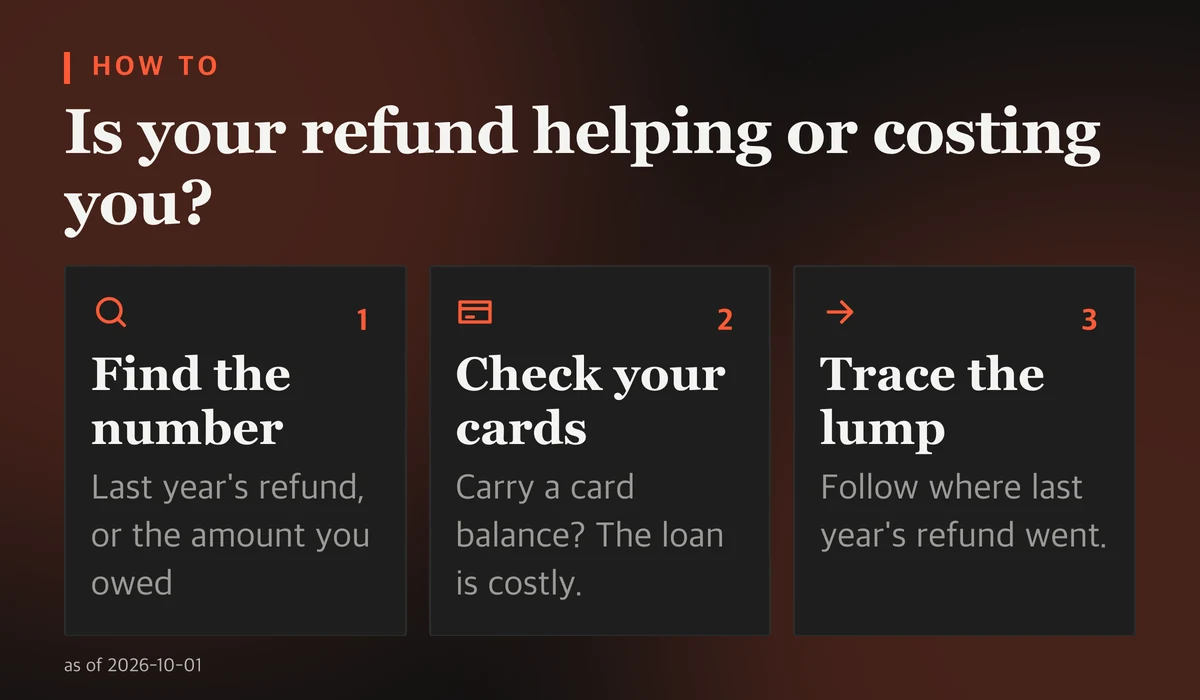
Find the number. Last year’s refund, or the amount you owed, is on your return or in your bank history around filing season.
Check your cards. Do you carry a card balance? If so, the loan is costly, and a smaller refund put toward that debt may do more for you.
Trace the lump. Open the bank statement from the month the refund arrived and follow where it went. Would that money have been saved if it had come in your paychecks instead?
You don’t have to change a form tonight. You only have to look.
A refund feels like a bonus because it arrives once, with its own label, after months out of reach, so it lands in its own account in your head. Whether that built-in forced saving is helping or costing you comes down to two things: what the money could have earned or saved you elsewhere, and what the last lump actually did.