
At a glance
- In one Cornell study, wearers of an embarrassing T-shirt guessed about 46% of observers could name the face on it; about 23% could.
- One explanation: people start from their own view of the slip and adjust down, but not far enough.
- The gap is in size, not direction. People's guesses still tracked what others noticed, and some moments really are watched.
In this essay
It’s 9:07, and the meeting started at 9:00. You ease the door open, and it clicks louder than any door ever has. You find a chair, and for the next hour you replay it: the door, the scrape of the chair, the heads that turned. Later in the week, the same loop plays for a word you tripped over on a call.
The mistake isn’t caring. It’s the estimate. We tend to guess, fast and without checking, that most of the room saw the slip and filed it away. How many actually did? Psychologists have measured that guess against reality. By the end, you’ll have a realistic estimate of how much other people notice your slip-ups, and a way to use that number before the next awkward moment.
Guessing the weather from next to the oven
Imagine guessing the temperature outside while standing next to a hot oven. You know the kitchen is warmer than the street, so you knock off a few degrees. But you started from the heat on your face, and the correction rarely goes far enough.
That is close to how psychologists Thomas Gilovich, Victoria Husted Medvec, and Kenneth Savitsky explain what they named the spotlight effect. Your own shirt or stumble fills your attention. When you picture what others saw, you start from that full view and adjust down. You just don’t adjust far enough.
Note what this does not say. It doesn’t say people are blind to you. It says your estimate starts too high.
The Barry Manilow shirt
The best-known test sounds like a prank. In a study published in 2000, Cornell students put on a T-shirt showing Barry Manilow, a shirt meant to embarrass a college student, and walked into a room of other students. Each wearer then guessed how many people in the room could name the face on the shirt.
The average guess was about 46%. About 23% of observers actually could. Forty-six is twice twenty-three, so the wearers guessed roughly double the real share.
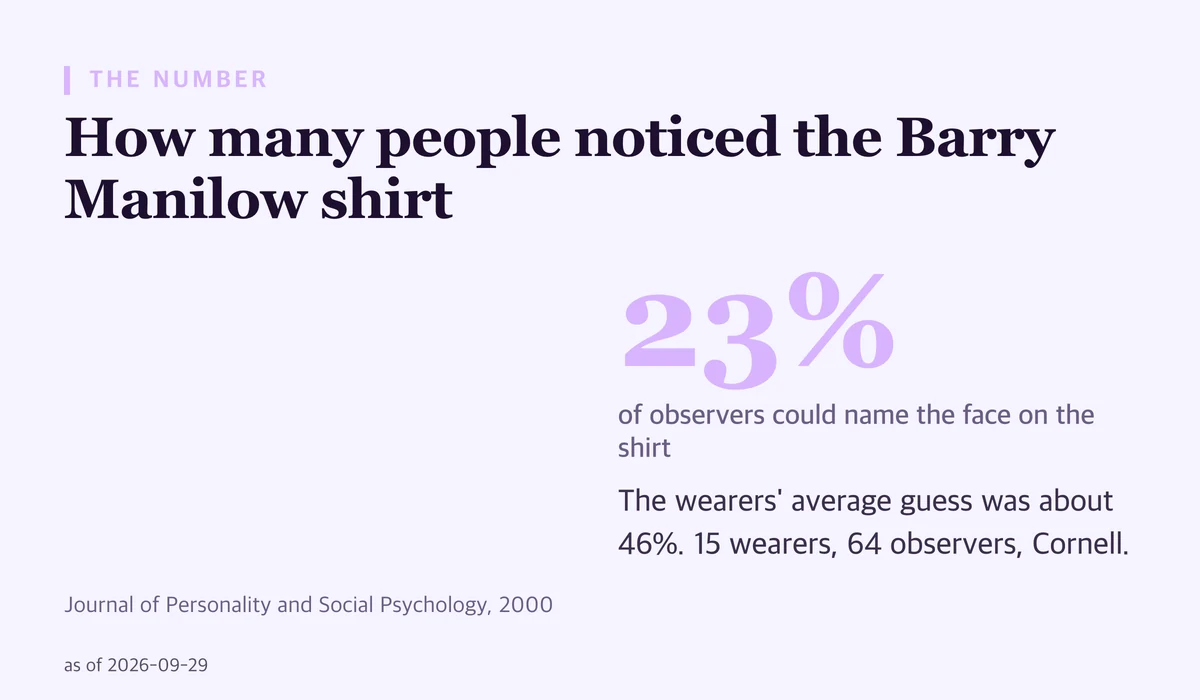
Hold that ratio loosely. The study had 15 wearers and 64 observers. The average gap of 23 percentage points came with a 95% confidence interval of 9% to 38%. “About half as many as you think” is a fair reading of this study. “Exactly half” is not.
A second version used shirts people were glad to wear: Bob Marley, Jerry Seinfeld, or Martin Luther King Jr. The wearers’ guess barely moved, at about 48%. The real share fell to about 8%. One way to read this: the guess tracked the wearer’s feeling of being on display more than what the room took in.
Spoken slips showed a similar pattern. In a third study, 193 Cornell students in 42 groups of three to seven held a 20-minute discussion. Each then predicted how the group would rank them on six dimensions, from moving the discussion forward to speech errors and offensive comments. People overestimated on all six, and most of all on mistakes. For speech errors, they expected a rank of about 2.30 in their group, where 1 meant standing out most. Groupmates put them at about 2.96. For offensive comments, it was 2.35 predicted and 2.90 actual.
Why does the guess start so high? At Northwestern, 44 students wore a Vanilla Ice T-shirt and gave their estimate. Afterward, 73% said they had considered another number first, and 77% of those said it was higher than the one they reported. The researchers read this as the oven at work: start from your own experience, adjust down, stop too soon.
Three ways to use the number
First: read your first guess as the high end
The first number that comes to mind is an anchor, and in these studies it ran high. Say you mispronounce a client’s name on a video call with eight people. Your gut says all eight caught it. The Manilow study measured shirts, not names, so its ratio won’t transfer exactly. It still gives you a reason to cut your first guess down instead of rounding it up. What changes is the size of the audience you’re apologizing to in your head.
Second: give it fifteen minutes
Your sense of being on display fades as you get used to the thing itself. In another Northwestern study, 30 students put on an embarrassing shirt. Those who entered a room right away predicted that about 51% of people would notice. Those who wore it for 15 minutes first predicted about 37%. The shirt was the same. Only the wearers’ guesses changed.
So if you spot a coffee stain on your sleeve at 9:40, don’t hide in the restroom until 9:59 and walk in with it fresh in your mind. Sit at your desk with it. You’ll carry a smaller number into the room, and in the Manilow study the wearers erred high, not low.
Third: keep the direction, shrink the size
Your sense of whether you stood out usually points the right way. It’s the size that’s off. Manilow wearers’ guesses still tracked what observers noticed, with a correlation of .50. In the group discussions, self-rankings and groupmates’ rankings correlated at about .34 to .79.
Say you cut a coworker off sharply in Tuesday’s meeting, and it still bothers you on Thursday. The research doesn’t say no one noticed. It suggests someone may well have, just less than you fear. A short line fits the real size of that moment: “Sorry for cutting you off Tuesday. What were you about to say?” A long apology fits the imagined one.
The other side
So does anyone care? Sometimes, yes. “Nobody notices” is its own error, and the same paper says so.
The effect can run in reverse. The authors describe routine habits a person has stopped noticing, like smoking or wearing too much cologne. There, people can underestimate how noticeable they are to others.
Some moments really are watched. Gilovich put it plainly in a 2026 interview:
Of course, there are times when you are the object of people’s attention. If you’re a tennis player and the match is tied and you’re serving, you know that everyone who happens to be there is paying attention to you.
A wedding toast, a pitch across a small table, the one question you ask at an all-hands: the room is looking, and your estimate should rise to match.
Then there’s scope. The participants were Cornell and Northwestern undergraduates in short sessions. These studies didn’t measure how a partner, or a team you see every day, remembers something you do week after week. The reverse effect suggests that repeated behavior can cut the other way.
Finally, in that same interview, Gilovich said that nothing he has learned in the more than 25 years since qualifies or challenges the idea. That is worth knowing. It is also the author’s view of his own finding, and the percentages here come from small samples with wide margins.
Try this today
Sounds too simple? It is, and that’s the point. Pick one moment today where you’d normally replay a slip: the late arrival, the typo in the group chat, the word you tripped on. Then do three small things.
- Write down your first guess. How many people noticed, out of how many were there? Put both numbers in your phone’s notes.
- Cut it down. Halving it is a rough rule taken from one shirt study, not a law. Write the smaller number next to the first.
- Check the setting. Was this a serve at match point, or a shirt in a room? If the room was really watching, say one short, direct thing. If not, let the smaller number stand.
Try it for one day. Not forever. One day. By evening, look at the two numbers and ask which one sits closer to what happened.
You came here for a realistic estimate. In the best-known test, about half as many people noticed as the wearer guessed. Not zero, and not everyone. Now you have a way to use it: write the first number, cut it down, and check whether the room was really watching. Then go back to the meeting.
Your first guess about who noticed is the high end. In one study, the real share was about half.