
At a glance
- In working-paper figures, doubling a salesperson's sales credits was associated with a 14.3 percent increase in the probability of promotion into management.
- Doubling a new manager's pre-promotion sales was associated with a 7.5 percent decline in the sales performance of that manager's subordinates.
- The authors offer two readings — inefficient promotions, or a reward valuable enough to justify the mismatch — and the results cover sales roles only.
In this essay
The email lands on a Monday morning. The rep who closed the most deals last year is now running the team. The group chat fills with congratulations, and it feels right. Who else would get the job?
As a reward, it makes sense. The quiet mistake is what comes bundled with it: the idea that being excellent at a job means being ready to lead the people who do it. You may carry the same idea about your own career. You get very good at the work in front of you and assume the next rung wants more of the same. Economists have tested a version of that idea with real company data, and the result is not what the group chat would predict. By the end, you’ll see what the data says about promoting top performers, and how to tell whether the next rung on your ladder actually rewards the skills you’ve been building.
Same title, different job
Picture the best line cook in a busy kitchen. On a Friday night they plate dish after dish, and almost nothing comes back. Now make them head chef. The question changes overnight. It is no longer about how good their own plates are. It is about how good everyone’s plates are, including the new hire on salads who is about to panic.
From the outside, the work looks similar. Same kitchen, same menu, same heat. But the measure has moved from one pair of hands to the whole line. A head chef who keeps grabbing pans to fix things personally can look busy and still leave the line weaker.
That gap has a name. In 1969, Laurence J. Peter and Raymond Hull published The Peter Principle, a satirical book arguing that people in a hierarchy tend to rise to their level of incompetence. You get promoted for doing your current job well, until you land in a job you don’t do well. There, the promotions stop.
It reads like a joke about bad bosses. You don’t have to take a satirical book’s word for it. The useful question is whether the pattern shows up when someone counts.
What the sales data showed
Alan Benson, Danielle Li and Kelly Shue looked for it in sales, where each person’s results can be counted. Their data came from sales performance management software. In the working-paper version, released by NBER in February 2018, the sample covered more than 53,000 workers at 214 firms, and about 1,500 of those workers became managers during the study period, according to a Yale School of Management summary. The published paper in the Quarterly Journal of Economics (2019) describes sales workers at 131 firms and reports evidence consistent with the Peter Principle. The firm count differs between the two versions, so the percentages below are best read as working-paper figures.
Here is what the researchers found, as reported in the NBER Digest. Doubling a salesperson’s sales credits was associated with a 14.3 percent increase in the probability of being promoted into management. And doubling a new manager’s pre-promotion sales was associated with a 7.5 percent decline in the sales performance of that manager’s subordinates.
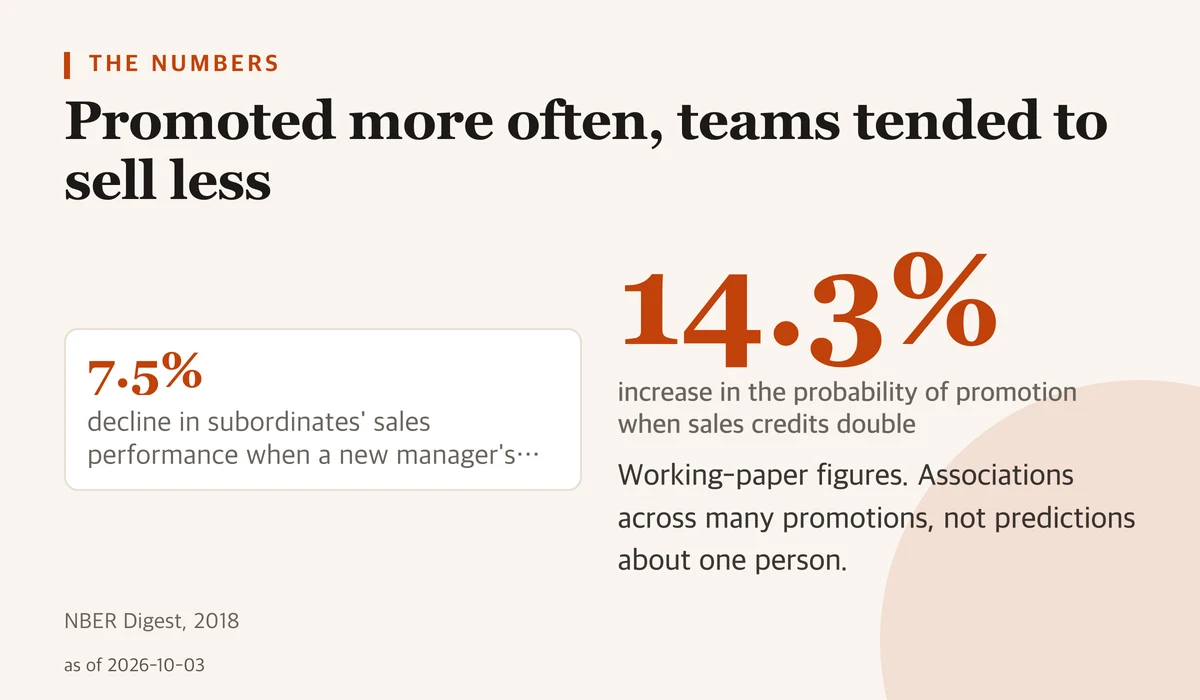
Put those two lines side by side. The stronger seller was more likely to get the job. Once in it, a stronger seller’s team tended to sell less, not more. The published abstract puts it in one line:
The best worker is not always the best candidate for manager.
The authors also estimate that the costs of promoting workers with lower managerial potential are high.
One way to read this: the habits that win a sales leaderboard — chasing your own deals, guarding your best accounts, closing it yourself when time is short — are not the habits that raise other people’s numbers. That is an interpretation, not something the data shows directly. But it fits the kitchen. The skill that got you noticed and the skill the new job runs on can be two different things.
What to check before you climb
None of this says top performers can’t lead. It says strong results in one job were a weak guide to results in a different one. Three checks help close that gap, whether a company is choosing or you are deciding.
First: find out what the next role is measured on
The next role has its own scorecard, and it may not look like yours. Picture your lunch break on a Tuesday, reading the posting for the team lead job one level up. The bullets say “coach,” “forecast,” “hire,” “run one-on-ones.” Few of them say “close.” Once you see the scorecard written down, you stop assuming the next job is your current job with a bigger title.
Second: notice whether your results travel
Some results live only in your hands. Others survive when you pass them on. Think of the last time a newer teammate asked how you handle a difficult client. Did you walk them through it so they could do it next time, or did you take the call yourself because it was faster? The first leaves evidence of the skill a manager needs. The second leaves another win on your own sheet. That is useful, but it is a different skill.
Third: separate the reward from the role
At many companies, a promotion is the main way to say “you did well.” That makes it easy to confuse wanting recognition with wanting the job. Picture a review where your manager says you’ve earned the next step. It’s a fair moment to ask what that step involves day to day, and whether you could grow pay or scope without managing people. Even asking tells you what you actually want.
The other side
The researchers don’t frame this as simple foolishness by firms. The paper offers two explanations. Either the promotion decisions are inefficient, or the incentive value of promotion is large enough to justify the managerial mismatch. Put plainly: if the top job never went to the top seller, would everyone below still sell as hard? Some loss in management quality may be the price of keeping that motivation. That is a real trade-off, not just a blind spot.
Firms also seem to adjust. According to the published paper, they put less weight on sales performance in promotion decisions when managerial roles carry greater responsibility, and when frontline workers are strongly paid for performance. In other words, sales numbers counted for less when the manager job mattered more, or when sellers already had a strong reason to sell.
Scope matters too. These results come from sales roles at the firms in the sample. The paper does not show the same pattern for engineers, nurses, teachers or anyone else. And the numbers describe averages across many promotions. Some strong sellers may well have become strong managers. The pattern describes a tendency, not any one person.
Try this today
Pick the role one step above yours. It might be a job posting, an internal level guide, or simply the person who does that job now. Then take a sheet of paper, or a blank note on your phone, and draw two columns.
In the left column, write what you are rewarded for now. Be concrete: deals closed, tickets resolved, code shipped, shifts covered. In the right column, write what the next role is rewarded for. If you aren’t sure, that blank is your first finding. Ask someone who holds the role, “What does a good month look like for you?”
Then circle the overlap. A lot of overlap suggests your current strengths will carry. Little overlap means the next rung asks for something new, which you can start practicing now, or decide you don’t want.
Try it for one day. Not a career plan. One page, one day.
The data from those sales firms doesn’t say top performers make poor managers. It says that, there, being a top seller made promotion more likely and was linked to weaker team sales afterward. You now know what that research found. And with one page in front of you, you can tell whether the next rung on your ladder rewards the skills you’ve been building, or a different set you haven’t started on yet.