
At a glance
- Descendants of Florence's richest third in 1427 tended to have above-average wealth in 2011, a group average rather than any one family's fate.
- Cornelius Vanderbilt left about $100 million with no trust; by 1907, according to 24/7 Wall St., no Vanderbilt ranked among the richest Americans.
- The famous '70% lose it by the second generation' figure comes from a study whose public account shows no methodology.
In this essay
A family group chat, the week after a funeral. Someone posts a photo of the house. Someone else asks who has the password to the bank account. Nobody answers for an hour.
That quiet hour is where many family money stories actually turn. Not when the fortune is made, but when it changes hands. And most of us walk into that moment carrying a proverb: “Shirtsleeves to shirtsleeves in three generations.” The rich always lose it. Or you’ve heard the reverse: the rich always keep it, and nobody else catches up.
Both get repeated like laws of nature. The long records say something messier. By the end, you’ll know why each story is half-true, what two tax records nearly six centuries apart show, and which choices seem to shape how long family wealth lasts.
A bucket, and a spot by the well
You can picture family wealth in two ways.
The first is a bucket of water. Every time you pass it along, some spills. Split it among heirs and each holds less. A bucket only refills if someone keeps walking back to the source.
The second is a spot by the well. It’s harder to see: a trade, a network, a name people trust, a habit of understanding money. You can’t divide it into shares, and it doesn’t drain when you drink.
So which proverb is right? They’re describing different things. “Shirtsleeves to shirtsleeves” is a story about buckets. “The rich stay rich” is a story about spots by the well.
Florence and the Vanderbilts
If you want to test a proverb, you need records that outlive it. Florence ran a detailed tax census, the catasto, in 1427. The city also has tax data from 2011. Economists Guglielmo Barone and Sauro Mocetti matched surnames between the two and found about 900 that appeared in both years. They published the result as a Bank of Italy working paper in 2016.
As The Local Italy reported, descendants of the wealthiest one-third of Florentine families in 1427 tended to have above-average wealth in 2011. Jobs followed the same pattern. In 1427, the top-earning surnames clustered in law and in the shoemakers’, wool and silk guilds. The lowest earners worked in sewing and wool-sorting. Those surname-to-profession links were still visible in 2011.
For context, The Local notes that Italy’s intergenerational elasticity, a measure of how closely a child’s socioeconomic status tracks a parent’s, is estimated at around 0.5, similar to the UK and the US. In Scandinavian countries it is less than 0.2. Higher means stickier.
The authors summed up the result this way:
…the existence of a glass floor that protects the descendants of the upper-class from falling down the economic ladder.
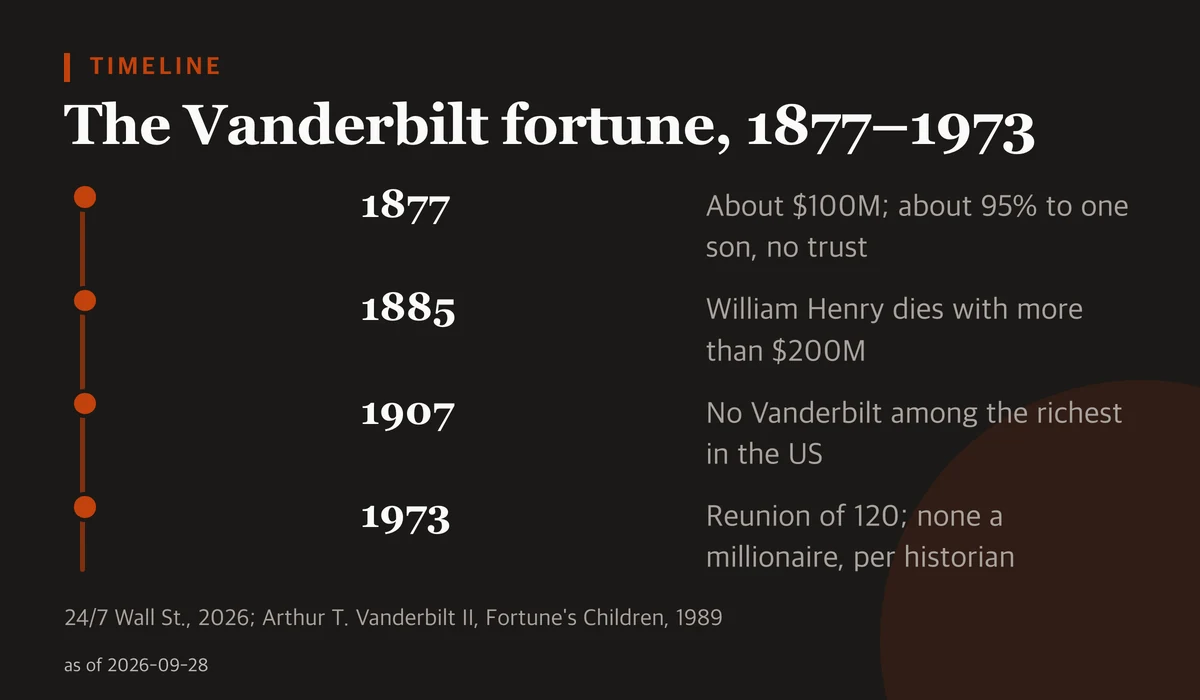
Now the other direction. Cornelius Vanderbilt died in 1877 with an estate of roughly $95–105 million, commonly cited as about $100 million. About 95% of it passed directly to his son William Henry Vanderbilt as railroad stock, with no trust structure. William Henry roughly doubled it, to more than $200 million by his own death in 1885. If you had to bet on one American family keeping its money, you’d have picked this one. Yet by 1907, thirty years after Cornelius died, no Vanderbilt remained among the richest people in the United States, according to 24/7 Wall St.
Family historian Arthur T. Vanderbilt II adds a later scene in Fortune’s Children (1989). At a 1973 reunion at Vanderbilt University, 120 of Cornelius Vanderbilt’s descendants gathered. He writes that not one of them was a millionaire.
One way to read the two cases together: the Vanderbilts held an enormous bucket, handed over in one piece with no rules attached. The Florentine families near the top held something closer to a spot by the well, in professions and guilds that kept producing income. The records don’t prove that’s why one faded and the other lasted. But the contrast is hard to miss.
What seems to decide how long it lasts
Neither study tested advice, so read what follows as an interpretation, not a formula.
First: set the rules before the money moves
A handoff with rules gives wealth a better chance than one without. The Vanderbilt fortune went mostly to one heir, in one kind of asset, with nothing in the paperwork shaping what came next. To be fair, that first handoff was followed by growth, not loss. The record doesn’t show the missing trust caused the later decline. The case for rules is about lowering risk, not a proven cause.
Your version is smaller and closer to home. It’s the beneficiary form on your workplace retirement account that you clicked past during onboarding. It’s a house three siblings will own together, with no one sure who decides whether to sell. It’s a savings account only one person knows exists.
What changes when the rules come first? The hard decisions get made calmly, by the person who built the money, instead of in a group chat by people who are grieving. That doesn’t make your savings permanent. It can close off one easy way for them to leak.
Second: pass down the trade, not only the balance
What travels well across generations is often a way of earning, not a sum. In Florence, the surnames near the top in 1427 were tied to law and the better-paid guilds, and those links were still visible in 2011. A balance can only be split. A skill you teach can be copied without shrinking.
The everyday version happens at a kitchen table. You open the credit card statement and, instead of sighing, show your kid what the interest line means. An aunt who runs a small business lets her nephew watch how she prices a job. You explain out loud why you’re choosing the cheaper apartment.
What changes? The next generation inherits a place in the economy, not just a pile that starts shrinking the day it arrives.
The other side
Start with the statistic you’ve probably seen: 70% of wealthy families lose their money by the second generation, 90% by the third. It traces back to the Williams Group. Its own account describes a 20-year study of 2,500 families, plus a roughly 750-family project with the Farmer School of Business at Miami University in Ohio. But that page gives no generation-by-generation breakdown, no sample methodology and no peer-reviewed citation. The percentages might be right. You just can’t check them from what’s published.
The Florence result has limits too. It is a group-level finding. Not everyone sharing a surname today descends from the 1427 household of that name. The study shows that a low-mobility society kept certain surnames clustered near the top. It doesn’t show that any particular family’s fortune survived intact. A glass floor is evidence of slow social mobility, not proof that wealth looks after itself.
The wider surname argument is contested. In The Son Also Rises (2014), Gregory Clark tracks surnames across societies including Sweden, England, the US, China, Japan and India. He argues that elite status can affect descendants for roughly ten to fifteen generations. Economist Miles Corak calls that an overreach when it becomes one universal mobility rate. In his reading, the surname method tracks “the propagation of elite status across the generations” for rare, high-status names. Other research, he notes, shows persistence is stronger at the top than a uniform model implies. What holds at the very top may say little about the middle.
The Vanderbilt reunion also rests on one family historian’s popular account. A later summary notes that commentators have questioned whether the 120 people there reflected the extended family’s actual finances. “Not one millionaire” describes a room, not a census.
Try this today
Tonight, open a blank note on your phone. Call it “The handoff.” Write three lines.
- Where your important accounts and documents are, in words someone else could follow.
- Who you’d want to receive what, or, honestly, “not decided yet.”
- One thing you know about money or work that you’d want someone younger to learn from you.
Then do one small thing with line three. Text it to that person, or put fifteen minutes on the calendar to explain it over coffee. Try it for one day.
You don’t need a fortune for any of this to matter. Florence and the Vanderbilts were never really arguing with each other. “Shirtsleeves to shirtsleeves” is half-true because piles of money do get split, spent and scattered. “The rich stay rich” is half-true because position, meaning trades, skills and networks, can persist for centuries, on average, across whole groups of families. One reading of these records: what may matter most is less the size of the pile than the rules around it and the know-how that travels with it. Both can start with a note tonight.