
At a glance
- Paying the highest interest rate first generally saves more on interest, according to the CFPB.
- In one debt-settlement dataset, the share of accounts closed predicted finishing; dollars paid did not, once that share was controlled for.
- If your rates are close, smallest-first costs little. If one large debt charges far more, price the gap before you choose.
In this essay
Four envelopes sit on the kitchen table: a store card, a medical bill, a car loan, and a credit card with the highest rate of the four. There’s a little extra money this month. Which envelope gets it?
The standard answer is quick: pay the highest rate first, because that’s where interest piles up. On paper, that’s right. But it’s easy to follow the correct plan, watch a large balance barely move for months, and drift back to minimum payments without ever deciding to quit. It’s just as easy to pay the smallest bill because it feels good, and never check what that feeling costs.
Both are the same mistake: picking an order without knowing what it does for you. By the end, you’ll see why the “wrong” payoff order can win in real life, when the math gap is too big to ignore, and how to decide which one fits you.
Two scoreboards
Every debt plan keeps score twice. One scoreboard counts dollars of interest. The other counts things you can see finished.
Think of clearing out a garage. Move a little from every corner all Saturday, and by evening it still looks full. Clear one shelf completely, and you walk past an empty shelf every time you get in the car. Same hours, different signal.
The two standard payoff orders split along this line. The “avalanche” sends extra money to the highest interest rate first, and the Consumer Financial Protection Bureau says you’ll generally save more on interest that way. The “snowball” sends it to the smallest balance first, so accounts disappear sooner. That means one fewer statement, one fewer login, one fewer due date.
The math reads only the first scoreboard. Sounds like a feel-good excuse for paying more interest? You don’t have to believe it yet. Whether the second scoreboard changes how long people keep going turns out to be testable.
What the repayment records showed
In a 2012 study in the Journal of Marketing Research, Gal and McShane analyzed real repayment records from a U.S. debt-settlement firm. They drew a random sample of 5,943 clients. Of those, 4,169 had at least one account settled and could be tracked over time.
The setup had a useful quirk. The firm, not the client, decided which accounts to negotiate and close at a given time. That makes the data closer to a natural experiment than a plain correlation.
Researchers found that the fraction of a client’s accounts that had been closed predicted whether the client eventually paid off everything, even after controlling for the dollars paid off. The reverse did not hold. Once the fraction closed was accounted for, the dollar amount paid off was not a significant predictor.
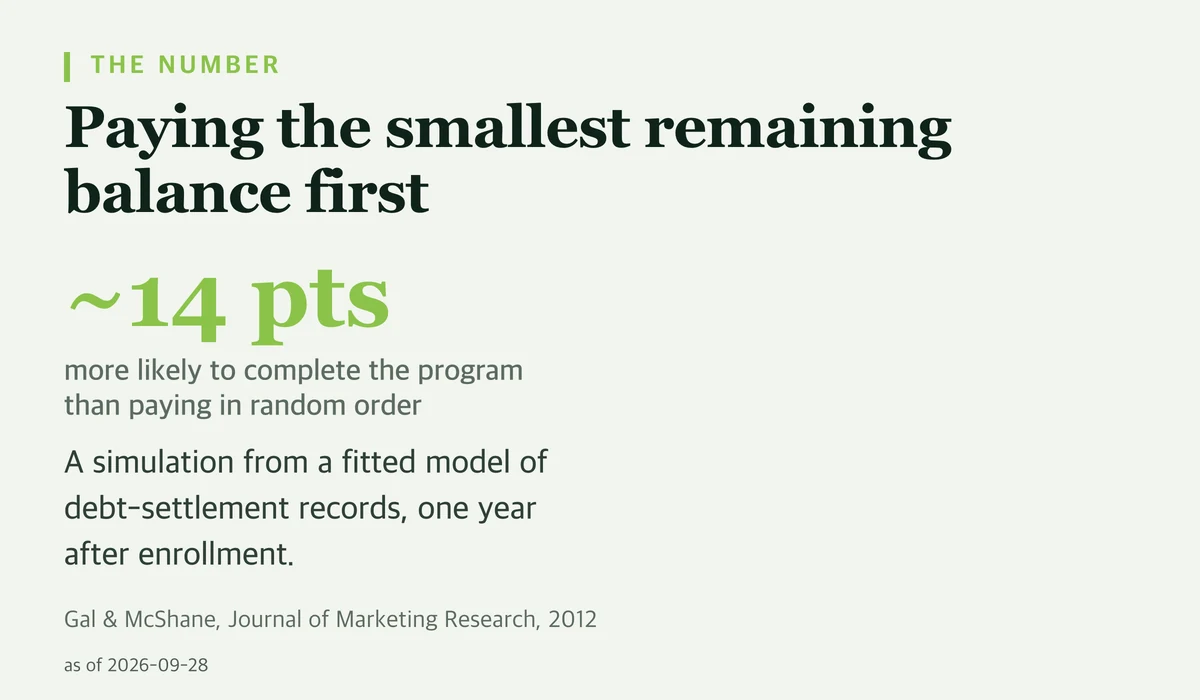
Overall, about 43.2% of clients who began the program completed it. Using their fitted model, the authors then simulated different payoff orders. One year after enrollment, a client who kept paying down the smallest remaining balance was about 14 percentage points more likely to complete the program than one who paid in random order. Against always paying the largest balance first, the gap was larger still.
One way to read this: each closed account shows you the plan is working, and that evidence helps people finish. A falling dollar total rarely feels like a finish line.
A lab study points the same way on a much smaller task. In a working paper presented to a CFPB research panel in 2015, Alexander Brown and Joanna Lahey had 91 Texas A&M undergraduates copy 150 lines of text split into five unequal columns. Those assigned to go smallest column first averaged 11.08 seconds per cell. An even order averaged 12.13 seconds, and largest first 12.50. Yet when 70 participants could choose their own order, only 16 picked smallest first. It was the least popular order, and the fastest.
The idea itself is older than the research. Dave Ramsey’s The Total Money Makeover popularized paying the smallest debt first for the quick wins. His argument is that seeing a small bill disappear keeps you going, even when the math has barely moved.
Three ways to use this
First: count what you’ve finished
A closed account is progress the interest math ignores. Picture a list taped inside a kitchen cabinet, one line per debt, with a line drawn through the store card the week it hits zero. Your car loan still looks huge. But the list is one item shorter, and you see that every morning when you reach for a mug.
Second: concentrate, don’t spread
Concentrating means sending all your extra money to one account while the rest get their minimums. Split a little extra four ways and none of your statements looks different. Put it all on one card and you watch that balance fall. Kettle, Trudel, Blanchard and Häubl found, in a field study and three lab experiments, that concentrating repayment increased people’s motivation to keep repaying. The effect was strongest when the target was the smallest balance. Their explanation: people judge progress by the largest proportional drop they can see in any one account.
This part works with either order. Even if you go highest-rate first, you can give yourself one focused target instead of a thin spread.
Third: price the pull before you follow it
Amar, Ariely, Ayal, Cryder and Rick ran four experiments and found consistent “debt account aversion.” Participants preferred to clear small debts first even when larger ones carried higher interest. Drawing attention to the interest each debt had accumulated made them reduce their overall debt faster. So before you choose, find the line on each statement that shows interest charged. Reading it turns a gut pull into a trade you’ve seen the price of.
The other side
The Gal and McShane data is not a randomized trial of ordinary people choosing their own order. The firm’s control over which accounts closed limits self-selection. It still can’t fully rule out that clients who were already more persistent ended up with more closed accounts. These were also clients in a debt-settlement program, not people making extra card payments on their own. The same motive may carry over, but the dataset didn’t test that.
The Brown and Lahey results come from a research-panel presentation, not a peer-reviewed journal. Their task was about half an hour of copying text, not years of repaying loans.
And the math doesn’t go away. The CFPB says the highest-rate method generally saves more on interest. The size of that gap depends on three things: how far apart your rates are, how big the costly balance is, and how long it waits. Every month it sits behind smaller debts, it keeps charging its higher rate on whatever balance remains. When your rates are close, going small-first costs little. When one large debt charges far more than the rest, it can cost real money. The Amar experiments also suggest people feel the pull toward small debts even when the larger ones cost more.
So which order is right? Neither, in general. One is cheaper on paper. The other may be easier to keep following. Which matters more depends on your numbers and on how you’ve done with long plans before.
Try this today
Tonight, after dinner, make one list. Nothing gets paid yet.
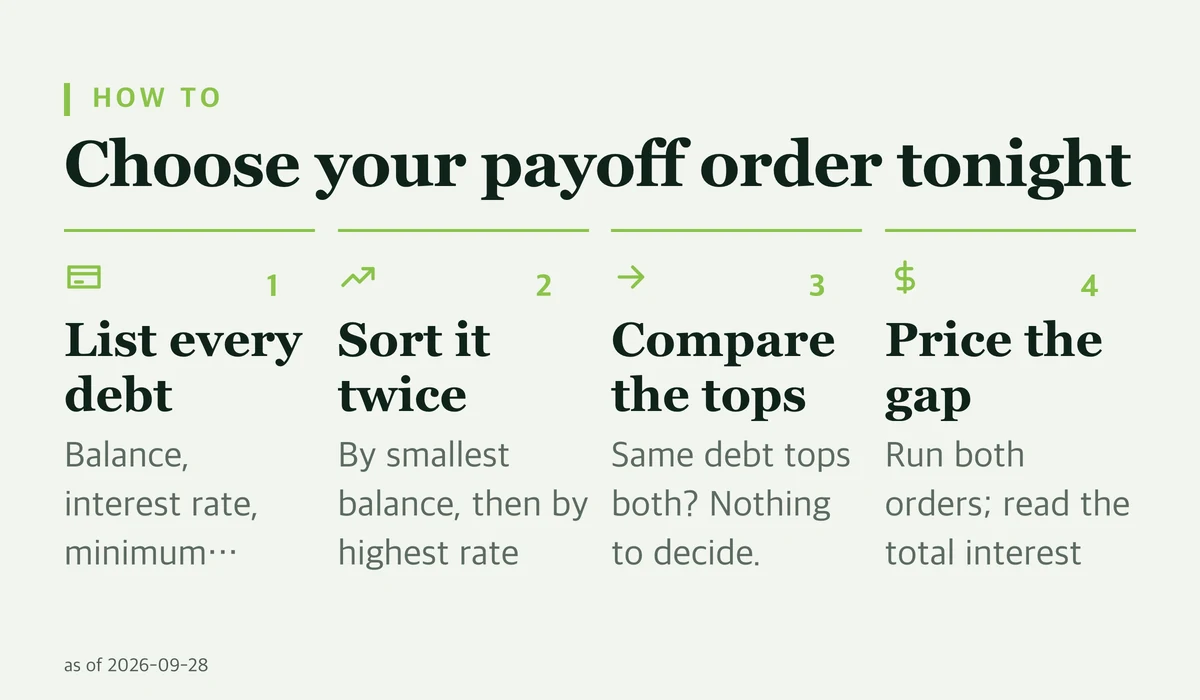
Write every debt on its own line: balance, interest rate, minimum payment. Sort it twice, once by smallest balance and once by highest rate. Then compare the top of each list.
If the same debt tops both, there’s nothing to decide. If your rates are close, start with the smallest balance and take the early win. If one rate stands far above the rest, run both orders through a payoff calculator with your real numbers. Read the total interest for each. If the difference is money you’d miss, go highest-rate first. Then borrow the snowball’s best trick: keep a paper tally of how much of that one balance is gone, so your progress stays visible.
This is a one-evening experiment, not a lifelong commitment. Just the list, both sorts, and one look at the interest lines.
Smallest-first is worse math and, for some people, a better scoreboard. That’s why the “wrong” order can win in real life. When one high rate on a big balance makes the gap too large to ignore, let the math decide. Otherwise, pick the order you’ll still be following a year from now, with its cost in plain view.