
At a glance
- "Failure is not an option" was written for the 1995 film; flight controller Jerry Bostick's real words were about calmly laying out the options.
- Houston saved the crew with an adapter made from plastic bags, cue cards, suit hoses and duct tape — all already on board.
- A review of 145 studies finds constraints often help creativity, but stifle it once they become too high.
In this essay
The most famous sentence ever linked to Mission Control was written for a movie. In the 1995 film Apollo 13, Ed Harris, playing flight director Gene Kranz, tells a room of engineers: “We’ve never lost an American in space; we’re sure as hell not going to lose one on my watch! Failure is not an option.” It’s a great line. It ends up on office posters and in team pep talks. But no one said it during the real mission.
That’s more than trivia. The movie line suggests that crises are solved by refusing to lose. What happened in Houston was quieter. People accepted a short, fixed list of materials and worked inside it. Most of us do the opposite. We wait for more time, a better app, one more option, before we start.
By the end of this piece, you’ll know why working with fewer options often produces better solutions — and where that stops being true.
A near-empty fridge
Think about an evening when the fridge is almost bare. Half an onion, a couple of eggs, yesterday’s rice. You don’t spend an hour on recipe sites. You look at what’s there and ask what it can become. Fried rice appears, and it’s often better than the dinner you would have planned.
Now picture a full fridge. Every dish is possible, so no dish is pressing. You browse, you hesitate, and you end up ordering takeout.
That’s the idea in one picture: a limit changes the question. “What’s the best thing I could make?” has no edge, so attention drifts. “What can I make from this?” has an edge, so attention goes to work. A constraint isn’t only an obstacle to a good solution. Often it’s the outline that makes one findable.
Sounds too simple? It is — and the evidence says it holds only up to a point. We’ll get there.
What Houston actually did
Apollo 13 launched on April 11, 1970. About 55 hours and 46 minutes into the flight, an oxygen tank failed. At 9:08 p.m. on April 13, Jack Swigert radioed Houston that they had a problem. The goal was no longer the moon. It was getting three people home.
The crew moved into the Lunar Module, and a quieter danger followed. The Lunar Module’s own lithium hydroxide canisters, which pull carbon dioxide out of the air, were sized to support two men for two days. Three astronauts needed to live in it for roughly four. The Command Module had spare canisters, but they were square, and the Lunar Module’s openings were round. After about a day and a half, carbon dioxide had built up to dangerous levels.
So the question became very narrow. Not “what would fix this?” but “what’s already on board that could make a square part fit a round hole?” According to the Smithsonian’s re-created mock-up, the answer was plastic bags, plastic-coated cue cards from a three-ring reference binder, hoses from the lunar spacesuits, and lots of grey duct tape. One news account adds socks stuffed into a central hole to keep air from slipping past the filter, and says the instructions ran to 19 steps, read up to the crew.
NASA notes that the “mailbox,” as the device came to be called, was designed and tested on the ground at the Manned Spacecraft Center first. The crew then built it by following instructions from Houston. Once it was in use, carbon dioxide stayed below 2 mm Hg for the rest of the trip home. The crew splashed down in the Pacific on April 17, 1970.
And the famous line? Flight controller Jerry Bostick recalls that the screenwriters interviewed him and asked whether people in Mission Control panicked. His answer:
No, when bad things happened, we just calmly laid out all the options, and failure was not one of them.
One way to read this: the real method wasn’t willpower. It was a list. Lay out the options that exist, cross off the ones that won’t work, build from what’s left.
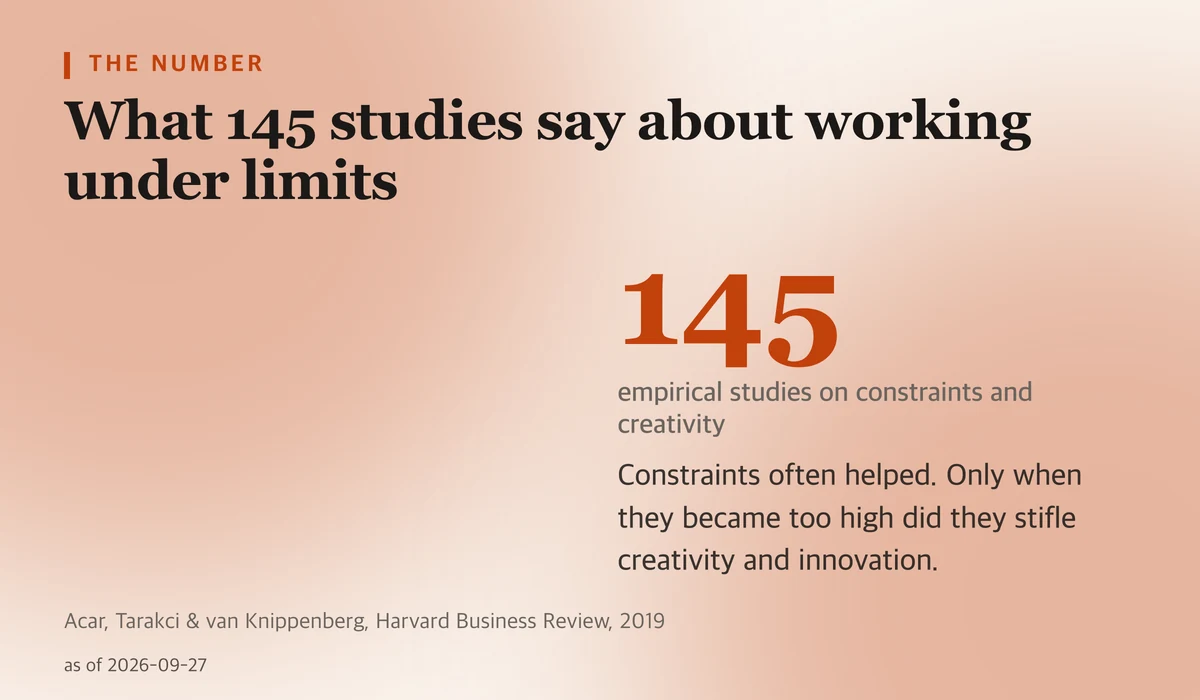
Researchers have looked at this pattern far beyond spaceflight. Acar, Tarakci and van Knippenberg reviewed 145 empirical studies on how constraints — rules, deadlines, scarce resources — affect creativity and innovation. In their Harvard Business Review summary, they argue that constraints are often good for innovation, and that it is only when constraints become too high that they stifle it.
Three ways to work with a limit
First: start from the inventory, not the ideal
List what you actually have before you describe what you want. A manager asks for a new onboarding guide, with no budget. The usual move is to sketch the perfect version and then feel stuck. The inventory move is to write down what exists: an old slide deck, a shared folder, a colleague who trained the last hire. Now you’re assembling instead of wishing, and the gap between perfect and possible stops draining you.
Second: give the problem a real edge
A limit only works if you hold to it. Say you’ve been “working on” a cover letter all week. Tonight, you give yourself until dinner to write one page, using only the job ad and your résumé. Decisions get made because there’s no room left to postpone them. Houston’s edge was a rising gas reading. Yours can be dinnertime.
Third: test the fix before you hand it over
Even Houston’s famous improvisation was checked on the ground before anyone in space touched it. Say you’ve squeezed your grocery spending into a tighter weekly plan. Before you announce it at the kitchen table, run it against last week’s receipts. Does it survive a real week? A constrained solution earns trust when it has been tried, not when it sounds clever.
The other side
It would be easy to walk away thinking “fewer options is always better.” The research doesn’t say that. The same review that found constraints often help also found that once they become too high, they stifle creativity and innovation. One way to picture it: a firm limit sharpens you, a crushing one flattens you. A deadline of tonight, no money, no help, and a rule on every step isn’t a creative prompt. It’s a trap.
Apollo 13 also had something most of us don’t. The materials on board were fixed, but the minds behind them weren’t. At its peak, the Apollo program employed 400,000 Americans and drew on more than 20,000 industrial firms and universities. Mission Control was short on duct tape, not on expertise, simulators, or people. The bag-and-tape fix worked partly because of the deep bench behind it — and it wasn’t invented from nothing in orbit.
The myth has its own nuance too. Kranz later used Failure Is Not an Option as the title of his 2000 memoir, and a review describes the phrase as his personal philosophy at NASA. So the words came from a screenplay, but the attitude belonged to the people. What the movie changed was the emphasis. Bostick’s version is about laying out options. The poster version is about refusing to lose. Only one of those tells you what to do next.
Is a constraint a gift, then? Sometimes. It depends on how tight the limit is, and on what you bring to it.
Try this today
Pick one task that has stalled because you’re “waiting until you have everything” — a budget, a side project, a hard email.
- On a sheet of paper, list only what you already have for it: tools, notes, people you can ask, and the time left today.
- Set one edge: a first version, built from that list alone, finished before a specific time tonight.
- Before you share it, test it once. Read it aloud, check it against last month, or show it to one person.
If the list is so thin that nothing is possible, don’t push harder. Loosen one limit, not all of them. You’ve found the point where a constraint stops helping.
Try it for one day. Not forever. One day.
Fewer options help because they turn an open question into one you can actually answer: what can I build from this? They stop helping when the limits leave you nothing to build with, or no one to build it with. Houston had plastic bags, cue cards, tape, and a room of people who calmly laid out the options. Your version is smaller — a short list on the desk, and the hours left in the day.
Before you wish for more options, list what you already have. Loosen a limit only when it leaves you nothing to work with.