At a glance
- In one 15-minute study, people with strong cinema-popcorn habits ate stale popcorn about as much as fresh, though they rated it worse.
- In a meeting room, strong-habit eaters ate about half as much stale popcorn as fresh, which suggests the cinema setting kept the habit running.
- Changing the place, switching hands and timing a change around a move may help, but the evidence is small and a move can break good habits too.
In this essay
The chips weren’t even good. You knew it by the third handful, and you kept going until the bag was empty, somewhere between one episode ending and the next starting. Afterwards, the familiar verdict arrives. Either you secretly like the stuff more than you admit, or you have no willpower. Both stories put the problem inside you, in your taste or your character, and both point to the same fix: want it less, or try harder.
A small experiment in a campus cinema points somewhere else. Why does a habit keep running after the pleasure has gone, and what can you change besides your resolve? Week-old popcorn suggests three modest levers: where you do it, which hand you use, and when you make a change.
Six trailers and a box of week-old popcorn
A 2011 study appeared in Personality and Social Psychology Bulletin. For it, David Neal, Wendy Wood, Mengju Wu and David Kurlander recruited 98 people just before a regular feature film at a campus cinema. Each was paid $6, handed a box of popcorn and shown six trailers for unreleased films, 15 minutes in all.
The box was the experiment. At random, the popcorn was either fresh, popped 1 hour before the session, or stale, popped 7 days earlier. Participants also said how often they usually ate popcorn at the movies, on a 7-point scale. That single answer became the study’s measure of habit strength.
Nobody enjoyed the stale batch. On a 7-point liking scale, fresh popcorn averaged 3.56 and stale averaged 2.72. Participants in the stronger-habit half rated fresh 3.66 and stale 2.70. Moviegoers also tend to credit taste for the habit: in a pilot, 17 of 22 people asked why they ate popcorn at the cinema answered “tastes good” or something close.
Taste still didn’t decide how much the habitual eaters ate. Participants with weak or moderate habits ate noticeably less of the stale popcorn, as you’d expect. Those with strong habits did not. The gap between their stale and fresh eating was too small to count statistically. The authors write that they consumed “about 63% of the popcorn regardless of its palatability.”
What kept the hands moving
If taste wasn’t moving those hands, what was? The researchers ran the same test on a separate 60 people in a campus meeting room near the cinema. They watched music videos for the same 15 minutes, videos that pilot viewers had rated about as interesting as the trailers.
In the meeting room, the strong-habit participants behaved like everyone else. They ate about half as much stale popcorn as fresh. The snack and the session length were unchanged. What was missing was the rest of the cinema setting: the auditorium, the evening show time.
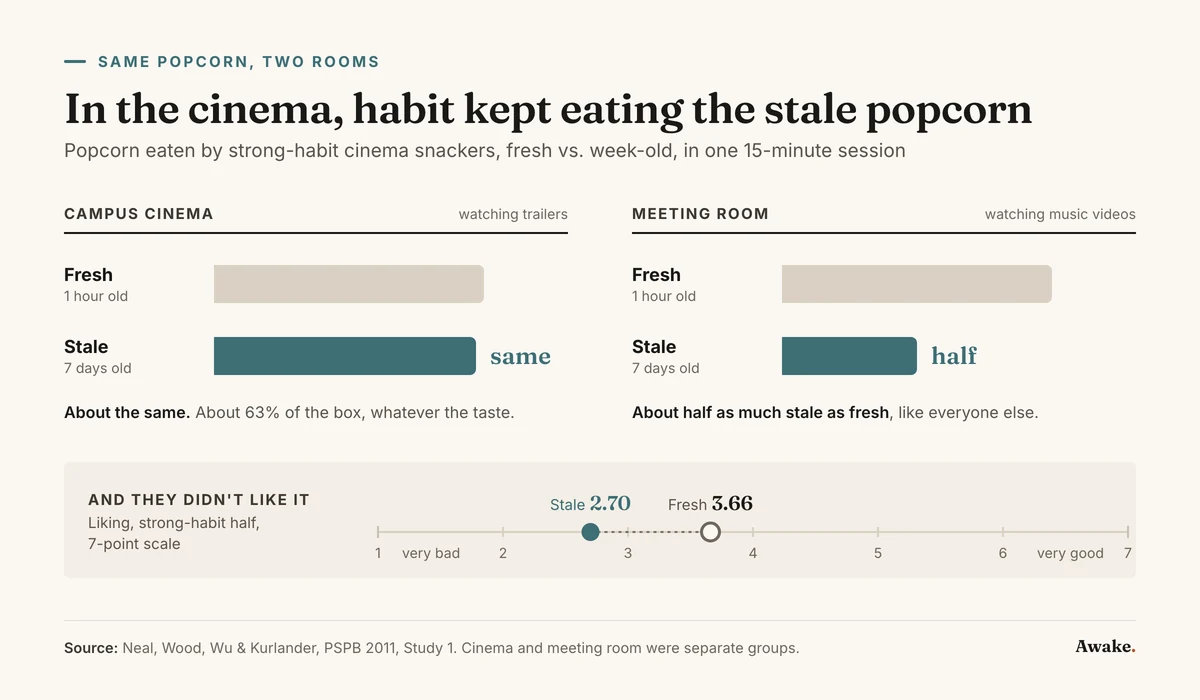
For the most frequent cinema snackers, taste had already voted against the stale box. The cinema outvoted it.
The authors are careful about what “the cinema” means. They did not isolate one trigger, writing that the cues “might include a variety of aspects of the cinema setting and the evening show time.” So the study shows that a familiar setting, taken whole, can keep a well-worn habit running after the reward has gone. Whether the same holds for your phone or your evening glass of wine is an extension nobody tested here.
Three ways to change the setting
Move where it happens
Changing location means doing the habit somewhere its usual cues are missing. The chips you finish on the couch during a show may go differently at the kitchen table with the TV off. The phone you scroll in bed may lose some pull if it charges in the hallway. Nothing is forbidden. The habit simply has to be chosen, because the room no longer starts it for you.
A 2005 study of transfer students points the same way. Wood, Tam and Guerrero Witt followed 115 students moving to Texas A&M University in Spring 2002. They reported on exercise, newspaper reading and TV about a month before the transfer and 4 weeks after the semester began. The habits “survive[d] the transfer only when aspects of the performance context did not change.” Where an old habit broke, behavior tended to follow what students now intended, though not always significantly.
Switch hands
In a second experiment, 89 people at the same kind of cinema session held the popcorn box by a handle, in either their dominant or nondominant hand. With the usual hand, strong-habit participants again ate similar amounts of stale and fresh popcorn. With the other hand, they ate only marginally less of the stale popcorn, a result just short of the usual statistical bar.
The awkward hand seems to put a stumble into an automatic sequence. The authors offered it as a suggestion rather than a proven method:
More feasible, perhaps, is for dieters to actively disrupt the execution of the activated eating sequence by simple manipulations such as eating with the nondominant hand and, in so doing, bring their eating under their personal control.
At a desk lunch, that means the fork in your other hand; on the couch, the phone. The clumsiness buys you a second in which you notice what you’re doing.
Time it for a big move
About 70% of the transfer students were also moving to a new community, so many of their old cues vanished at once. The same paper cites earlier work by Heatherton and Nichols: about 36% of people’s accounts of successful life changes involved moving to a new place, against 13% of accounts of failed attempts. Those were remembered stories, not an experiment.
A field experiment came closer. Verplanken and Roy gave 800 participants either an intervention promoting sustainable behaviors or none, and in each group half had recently moved house. The University of Bath’s release places the study in Peterborough, UK. Over 8 weeks, the intervention worked better among recent movers, and the results suggested a window of about three months after a move.
Where this breaks down
The popcorn evidence is narrow: two small experiments at one campus cinema, with one snack, over 15 minutes. “Strong habit” isn’t a recruited group of regulars but a statistical estimate built from one self-report question. Some key results were borderline, too. The hand effect for strong habits was marginal, and the central interaction in the first experiment was only “close to significant” once liking entered the model.
The design was adapted from earlier work by Wansink and Kim. In 2018, Cornell University announced that a faculty committee had found Brian Wansink committed academic misconduct, including misreporting research data. The Neal and Wood studies were not part of that finding, but it is another reason to hold one snack study loosely.
The hand switch was tried once, for 15 minutes. Whether it keeps working after the other hand gets used to the job was never tested, and it may well fade.
Context change also cuts both ways. In the transfer study, strong exercisers kept the habit when they worked out in the same place, such as home or the gym. Those who changed location exercised less. A move can erase a running routine as easily as late-night snacking. That study was correlational and built on self-reports, and its authors called for experiments to establish cause.
Can a new setting build a better habit on its own? The evidence here doesn’t show that. The transfer-study authors write that adopting a new behavior “is likely to be accomplished effectively through other strategies, such as making a commitment to change or accepting support from others.” In the moving-house study, the move made an outside intervention work better, measured by self-reports. Moving alone was never tested as the cause.
Start here
Choose one habit that has outlasted its pleasure, the one you finish and then wonder why. Note where it happens, at what hour, and what’s in your hand.
Tonight, move it. If it’s chips on the couch, put the bowl on the kitchen table and eat there with the screen off. If it’s the phone in bed, plug the charger in the hallway before you brush your teeth.
When it slips through anyway, switch hands the moment you notice: fork, phone, mouse.
If a new job, apartment or school term starts within the next three months, decide before the first day which old routine stays behind. Then decide which good one, like a morning run, you’ll set up on purpose in the new place.
The frequent snackers in that cinema kept eating week-old popcorn, it seems, because the setting kept starting the sequence. Your couch, your bedside table and your desk start sequences too, and unlike your taste or your character, they can be rearranged tonight.
When a habit outlasts its pleasure, look at where and when it happens before you blame your willpower.