
At a glance
- In three U.S. health clubs, members on flat monthly fees over $70 averaged 4.3 visits a month, paying more than $17 per expected visit against $10 on a 10-visit pass.
- Members who could cancel any month were 17 percent more likely than annual members to still be enrolled beyond one year, despite paying higher fees for that option.
- The authors' leading explanation is overconfidence about future self-control or efficiency; the data is observational, from three clubs in one country.
In this essay
The monthly membership is the sensible option. That is how it feels when you sign up, anyway. You plan to go three or four times a week, so paying per visit would waste money, and an unlimited plan makes every extra workout free. A monthly contract also lets you walk away whenever you like, so where is the risk?
Two economists, Stefano DellaVigna and Ulrike Malmendier, tested that reasoning against the records of 7,752 members at three U.S. health clubs over three years. They could see which contract each member chose and how often that member actually came in. Their data raises two questions worth asking of any flat-fee plan you pay for. What has each use really cost you so far, next to the pay-per-use price? And why did members who could quit any month stay enrolled longer than members who signed up for a year?
The arithmetic behind the monthly plan
The belief rests on a tidy piece of logic. A flat fee makes each visit cost nothing extra, and things that cost nothing extra feel like bargains to use. Spread the fee over enough visits and the price of each one drops below a pass. The plan is cheap on one condition: that you show up as often as you expect to.
That condition is where the logic gets fragile. You make the forecast on the day you’re keen enough to join, which may be the keenest you’ll feel all season. The number in your head is a plan for the coming months. At the moment of choosing, it gets used as if it were a record of what you already do.
The cancel-any-time option adds a second layer of comfort. If the forecast turns out wrong, you assume you’ll notice and stop paying. A monthly contract seems to limit the damage to a month or two of fees. That assumption is a forecast too, about a future self who reads statements and acts on them promptly.
What 7,752 members actually did
The records from the three clubs put both forecasts to the test. According to the published paper’s abstract, members who chose a flat monthly fee of over $70 attended 4.3 times a month on average. By the authors’ calculation, they paid more than $17 per expected visit. A 10-visit pass at the same clubs would have cost $10 per visit.
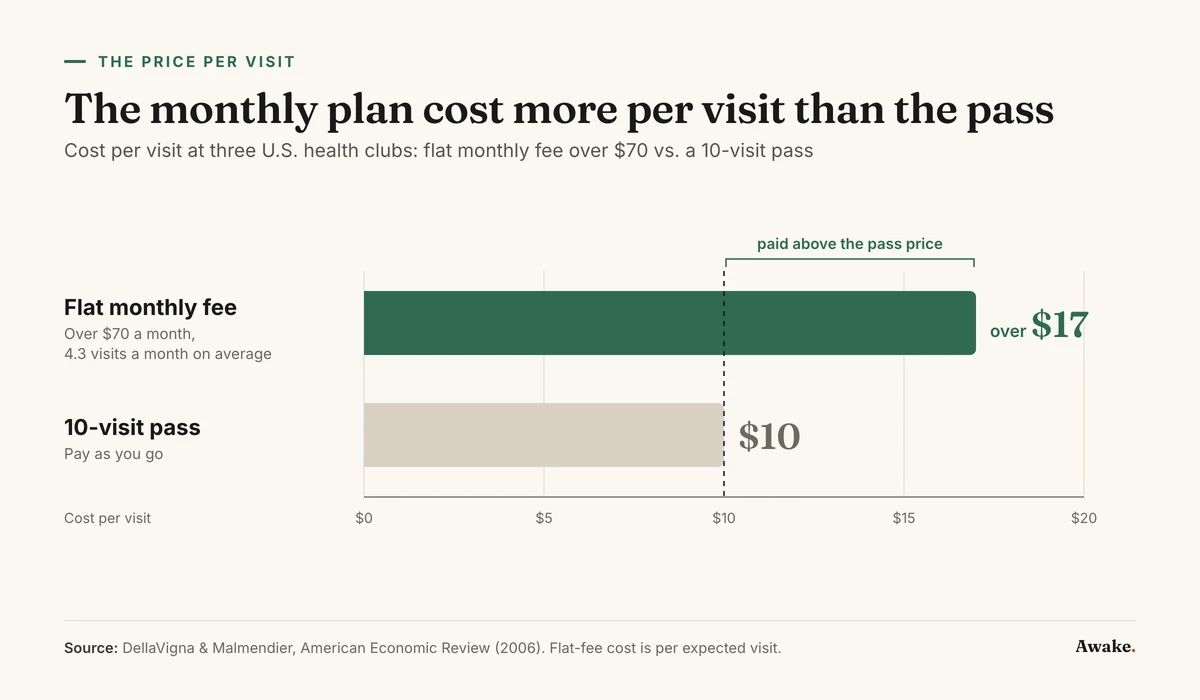
The authors estimate that these members forwent about $600 in savings, on average, over their membership. That is their estimate of what buying passes instead would have saved. The figure concerns the flat-fee members specifically, not everyone at the clubs.
The second finding is the stranger one. Some members chose a monthly contract they could cancel at any time. Others committed to a one-year contract. The monthly members paid higher fees for the option to leave. Even so, they were 17 percent more likely than the annual members to still be enrolled beyond one year.
The authors sum up the pattern in a single line:
Overconfident agents overestimate attendance as well as the cancellation probability of automatically renewed contracts.
The records show what people chose, how often they came and when they left. They don’t show what anyone was thinking at sign-up. Overconfidence about future self-control, or about future efficiency, is the explanation the authors consider most likely. It is inferred from the gap between contract choices and attendance, not something the attendance logs record directly.
What the evidence doesn’t show
The study is narrow, and its reach is easy to overstate. It covers three clubs in one country, with data collected before a first draft of the paper circulated in 2004. Prices, contracts and gym habits may have shifted since then. Streaming services, app plans and software licenses are not in the data at all. Applying the result to them is an analogy, perhaps a reasonable one, but not a finding.
The mechanism is also less settled than the headline suggests. This is observational data, not an experiment, so the authors weigh several explanations against one another. The 2004 working-paper version named pressure from salespeople as one alternative. If a persuasive staff member steered people toward the monthly plan, part of the overpaying would be a sales result rather than a forecasting error. The published abstract does not say how much each explanation accounts for.
Averages hide individuals, too. A mean of 4.3 visits a month says nothing about any single member, including those who came often enough to beat the pass. Is paying more per visit always a mistake? Not necessarily. Some people may pick a flat fee on purpose, for the convenience of never buying passes, or to give themselves a push to go. That framing is ours, not the paper’s, but it means a high per-visit price is not automatically irrational.
One more caution. The 2004 draft reported different headline figures from the 2006 journal article, and some older press coverage mixes the two. The numbers here come from the published version only.
The plan you choose for a later self
Put the two findings side by side and a single habit of mind shows through. A plan gets chosen for the person you expect to be: the one who goes most weeks and cancels the moment it stops paying off. The bill is paid by the person who actually turns up, or doesn’t.
That helps explain how a contract you can cancel any month can end up costing more than an annual one. Its appeal is the exit. But the monthly plan renews automatically, and the authors’ account is that overconfident members overestimate how likely they are to cancel such contracts. Leaving can always wait until next month. A one-year commitment at least comes with a visible end. If the door is always open, what makes this month the one to walk through it?
The monthly members paid extra for the right to leave, and they were the ones more likely to stay.
None of this proves that you, specifically, are overconfident about your own plans. It does suggest where to look. The forecast you made when you joined may still be setting what you pay, long after anyone checked it against what you actually did.
Start here
Pick one flat-fee plan you pay for: a gym, a streaming service, a class bundle, an app. Find how much you’ve paid since you joined; your bank statement or the account page will show it. Then count how many times you’ve actually used it over the same stretch. If the service keeps a history, such as check-ins or a viewing log, use that rather than memory.
Divide what you’ve paid by the number of uses. Set that figure beside the pay-per-use price for the same thing: a day pass, a single class, renting one film. This check follows the logic of the study, but the paper itself didn’t test whether doing it changes anyone’s behavior.
If the plan is monthly, set a reminder for the day before the next charge, with your per-use figure written in it. The cancel option was open to the monthly members in the study all along. A dated reminder at least gives the question a specific day to come up.
For the flat-fee members at those three clubs, the division came out at more than $17 a visit against $10 for a pass. Yours might come out lower, and the plan might be worth keeping. Either way, the figure will rest on what you did after joining, not on what you expected to do on the day you signed up.