At a glance
- In more than 22 million wholesale used-car auction sales, average prices dropped about $150 to $200 at each 10,000-mile threshold.
- Cars at 79,900–79,999 miles sold for about $210 more than cars at 80,000–80,100, but only about $10 more than cars at 79,800–79,899.
- Before reacting to a price or a mileage figure, name the nearest round line and how far the number sits from it. The effect is modest per car, but it runs on both sides of a sale.
In this essay
It’s late, and you’re scrolling used-car listings on your phone. Two sedans look like twins: same year, same trim, same color. One shows 79,900 miles. The other shows 80,100. Your eye settles on the first one, and something in you relaxes. It still feels like a “seventies” car. The other one already feels older.
That small flinch has a name: left-digit bias. People tend to read numbers from the left and give the first digit most of their attention. It happens when you skim a price tag, a mileage reading, or an offer. It happens when you’re the one selling, too.
Sounds too small to matter? Often it is. But in one very large set of car sales, it showed up as real money at very specific points. By the end, you’ll be able to spot the round-number thresholds that quietly tilt what you pay and what you’re offered — on both sides of a sale.
The first digit gets the vote
Think of a number as a sign you read while driving past. You catch the first word clearly. The rest blurs. 79,900 registers as “seventy-something thousand.” 80,100 registers as “eighty thousand.” The real gap is 200 miles. The felt gap is a jump from one category to the next.
That’s the whole principle. Attention is limited, so the mind takes a shortcut. The leftmost digit gets full weight, and the digits after it get less. Most of the time the shortcut costs nothing. It only bites when a number sits right on a boundary, where one more mile or one more dollar flips the first digit.
And it bites in both directions. A buyer who reacts to a flipped digit may pay extra on one side of the line and pass over fair value on the other. A seller who reacts to it may accept less than the car’s condition would justify. Either way, money moves over something that barely changed.
Over 22 million car sales, and a step every 10,000 miles
Economists Lacetera, Pope, and Sydnor wanted to see whether this shortcut showed up where real money was at stake. They analyzed more than 22 million wholesale used-car auction transactions and published the results in the American Economic Review in 2012.
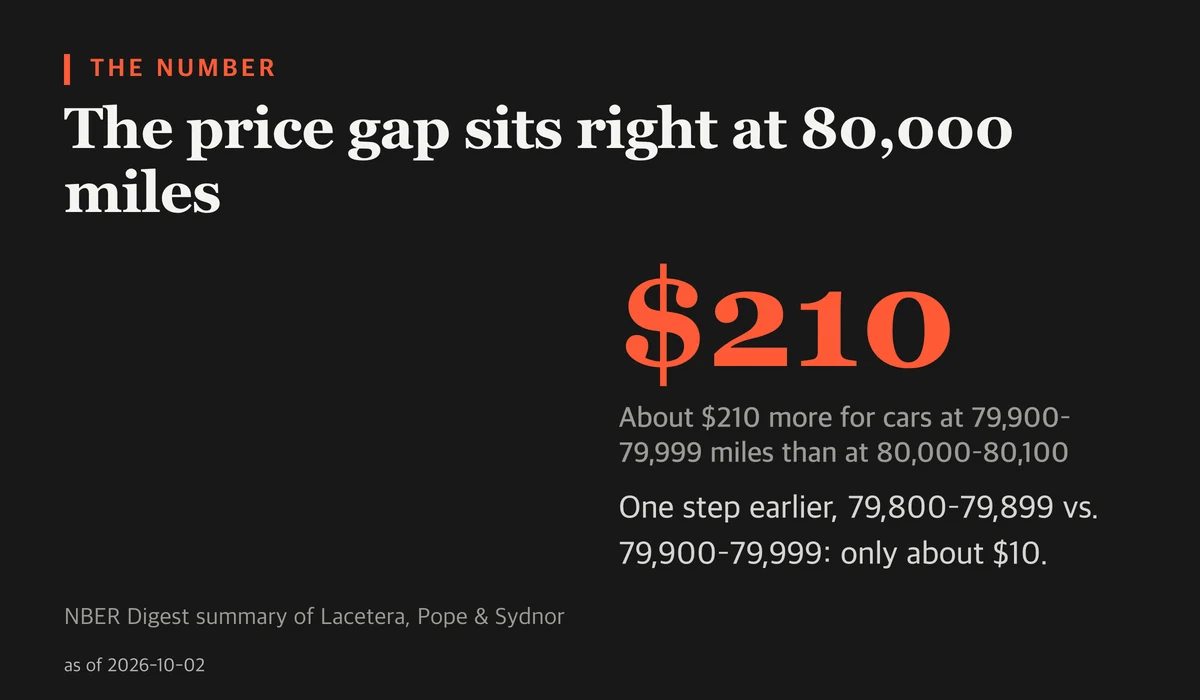
Researchers found that cars with odometers reading just under 80,000 miles sold for noticeably more than nearly identical cars reading just over it. According to an NBER summary of the work, cars at 79,900–79,999 miles sold for about $210 more than cars at 80,000–80,100 miles.
The telling part is the comparison right next door. Cars at 79,900–79,999 miles sold for only about $10 more than cars at 79,800–79,899. So one 100-mile step inside the seventies was worth about $10, while the step across 80,000 was worth about $210 — roughly 21 times as much.
The pattern wasn’t a one-off. Across the mileage range studied, from 10,000 to 100,000 miles, average prices dropped by about $150 to $200 at every 10,000-mile threshold. The paper also reports smaller, similar drops at each 1,000-mile mark.
A later Chicago Booth Review write-up of the research adds two details. It reports drops of about $173 at each 10,000-mile threshold for dealer-purchased cars and about $157 for fleet-purchased cars. It also reports that almost a third of the depreciation a car experiences from added mileage happens right at these thresholds.
Who is doing the misreading? The researchers compared more- and less-experienced dealers bidding at the same auctions, as part of their case that the effect comes from buyer inattention rather than seller trickery. A follow-up paper found the same 10,000-mile drop in retail, consumer-facing used-car prices and sales volumes. One way to read this: part of a used car’s price is set by attention, not by wear.
Cars aren’t the only place where price digits behave oddly. In field experiments with a women’s-clothing mail-order catalog, Anderson and Simester found about 24% more purchases of an item priced at $39 than of the identical item priced at $35. Why would a higher price sell more? Strictly, this isn’t a left-digit story, since both prices start with a 3. The boost was stronger for items new to the catalog, and it weakened when the item was marked as a “Sale” item. One way to read that is that a 9 ending can work as a signal on its own, especially when shoppers have little else to compare against.
Three ways to read the whole number
First: find the line before you judge the number
Before you react to a number, ask where the nearest round threshold is and how far away it sits. Say you’re comparing two listings, and one has just crossed 80,000 miles. Is it really a different class of car from one at 79,900? Name the actual gap in miles. What changes is that the crossing stops working as a quality signal. In the auction data, the price fell hardest right at the line, while the cars on either side differed by as little as a few hundred miles. For a buyer, a car sitting just past a round number is worth a closer look, not a quicker pass.
Second: if you’re selling, know which side of the line you’re on
A threshold you can ignore as a buyer can cost you as a seller. Picture your car’s odometer creeping toward the next 10,000-mile mark while you’ve been meaning to list it “sometime this season.” The auction data suggest buyers, on average, mark down that crossing more than the extra miles alone would explain. What changes is that timing becomes a deliberate choice. You can list a little earlier and describe the car exactly as it is. And if an offer leans on “it’s over 80k,” you can ask how far over, in actual miles.
Third: notice when a price is talking to your feelings
How a price is written can change how you think about it. In experiments by Wadhwa and Zhang, published in 2015 in the Journal of Consumer Research, a rounded price like $100.00 led buyers to rely more on feelings. A precise price like $98.76 led them to rely more on reasoning. Picture a weekend-trip package with a clean, round price. It feels right. What changes is that you can read that feeling as a prompt to check the math, not as a verdict on the price.
The other side
The money involved is modest. The swings in the car study run about $150 to $210 per car, against purchase prices in the tens of thousands of dollars. Left-digit bias nudges what people pay. It isn’t the main driver of a big purchase. Reliability, running costs, and whether the car fits your life matter far more than which side of 80,000 it sits on.
The “.99” ending doesn’t always win, either. Wadhwa and Zhang found that rounded prices raised purchase likelihood for emotionally driven purchases, such as a camera bought for a vacation. Precise prices did better for utilitarian ones, such as a camera bought for a class project. So the effect of a price ending depends on what the purchase is for. A rule like “odd prices always sell better” doesn’t hold up.
Context also shrinks the nudge. In the catalog experiments, the $9 boost was weaker for items the retailer had already sold at other prices, and weaker when the item was labeled a sale. One way to read this: when shoppers already have a reference point, the digits matter less.
Finally, these are averages from large markets. The car figures here come from the paper’s abstract and from published summaries of it. An average drop of $150 to $200 says little about the specific car in front of you. A car just past a threshold might be cheaper for that reason, or for one you can’t see in the listing.
Try this today
Pick one moment today when a number is about to decide something for you. It could be a price tag in a store, a listing on your phone, or an offer in your inbox. Before you react, do three small things.
- Read the whole number, every digit, not just the first.
- Name the nearest round line and how far the number sits from it.
- Ask whether your reaction would change if the number sat just on the other side.
Try it for one day. Not forever. One day. You may find the first digit was doing more of your thinking than you expected. You may also find it was fine most of the time, and that’s useful to know, too.
The aim isn’t to distrust every number. It’s to see the round-number lines before they decide for you, so you can tell when they’re tilting what you pay and what you’re offered — whether you’re the one buying or the one selling.