
At a glance
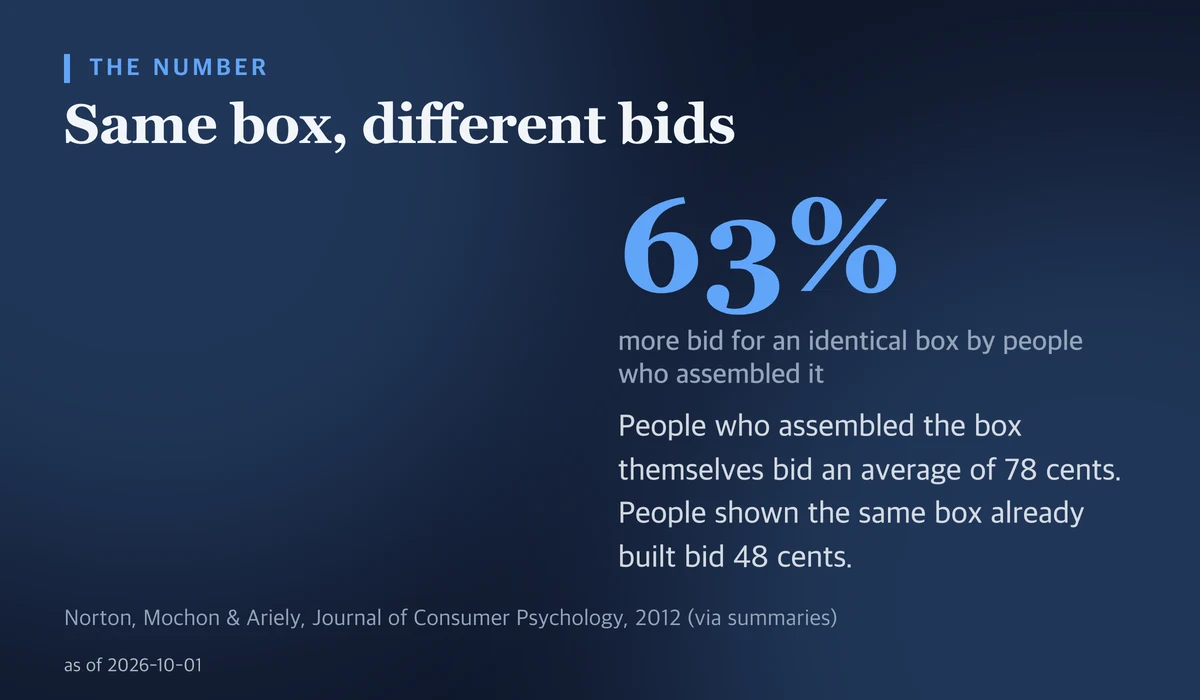
- In one study, people who assembled a plain IKEA box bid about 63% more for it than people shown the same box already built.
- The premium collapsed when a Lego model was taken apart, and was much smaller when a box's assembly was interrupted.
- Judging your plan as if a stranger made it can help separate attachment from quality.
In this essay
Sunday afternoon, living room floor. Three hours, one flat-pack bookshelf, and an Allen key that keeps slipping. The finished shelf leans a little to the left, and one panel went in backward. Still, when a friend comes over, you point it out before they’ve taken off their coat.
The trouble starts when that same feeling follows you into bigger decisions. The budget spreadsheet you built at midnight. The project plan you drafted for your team. Someone suggests a simpler option, and you’ve listed its flaws before you’ve really looked at it. Sound familiar?
Researchers have a name for this pull, and a set of small experiments that measure it. By the end, you’ll know how to spot when your attachment to your own work is effort talking rather than quality. You’ll also have a simple test for judging your plans the way a stranger would.
Two price tags on everything you make
Picture a garage sale. The seller looks at an old lamp and remembers the weekend spent rewiring it. The buyer just sees a lamp. Same object, two very different prices.
Anything you build carries both kinds of price tag. One says what the thing is worth to anyone. The other quietly adds what it cost you to make — the hours, the frustration, the small choices that felt like yours. From the inside, the two tags are hard to tell apart. They tend to read as one number.
For a bookshelf, that merged number does no harm. For a plan, it can, because plans get compared. When you weigh your plan against someone else’s, you may be holding your two-tag price up against their one-tag price. The contest is tilted before it starts.
You don’t have to believe this about your own plans yet. The experiments make the case better than a metaphor can.
What the IKEA experiments found
In 2012, Norton, Mochon and Ariely published a paper in the Journal of Consumer Psychology with a blunt title: The IKEA Effect: When Labor Leads to Love. Across four studies, ordinary people assembled a plain, unbranded IKEA storage box, folded origami, or built Lego models, then bid real money on the results. The figures below come from two summaries of the paper that agree with each other.
In the box study, people who assembled the box themselves bid an average of 78 cents for it. People shown the same box already built bid 48 cents. That’s 30 cents more on a 48-cent base — about 63% more for an identical box.
The origami study was starker. People who folded their own paper crane or frog valued it at about 23 cents. People who only looked at that same amateurish creation would pay about 5 cents for it, so the builders’ figure was roughly five times higher. Outside bidders also priced origami folded by an experienced expert, at about 27 cents. Amateur builders valued their own lopsided work at almost what outsiders would pay for an expert’s.
Then comes the twist. In a Lego version, people who built their own model bid about twice as much for it as for an identical model someone else had built. But when a separate group built a model and then watched it get taken apart before valuing it, that premium collapsed entirely.
In another box study, a finished box was valued at $1.46. A box whose assembly was interrupted before completion was valued at only 59 cents, less than half as much. That’s close to what an unbuilt box or someone else’s box fetched.
The premium seemed to need a finished product, not just effort spent. One way to read this: the attachment is to labor that became something you can point at.
Ariely described the pattern in a 2009 blog post, three years before the journal version appeared:
When people construct products themselves, from bookshelves to Build-a-Bears, they come to overvalue their (often poorly made) creations.
Three ways to see the second price tag
First: separate building from judging
Building and judging are two different jobs, and they work better kept apart. Say you spent two evenings on a color-coded budget spreadsheet, formulas and all. Your partner suggests the free budgeting app your bank offers. Your first reaction is a list of reasons the app falls short. If you make judging a separate step — tomorrow morning, with the app open next to your sheet — you’re more likely to compare features instead of hours.
Second: run the stranger test
The stranger test asks one question: what would you think of this plan if someone else had made it? Picture the project proposal you just wrote landing in your inbox from someone in another department. Would you approve it as written, or ask for the changes you’d ask of anyone else? The origami observers are the model here. They saw a paper crane, not an afternoon. Taking their view won’t erase the second price tag, but it makes the tag easier to see.
Third: slow down right after you finish
Be most careful in the moment you finish something. One reading of these studies is that the premium attaches to finished work; it faded when work was interrupted or taken apart. Picture the slide deck you wrap up at 11 p.m. It feels great, and some of that feeling is the deck. Some of it is the finish. Sleep on it before you send it, commit to it, or rule out the alternatives.
The other side
The simple story — you worked hard, so you love it — doesn’t fully hold up. A 2018 study by Marsh, Kanngiesser and Hood in Cognition found the bias first appears in children at around age 5. In 5-to-6-year-olds, it was not moderated by how much effort they put into the task. A sense of ownership alone could not explain it either. The authors argue the effect is tied to how a creation connects to the child’s emerging self-concept.
So “effort talking” may be shorthand. Sometimes what’s talking is identity: the plan feels like a piece of you. The stranger test still applies.
The effect itself has held up in at least one rerun. A 2017 conceptual replication by Sarstedt, Neubert and Barth reported that its results supported the robustness of the original effect. It pointed to psychological ownership as the mechanism. So the effect looks solid, while its cause is still debated.
There are limits of scale, too. The first box study had roughly 50 participants, and the bids were in cents. Going from a 78-cent box to a career plan is an extrapolation. It’s a reasonable one, but these lab studies didn’t test it directly.
And the bias isn’t purely a trap. The Decision Lab notes that children who help prepare a vegetable dish report liking it more and eating more of it. Employees who help design a work process tend to feel more ownership of it. The attachment that blurs your judgment may also be what keeps you working on something hard. So the answer isn’t to stop building things yourself. It’s to notice the moment you switch from builder to judge.
Try this today
Pick one plan you made yourself and are currently defending. It could be your weekly meal plan, your job-search spreadsheet, or the way you set up a project at work. Then take three small steps:
- Name the goal. Write one line: what the plan must achieve.
- Find a rival plan. A template or a colleague’s version.
- Judge as a stranger. Score both on the goal as if neither is yours.
Try it for one day. Not forever. One day. Your plan might win, and that’s fine — now it has won on quality, not on hours. If it loses, notice how much that stings. That sting is often the second price tag showing.
The attachment you feel to what you build is real, and it isn’t a flaw. It just doesn’t always measure quality. When a plan feels better than it looks on paper, ask whether that’s quality talking or effort — and the bit of you in it. Then look at it the way a stranger would. The shelf can stay crooked. The plan deserves a second look.
Before you defend a plan you built, ask what you'd think of it if a stranger had handed it to you.