
At a glance
- In Benartzi's 2001 study, employees put 10.37% of discretionary contributions into company stock at firms with the worst prior 10-year returns and 39.70% at the best.
- Those allocations did not predict how the company's stock performed afterward.
- When your savings sit in your employer's stock, your paycheck and your retirement can be hit by the same bad year.
In this essay
Your employer’s stock is the one investment you can watch from the inside. You see the orders come in, you know which managers are good, and you hear about the new contract before it reaches the news. Next to that, an index fund full of companies you have never visited can feel like guessing. So when the retirement plan offers company stock, putting a large share there feels less like a bet and more like common sense.
That choice has been studied. Shlomo Benartzi looked at how employees in large U.S. retirement plans split their new savings, and what seemed to drive the split. Why does the company you know best feel like the safest place for your money, and how can you tell when your savings and your paycheck are riding on the same company?
Ten good years on the ticker
Take the company you know best and give it a strong decade. The share price has climbed for most of the years you have worked there. Coworkers mention it in the break room. Each bonus and each upbeat quarterly email seems to confirm the same story: this company knows what it is doing.
Benartzi’s paper, published in the Journal of Finance in 2001, looked at that situation across many plans. He sorted firms by how their stock had performed over the previous 10 years. At the firms with the best 10-year record, employees put 39.70% of their discretionary contributions into company stock. Discretionary contributions are the money employees direct themselves, as opposed to an employer match.
That share sits inside a wider pattern. The same paper reports that about a third of the assets in large retirement savings plans were invested in company stock. From a diversification point of view, the abstract treats that as hard to defend.
For someone inside the strong company, none of this feels like concentration. It feels like loyalty that also happens to be good sense. The stock has rewarded the people around you before. Why would the next decade look different?
Ten bad years down the hall
Now give the same employee a different company, one whose stock has lagged for a decade. The plan looks similar, with the same kind of fund menu and the same enrollment forms. People in this break room talk about the stock too, mostly with a shrug.
In Benartzi’s data, employees at firms with the worst 10-year stock performance put 10.37% of their discretionary contributions into company stock. These were contributions employees directed themselves. The same decision, how much of their own pay to steer into the employer, came out far apart depending on how the last decade had gone.
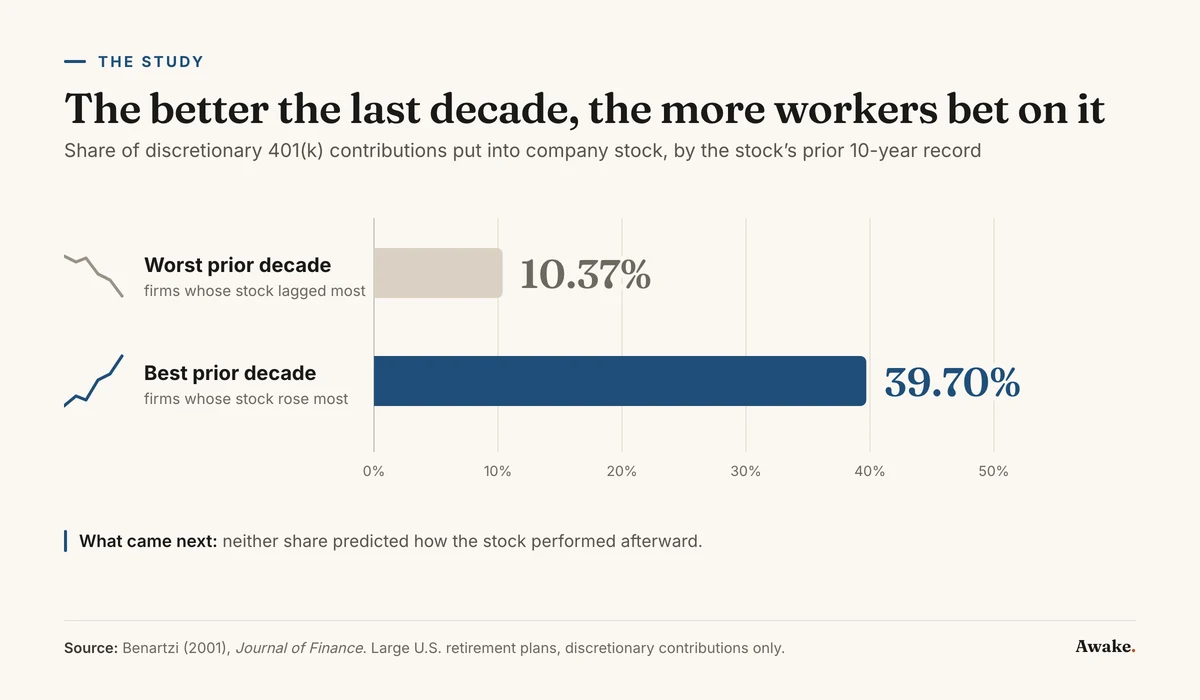
The tempting explanation is that each group knew something. Workers at the strong firms saw a healthy business from the inside, and workers at the weak firms saw trouble. If that were the whole story, their choices should have lined up with what the stock did next. Benartzi checked. The allocations did not predict the stock’s future performance.
When the paycheck and the plan share an address
Both numbers, 39.70% and 10.37%, describe a decade that had already happened. A long run of good results feels like information about the future, because the people living through it see real evidence every day. The climbing share price, the bonuses and the upbeat quarterly emails are real. Across the plans studied, though, the allocations that followed did not predict the stock’s later performance.
The second pattern is easier to miss, because it never shows up on a retirement statement. Your job is already an investment in your employer. Your salary, your next raise and your health coverage all depend on the same company. When part of your savings also sits in its stock, one bad turn for the business can reach both at once. Diversification is meant to keep one piece of bad news from reaching everything you own, and company stock works against that for an employee, since the news that hurts the stock can also threaten the job.
Enron’s 401(k) plan became the case lawmakers studied after the company collapsed. According to GAO testimony citing the Department of Labor, 63 percent of the plan’s assets were in Enron stock at the end of 2000. Figures quoted at the Senate hearing on February 5, 2002 varied a little, with Senator Lieberman citing about two-thirds. Either way, most of the plan’s money was tied to the company that paid its members’ salaries.
The stock that feels safest is the one you already hold through your paycheck.
Your first step
Put two documents side by side: your most recent pay stub and your latest retirement plan statement. Look for your employer’s name or ticker on the statement. If it appears, write down what share of your balance it makes up.
Then open the plan’s summary documents and find two answers. One is whether the employer match arrives as company stock. The other is whether you can move it to other funds, and after how long. Together they show how much of the concentration you chose and how much came with the plan.
Last, ask one plain question of both pages: if this company had its worst year in a decade, which of these numbers would change? If the answer is both, you have found the single bet. Whether you keep it, trim it, or talk it through with an adviser is your decision, and it is easier to make with the percentage written down.
Where this breaks down
Not all of that concentration was a choice. At Enron, according to the GAO’s summary of the plan, the company matched 50 percent of participants’ pre-tax contributions, up to 6 percent of base pay. That match went only into Enron stock. Testimony at the Senate hearing said participants could not move the matching stock into other investments until age 50. An employee who never picked a single share could still end up heavily invested in the company.
That design was common. Susan Stabile testified at the same hearing that in about 40 percent of 401(k) plans offering an employer stock option, the match had to be invested in company stock. She also said participants in plans offering company stock held about one-third of their accounts in it on average. That is why it matters that Benartzi’s 10.37% and 39.70% cover discretionary contributions only; total balances also reflect how the plan was built.
The study has edges of its own. It describes a pattern across plans, drawn from plan-level data. It did not ask what any employee believed, and it did not test whether a particular worker had better information than the market. Some individuals may well have had real insight. What the study shows is that the allocations, taken together, did not predict returns, and it says nothing specific about your plan or your company.
The rules have also changed. According to a summary by the law firm Faegre Drinker, the Pension Protection Act of 2006 requires covered public-company plans to let employees with three years of service move employer contributions out of company stock. Those plans must also offer at least three other diversified investment options. Stand-alone ESOPs are excluded, so your own plan documents are where to confirm which rules apply.
What the rules did not change is the pull. A decade of good news still feels like knowledge, and a familiar name still feels safer than a list of strangers, even though the plans in Benartzi’s study showed that feeling did not forecast anything. The check is the one on your desk: when the same company’s name appears on your pay stub and your retirement statement, your income and your savings are riding on one bet.