
At a glance
- In 9,524,071 marathon finishing times, Allen, Dechow, Pope and Wu found runners bunched just under round numbers such as four hours, and Boston qualifying, peers and pacesetters did not explain it.
- The authors trace the bunching to planning and effort near the finish; its shape fits a prospect-theory model in which missing a line counts as a loss.
- A reanalysis of baseball's .300 effect found no gain in late-season hitting: round numbers change what people do near the line, not how well they perform.
In this essay
A goal has to mean something to you, or it won’t move you. That is the advice most people trust, and it sounds right. A number picked because it looks tidy, like four hours for a marathon or a round figure in a savings account, feels like decoration. The real push, you’d assume, comes from the reason underneath it: the doctor’s warning, the kids, the promise you made to yourself.
Millions of race results suggest the tidy number does more work than that. No marathon pays a prize for 3:59 over 4:01, yet the clocks show runners crowding in just before the hour. What is a runner chasing at 3:58 when nothing is waiting at 4:00, and how far back from the finish does that pull reach?
Four hours, and nothing riding on it
Allen, Dechow, Pope and Wu tested the tidy number at scale. In a 2014 NBER working paper, later published in Management Science in 2017, they examined 9,524,071 marathon finishing times. They did not ask runners what their goals were. They looked only at when people crossed the line.
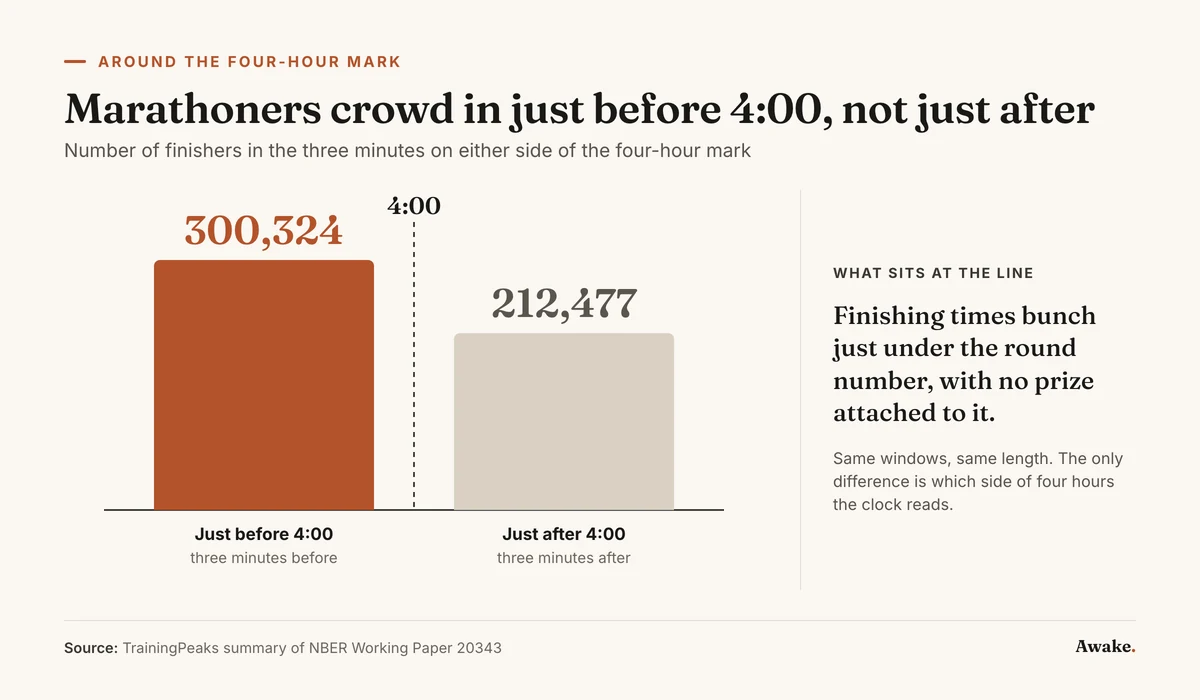
If a round number were just decoration, the minutes just before four hours and just after would hold similar crowds. They don’t. The paper reports significant bunching of finishing times just under round numbers, with the four-hour marathon as its plainest example.
A TrainingPeaks summary of the study, rather than the paper itself, puts a size on the gap. It counts 300,324 finishers in the three minutes before the four-hour mark and 212,477 in the three minutes after.
So what is waiting on the near side of four hours? The natural suspicion is a hidden reward: a qualifying time, a group of friends running together, a pacer holding a sign. The abstract addresses each one. It says the bunching is not explained by explicit rewards such as Boston Marathon qualifying, by peer effects, or by race features such as pacesetters. In the authors’ reading, it comes from planning and from effort adjusted near the finish.
A clock that reads as gain or loss
The four-hour mark gives a finishing time a reference point. A reference point is the number a result gets measured against, so one time can land as a gain and a nearly identical one as a loss. As running goes, 3:59 and 4:01 are almost the same race. Against the line, one is a success and the other a miss.
The authors connect this to prospect theory, in which falling short of a reference point stings more than clearing it by the same margin pleases. Their abstract says the basic shape of the finishing times fits a simple prospect-theory model, using parameters estimated earlier in laboratory studies. That is a match between a model and the race clocks. It shows the times behave the way the model predicts, but it does not record what any runner felt in the final mile.
Go back to the list of what the authors ruled out. No qualifying standard, no friend at the shoulder and no pacesetter explained the crowd just under four hours. Nobody paid for that minute. Whatever gave four hours its weight was not a reward handed out at the finish, and it still bent the clock for millions of runners.
Lines you can see from the road
The bunching sits at the very end of the race, within sight of the line. The authors credit planning as well as late effort, so closeness is only part of their account. The data also stop at the finish. The two ideas below are an inference from where the crowding sits, not findings about savings or pages.
Put the line where you will be close to it. If the crowding is a guide, a round number pulls hardest when you can see whether you’ll make it. Early in a marathon, four hours is an abstraction; near the finish, it is a number on a clock. A step counter a few hundred short of its daily goal at night can send you walking laps around the kitchen. How often are you that close to a yearly target? A round number for this month’s savings, or this week’s pages, puts you near a line far more often.
When a line slips away, choose the next one in view. The paper describes round numbers in general acting as reference points, with four hours as one example, and the crowding shows up just under them, where the line is still reachable. A line that is already gone probably gives you little to lean toward, though no study here followed runners after four hours slipped out of reach. Take a report you meant to finish by noon that is half done at three. Holding on to noon leaves you only the miss. Picking the next point you can still reach, such as the end of the workday, puts a line back in front of you.
Where this breaks down
The round-number story has a well-known baseball chapter, and it is easy to stretch. Pope and Simonsohn, in a 2011 Psychological Science paper, found professional players were four times more likely to end a season batting .300 than .299. The press release credits choices made near the line: whether to swing or take a walk, and whether to send in a pinch hitter. The same paper found SAT takers just below round scores such as 1100 were more likely to retake the test.
It is tempting to read the baseball result as players hitting better when .300 is in reach. Scott and Birnbaum, writing for SABR, tested that with Retrosheet data from the 1975 to 2008 regular seasons. Their late-season sample of 121 plate appearances hit .491, or 57 for 116. About 50 of those were apparently the batter’s last of the season. With them removed, the rest hit .299, 20 for 67, matching how those batters had hit earlier.
They concluded that sampling bias accounts for the apparent jump, with no statistically significant gain in performance. Pope and Simonsohn never claimed such a gain, and the reanalysis leaves the pile-up at .300 alone. The version that holds up is about behavior: a round number changes what people do near the line, such as when they swing, sit or retake a test. It does not make them better at the task.
The marathon clocks record when people finished, and little else. The data are observational, and the bunching appears near the finish. Nothing in them shows a round number helping early in a race, let alone with a savings plan or a stack of pages, and nothing shows it is the best kind of goal to pick.
The mechanism is also less settled than a neat model suggests. In a Q&A on Katy Milkman’s newsletter, Pope said it is still a little unclear why people choose round numbers as goals, and named convenience and left-digit bias as possible reasons. None of these studies measured how a runner who finishes at 4:01 actually feels. If the loss model is right, though, the pull that lifts effort before the line is the same thing that makes a near miss sting.
One thing to try
Pick one goal you’re working on this week and find the nearest round number you could still reach by Friday. It might be pages, dollars moved into savings, or minutes of practice. Write that number where you’ll see it when you are close: on the last page you expect to reach, or in a reminder set for Friday afternoon.
On the same note, write what a near miss would mean to you. Falling a few pages short of the round count still leaves you the pages you wrote. If the sting and the pull are one thing, this note is not there to make Friday’s number matter less while you work toward it. It is for afterward, so that your own 4:01 is easier to carry once the week is over.
A runner at 3:58 is chasing nothing a race official will hand over, and the data never asked whether there was a deeper reason behind four hours. What they do show is how far the pull reached: into the final stretch, where 3:59 was still possible and the clock was in view. A line like that, round and close enough to watch, is one you can draw for this week.