
At a glance
- In 2009 experiments, strongly committed students whose identity goals were noticed by someone else put in less effort afterward.
- In 2020 studies, telling a goal to someone seen as higher status raised commitment and performance; telling a lower-status person did no better than telling no one.
- Neither finding covers every goal: the first was limited to identity goals, the second was strongest for performance goals with a clear evaluator.
In this essay
It’s 11 p.m., and you type it into the group chat: “Starting my law school applications this weekend. Holding myself accountable.” Three hearts come back within a minute. Someone writes “you’ve got this.” You put the phone down feeling oddly finished, as if part of the work is already done.
Then the weekend comes, and the application folder stays closed.
Most of us have heard one of two rules about this. Keep your goals to yourself, because talking about them feels like doing them. Or tell everyone, because people will hold you to it. Both get repeated as if they settle it. They don’t. The research behind each rule measured different things, with different audiences.
By the end, you’ll know when sharing a goal seems to drain motivation, when it can strengthen it, and how to choose the person you tell.
Same goal, different room
Think about practicing a song. Playing it for your roommate and playing it for your old piano teacher are not the same event. Same song, same fingers. With the roommate, getting halfway through earns applause. With the teacher, you run the hard part three more times before you show up.
Sharing a goal works a bit like that. What it does depends on what the listener’s attention gives you. Sometimes it hands you credit early, a feeling that you’re already the kind of person who does this. Sometimes it hands you someone whose judgment you’d rather not face empty-handed. The first can quietly lower effort. The second can raise it.
What the two sets of studies actually measured
Going public, the 2009 version
In 2009, Peter Gollwitzer and colleagues Sheeran, Michalski and Seifert published four experiments in Psychological Science. Their participants were German psychology and law students. Their question was narrow: what happens to an identity goal, like becoming a psychologist or a jurist, when another person takes notice of your intentions?
In Study 1, 49 psychology students wrote down study intentions for the coming week. Students whose intentions stayed private acted on them on 2.70 days of that week, on average. Students whose intentions had been noticed by the experimenter averaged 1.92 days.
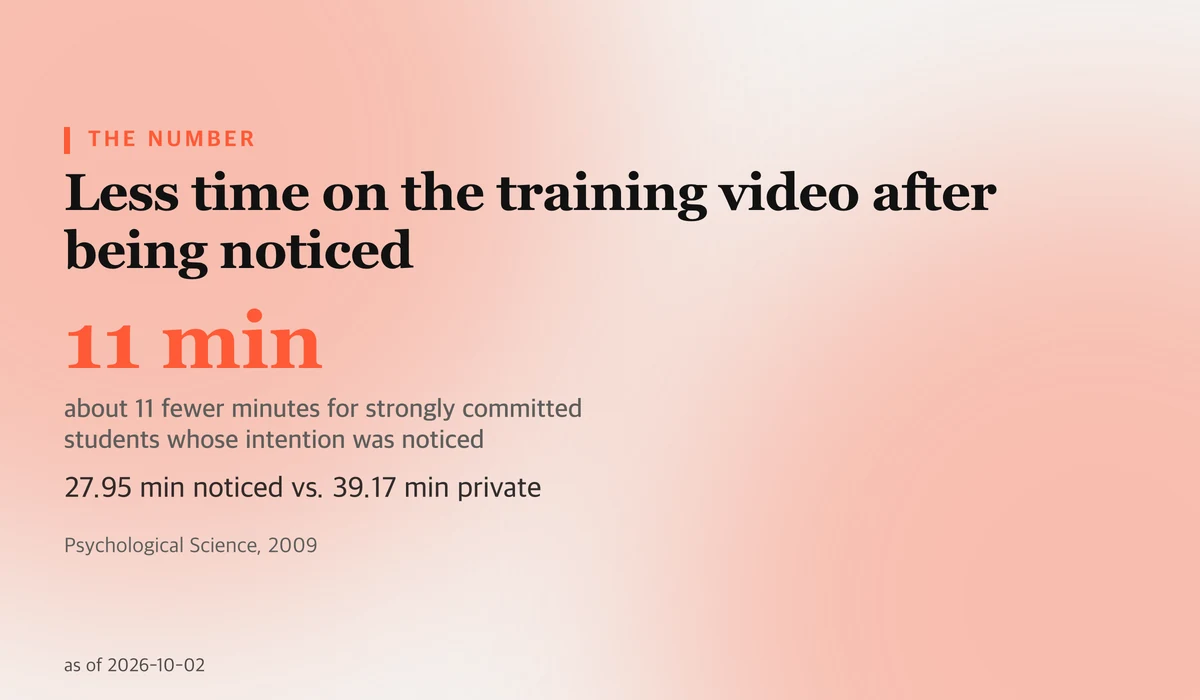
Study 3 looked at aspiring clinical psychologists. Among those strongly committed to that identity, the ones whose intention had been noticed spent 27.95 minutes on a training video. The ones whose intention stayed private spent 39.17 minutes. That’s 39.17 minus 27.95, or about 11 fewer minutes. For weakly committed participants, the gap was only 13.2 seconds.
Study 4 hints at why. Law students who announced their career intentions to a small group rated themselves as closer to already being a jurist than students who kept the same intentions private: 4.19 versus 3.10 on a rating line. Yet their commitment scores were about the same, 6.00 versus 6.08.
When other people take notice of one’s identity-relevant behavioral intentions, one’s performance of the intended behaviors is compromised.
The authors tie this to a premature sense of already having the identity. One way to read it: someone’s nod gives you a small dose of “lawyer” in advance. If you already feel the part, does the next hour of case reading still feel as necessary?
The “keep it secret” idea reached a mass audience through Derek Sivers’ TEDGlobal 2010 talk, “Keep your goals to yourself.” Its official description points to research going back to the 1920s. In popular retellings, the narrow conditions above often get dropped.
Telling up, the 2020 version
Howard Klein and colleagues Lount, Park and Linford took a different angle. Their four studies, published in 2020 in the Journal of Applied Psychology, asked whether it matters who hears the goal. According to Ohio State University, people showed greater goal commitment and performance when they told their goal to someone they believed had higher status than themselves. Telling a lower-status person produced no benefit over telling no one.
In one lab study, 171 undergraduates did a computer slider-speed task. An assistant reviewed each stated goal, introduced either as a doctoral student in business or as a part-time community-college student. Only the higher-status audience raised commitment and performance.
In a field study, 292 college students set challenging grade goals at the start of a semester. Those who shared their goal with a higher-status person showed more commitment, and were more likely to hit their target grade, than those who shared with a lower-status person.
Klein and colleagues attribute the effect to “evaluation apprehension”: concern about being judged by the specific person you told. Public exposure alone wasn’t the point.
Contrary to what you may have heard, in most cases you get more benefit from sharing your goal than if you don’t — as long as you share it with someone whose opinion you value.
So do the two findings contradict each other? Not necessarily. One studied how being noticed can make you feel the identity early. The other studied how a specific evaluator can make you want to follow through. Read together, they suggest the audience matters more than the act of telling.
Three ways to tell a goal well
First: say what you’ll do, not who you’ll be
The 2009 effect showed up for identity goals among people already strongly committed. Compare two messages. “Officially becoming a writer this year” invites applause for an identity. “Sending three pages to a former editor by Friday” names an action and a date. One reasonable reading: the second gives the listener something to check, and gives you less early credit to coast on.
Second: tell someone whose opinion you value
In Klein’s studies, the benefit came from telling someone seen as higher status. In everyday life, that might be your manager in a one-on-one, a former coach, or a mentor you see over coffee once a quarter. It’s probably not the friend who cheers for everything. What changes is that there’s one person you’d rather not disappoint. That mild pressure is the part the researchers point to.
Third: notice what the telling gives you
After you hit send, check your reaction. If you feel relieved and finished, that resembles what Study 4 measured: feeling closer to the identity without any extra commitment. If you feel slightly on the hook, that’s closer to what Klein described. The difference hints at whether the announcement is standing in for the work or tying you to it.
The other side
The 2009 studies were small: 49, 32, 63 and 24 participants, all German university students. “Going public” mostly meant an experimenter noticing a written intention, or announcing to a small group. That’s not the same as posting to a few hundred followers. The authors also say the effect does not occur for people who aren’t committed to the underlying identity goal. So the paper doesn’t show that announcing an ordinary target, like a one-off fitness goal, will backfire.
The 2020 advantage has its own limits. Telling a lower-status person did no better than telling no one. Two of the four studies used a lab slider task and a single semester of grades. The finding is strongest for performance goals with a specific evaluator in mind. It may not hold for every personal goal told to every kind of audience. Klein himself says “in most cases,” not always.
Neither project measured how you, in particular, react to being watched. For some people, telling a respected boss may bring more anxiety than effort. These were averages across groups, and averages hide individuals.
Try this today
Pick one goal you’ve been sitting on. Write it as an action with a date: “Draft the cover letter by Thursday.” Then choose one person whose opinion you’d care about. A manager, a former teacher, a colleague you look up to. Send them one sentence with the goal and when you’ll report back. Skip the group chat for this one.
Then pay attention to the next hour. Do you feel finished, or slightly on the hook?
Try it for one day. Not forever. One day.
Sharing a goal isn’t good or bad on its own. When a listener’s nod seems to give you the identity early, it can drain the effort that was supposed to earn it. When the listener is someone whose judgment you’d rather meet with results, it can strengthen your follow-through. So the question worth asking is less whether to tell, and more who.