At a glance
- In Fryer's experiments, paying New York kids for test scores produced no measurable gain; paying Dallas second-graders $2 a book raised reading comprehension.
- One reading: a reward has little to push on when you don't know what action produces the result.
- Rewrite a goal as an input with a verb, a time and a small check, and keep watching the outcome to test the guess.
In this essay
A sticky note on a laptop says GET PROMOTED in capital letters. It has been there since January. Every morning you see it, feel a small jolt of pressure, and open your email anyway. The note names a result. It says nothing about what to do at 9:15 on a Tuesday.
That is the everyday mistake. We write goals as outcomes, then reward or blame ourselves only for outcomes. In the 2007–08 and 2008–09 school years, a Harvard economist tested a version of this with real money and real kids. Some cities paid students for test scores and grades. One paid second-graders to read books. The results split in a way worth knowing.
By the end, you’ll know why paying for a result you don’t know how to produce often fails to move it, and how to turn a vague goal into inputs you can actually push on.
The pedal, not the speedometer
Picture yourself on a highway, wanting to go faster. You can’t reach over and push the needle on the speedometer. You press the pedal, and the needle follows. The needle is the output. The pedal is the input.
Most goals are written as needles. Get promoted. Lose weight. Score higher. Those are fine things to want, but none of them is something you can do at 7 p.m. tonight. An input is different. It’s an action you already know how to take, can finish today, and have some reason to think moves the needle.
Roland Fryer’s paper has a stiffer name for this: “inputs to the educational production function.” In plain words, the things a student does that turn into learning. The claim here is narrow. Effort, whether it comes from money, a deadline or willpower, needs something to grip. Aim it at the needle, and it may have nowhere to go.
You don’t have to believe this yet. The kids in four cities make the case better than a metaphor can.
Four cities, four bets
Fryer ran randomized experiments in more than 250 urban schools across New York City, Chicago, Washington, DC and Dallas. Education Week reported that about $6.3 million went to roughly 38,000 students over the two school years. Each city paid for something different.
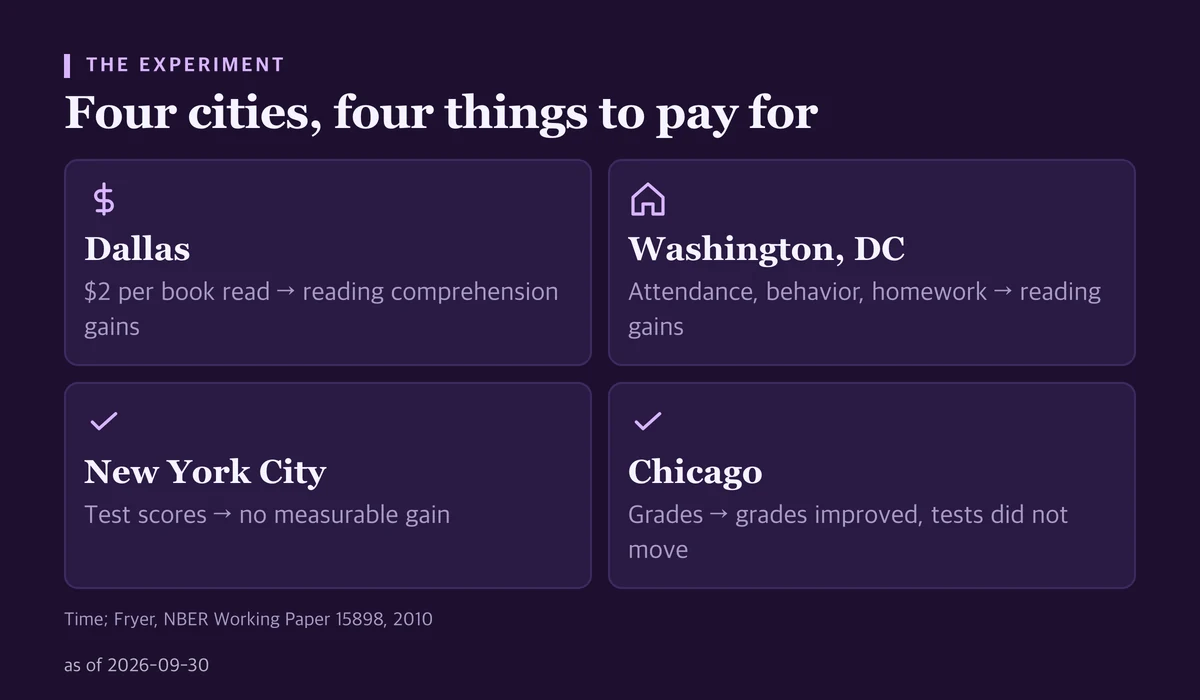
In New York City, fourth-graders could earn up to $25 per interim assessment for good scores, and seventh-graders up to $50 per test. In Chicago, ninth-graders earned $50 for an A, $35 for a B and $20 for a C in five core courses. That could reach $2,000 a year, with half held back until graduation. In Washington, DC, middle-schoolers could earn up to $100 every two weeks for attendance, behavior and homework.
Dallas did something smaller. Second-graders got $2 for each book they read, up to 20 books a semester, after passing a short computer quiz showing they had read it. The ceiling was about $80 a year: $2 times 20 books times two semesters. The average child earned about $14 a year, or roughly seven books at $2 each.
Then the results, as Time summarized them. New York’s program, about $1.5 million, produced no measurable gain in standardized test scores. In Chicago, attendance and grades improved, but standardized test scores did not move. Dallas second-graders posted statistically significant gains in reading comprehension, roughly equal to three additional months of schooling. DC was the only other city with standardized reading test-score gains, and boys gained the most.
Fryer’s own summary is blunt:
In stark contrast to simple economic models, our results suggest that student incentives increase achievement when the rewards are given for inputs to the educational production function, but incentives tied to output are not effective.
That’s what the researchers found. One way to read it is about know-how, not greed. A fourth-grader offered $25 for a better score wants the money. But what exactly should they do differently on Monday morning? “Get smarter” is not a plan. “Read this book and pass the quiz” is. The Dallas kid knew how to earn the next $2. The New York kid may not have known how to earn the next $25. Fryer drew a similar lesson himself: incentives, as Chalkbeat put his view, should spur action rather than reward scores.
Three ways to turn a result into a lever
First: write a verb you already know how to do
An input is an action you could take today without learning anything new first. Go back to the GET PROMOTED note. Underneath it, write something like “Send my manager a three-line update every Friday before lunch” or “Ask for one piece of feedback after each project.” Neither one makes the promotion certain. What changes is the question you face at 5 p.m. It’s no longer whether you’re “on track,” which has no clear answer. It’s whether you sent the update, which does.
Second: attach a small, honest check
The Dallas design had a detail that’s easy to miss. It didn’t pay for books claimed. It paid for books confirmed by a quiz. An input needs a simple sign that it really happened. Say the goal is “read more.” Pages skimmed on the train don’t count. After each chapter, type one sentence in your phone’s notes app about what it said. If you can’t write the sentence, the chapter isn’t done yet. The check keeps the input from sliding into its easier cousin: looking busy.
Third: keep watching the needle
An input is a guess about what moves the result, so check the guess. Chicago is the warning here. Grades went up, and test scores stayed put. Picture someone training for a 5K who logs every run for a month while their race time doesn’t budge. The runs were real. They may just be the wrong runs, all easy miles and no faster sessions. The outcome still matters. It just changes jobs. Instead of a verdict on you, it becomes information about your inputs. Is the thing you’re doing actually touching the thing you want?
The other side
This is not a clean law, and the data say so. Two of four cities showed gains and two showed none. Even in Dallas and DC, the test-score effects were on the order of a few months of schooling, not dramatic jumps.
The gains also faded. According to Chicago Booth Review, one year after the Dallas program ended, the reading-comprehension gains had shrunk by about half and were no longer statistically significant. There was no evidence the kids ended up worse off than if the money had never been offered. Still, paying for an input did not reliably build a habit that outlasted the payments.
The input/output line is blurry, too. Chicago paid for course grades, which partly reflect effort and behavior. That sits closer to an input than a raw test score does, and it still didn’t move achievement. So “reward inputs, not outputs” is a strong pattern in this data set, not an ironclad rule.
Then there’s the worry that outside rewards crowd out real interest, a concern Daniel Pink explores in Drive. The Booth finding eases that worry for Dallas. It doesn’t settle it in general.
Last, scope. These were children in urban American schools, paid by adults, in 2007–09. You are usually setting your own goals, with no cash on the line. Moving from their classrooms to your sticky note is an analogy, not a finding. Does it still help? Often, as a way to think. But the evidence behind it is about kids, books and grades.
Try this today
Pick one goal that’s been sitting on a sticky note, real or mental. Write the result at the top of a page. Under it, write one input with three parts: a verb, a time and a check. “After dinner, read one chapter and write one sentence about it.” “Before noon on Friday, send the three-line update.” Tonight, before bed, look at the page and mark one thing: done or not done. Don’t grade the result. It won’t have moved yet, and that’s fine.
Sounds too small? It is — and that’s the point. Try it for one day. Not forever. One day.
New York paid for the needle. Dallas paid for the pedal. When you push on a result you don’t know how to produce, the effort often has nowhere to land. Turn the goal into an input you can name, do and check, and the effort has somewhere to go. Tomorrow you can decide whether to press again.