
At a glance
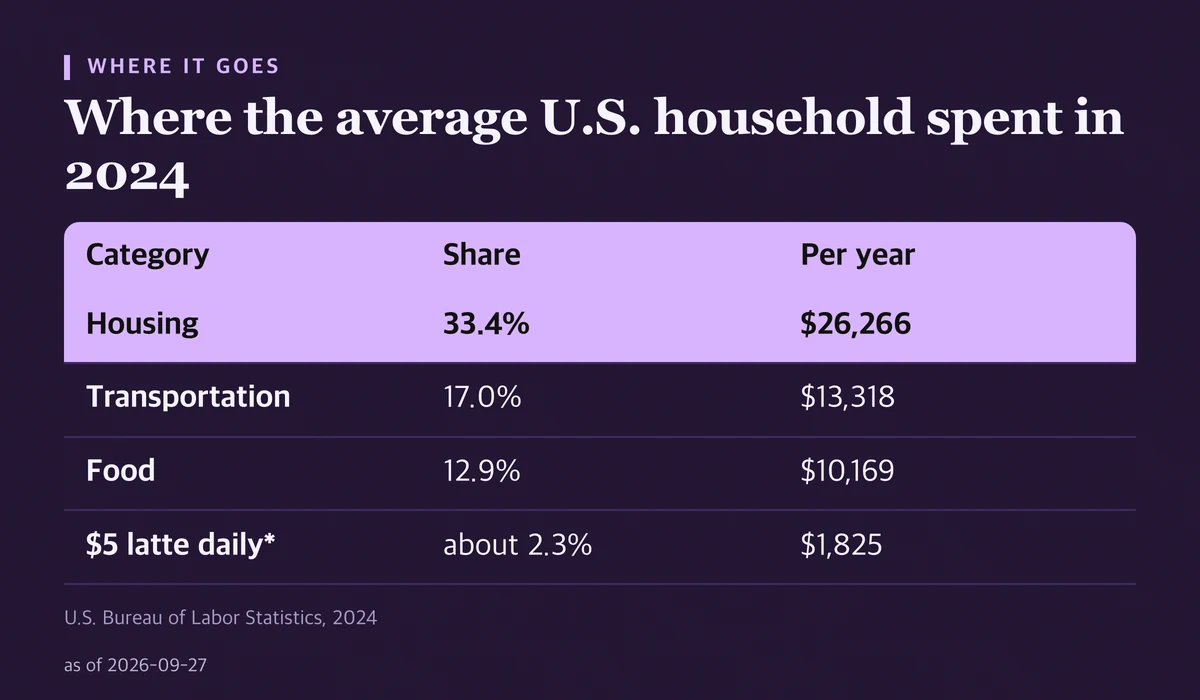
- Housing (33.4%), transportation (17.0%) and food (12.9%) added up to 63.3% of average U.S. household spending in 2024.
- A $5 latte every day works out to about 2.3% of the average budget: real money, but at the edges.
- The big decisions come back up on dates you can see coming: lease renewals, loan payoffs, insurance renewals.
In this essay
It’s 7:40 a.m. at the coffee shop counter, and you pause before tapping your card. Five dollars. You’ve heard this is exactly where money leaks away. So you feel a small jolt of guilt, pay anyway, and tell yourself tomorrow will be different.
That guilt is doing a lot of work. It makes a small purchase feel like the whole story. Meanwhile, the choices that really decide your budget were made months or years ago, often in a single afternoon. They don’t show up at the counter. They leave your account quietly, on the same day every month, and you barely notice them.
This is the everyday mistake: fighting hardest where the stakes are smallest. By the end of this piece, you’ll know which three spending decisions shape most of your budget. Then you can stop fighting over coffee and start fixing what matters.
A suitcase, not a sieve
Picture packing a carry-on for a long trip. You can roll your socks tighter. You can leave out one T-shirt. But if a winter coat is already in there, no amount of careful folding will close the zipper.
A budget works the same way. A few large items set its shape. Everything else fits around them. Small daily choices move the edges, and the edges matter. They just can’t fix a suitcase that was full before you started packing.
The large items share one trait. You choose them rarely, and then they repeat on their own. A lease. A car loan. A weekly pattern for meals. Each is a single decision that keeps costing money for years, without asking again.
So why does the latte get all the attention? Because it’s the one purchase you actually feel. There’s a moment of choice, a price on a screen, a tap. The rent has none of that. It was decided once, and now it simply happens. You don’t have to believe the suitcase picture yet. The numbers make the case better.
Where the money went in 2024
The coffee story has a real source. Financial author David Bach popularized the “latte factor” in The Automatic Millionaire and later in a book called The Latte Factor. On his own site, he says the idea is about more than coffee. It’s about small daily amounts in general, and the belief that “small amounts of money can truly change your life.”
You don’t have to be rich to live rich.
His best-known illustration: $5 a day, combined with 10 percent annual interest, grows to $948,611 after 40 years. That 10 percent is his assumption about returns, not a promised rate. The lesson he’s drawing is about compounding, not coffee.
Now look at what households actually spend. The U.S. Bureau of Labor Statistics runs the Consumer Expenditure Survey, the official record of household spending. In its 2024 release, average annual expenditures per household were $78,535. Three categories led the list:
- Housing: $26,266, or 33.4% of spending
- Transportation: $13,318, or 17.0%
- Food: $10,169, or 12.9%
Add those three shares and you get 63.3%, or $49,753. That sum is our own arithmetic on the BLS figures, not a number BLS reports. Roughly six of every ten dollars go to three categories.
Where is coffee? BLS doesn’t track it as a separate line. The closest bucket is all food away from home: restaurants, coffee shops, takeout, everything. It came to $3,945, about 5% of total spending. For comparison, a $5 latte every day adds up to $1,825 a year. That’s about 2.3% of the average budget, against 33.4% for housing. This is simple illustrative math, not a survey statistic.
BLS also reported that housing spending rose 3.3% in 2024. It was the only statistically significant increase among the major categories.
One way to read all this: the latte is real money, but it sits at the edge of the suitcase. Housing is the winter coat. And two more bulky items are packed right beside it.
Three decisions that set the budget
First: where you live
Housing means the rent or mortgage, plus everything that comes with the address. Shelter alone was 20.8% of total 2024 spending, according to the BLS report. The scene where this gets decided isn’t the coffee shop. It’s the evening you tour an apartment with a second bedroom you might use someday. Or the week the renewal letter arrives and you sign it without looking at other listings.
What changes when you see this: the lease renewal date becomes one of the most important days in your financial year. A modest difference in monthly rent, locked in for twelve months, can easily outweigh a year of skipped lattes.
Second: what you drive
Transportation covers the car itself, the gas, the insurance and the repairs. In 2024, vehicle purchases averaged $5,337, or 6.8% of total spending. Gasoline was $2,411. Other vehicle expenses were 5.4%, and spending on vehicle insurance rose 12.3%.
The deciding scene is the finance office at a dealership. The question slowly shifts from “What does this car cost?” to “What monthly payment works for you?” That framing shrinks the choice down to one comfortable number. Once you sign, the payment, the insurance and the fuel bill all arrive on their own.
What changes: you start judging a car by what it costs you per year, all in, rather than by its monthly payment.
Third: how you eat
Food splits into two parts. In 2024, households spent $6,224 on food at home and $3,945 on food away from home. The deciding scene is 6:30 p.m. on a Tuesday. Nothing is planned, everyone is tired, and the delivery app is one tap away.
No single order is the problem. The missing default is. What changes: a plain dinner you can make without thinking, on hand for tired nights, may matter more than any single order you skip.
The other side
First, “fix the big three” assumes you can. Many people can’t. In 2024, a record 22.7 million U.S. renter households were cost-burdened, spending more than 30% of income on housing. That’s almost half of all renters, according to a Harvard Joint Center for Housing Studies report summarized by NLIHC. Renters earning under $30,000 had a record-low $210 left after housing costs. If your job, city or family ties you to one place, “just move” isn’t advice. It’s a wish.
Second, the BLS figures are averages across households, with an average pre-tax income of $104,207. They describe a typical budget, not yours. A single renter in an expensive city and a large family in a small town will see very different shares.
Third, small spending isn’t meaningless. The Federal Reserve Bank of St. Louis describes mental accounting, the habit of sorting money into separate mental buckets. It argues that recognizing these patterns helps people make more intentional choices.
The good news is that awareness is the first step toward making better financial decisions.
Seen this way, noticing the coffee habit is practice in attention. The value is in the noticing, not the $5. That is also closer to what Bach himself describes than the “skip coffee, get rich” version that gets passed around.
So the fair claim is narrower than the headline. Small habits train your attention. The big three decide the total.
Try this today
You don’t need a new app or a fresh spreadsheet. You need one statement and about ten minutes at the kitchen table.
- Open last month’s bank or card statement. Find every line for housing, transportation and food, and add up each group.
- Divide the total of those three by everything you spent. Is your share near 63%, or far from it?
- For the largest of the three, write down the next date that decision opens again. That might be the lease renewal, the last car loan payment, or the insurance renewal. Put it on your calendar.
Try it for one day. Not forever. One day. Keep the latte if you enjoy it. Just drink it knowing where it sits in the suitcase.
The coffee was never the main event. Where you live, what you drive and how you eat set most of your budget. Each one comes back up for decision on a date you can see coming. Now you know which three to watch, and where your effort will actually count.