
At a glance
- Leicester opened 2015–16 at 5,000/1 and finished with 81 points, 10 clear of Arsenal, on a wage bill of £48.2m against Chelsea's £215.6m.
- Luck was real: Chelsea finished 10th, Liverpool 8th, and 11 Leicester players made at least 28 league starts. Effort was real too: a stable side and a clear counter-attacking plan.
- The next season they finished 12th with 44 points. One title isn't a formula. What you can copy is staying ready for an opening you can't schedule.
In this essay
On 8 August 2015, bookmakers priced Leicester City at 5,000/1 to win the Premier League. Nine months later, they were champions by 10 points.
There are two easy ways to tell that story. One says belief and hard work can beat anything. The other says it was a fluke, an accident that won’t happen again. You probably use the same two stories about your own life. A colleague gets the promotion, and it’s either “they earned it” or “they got lucky.” You land a big client, and you take all the credit or none of it. Both stories feel complete. Both leave out half of what happened.
Leicester’s season is useful because both halves are visible, and many of them come with numbers. By the end, you’ll see how to separate luck from effort in any big win, and why staying ready matters more than believing in miracles.
Luck opens the door. Readiness decides who walks through.
Most big wins need two things at once. There’s an opening you didn’t create, and a readiness you did. Neither is enough alone.
Picture a text from a friend at 6 p.m. Someone has dropped out, there’s a spare concert ticket, and doors open at 7:30. You didn’t cause that text. That part is luck. But whether you can go depends on things you did earlier. Did you finish work on time? Do you have the train fare? Are you rested enough to enjoy a late night? Everyone on the group chat got the same lucky message. Only some of them can say yes.
This changes the question. “Was it luck or effort?” usually starts an argument. “What was the opening, and what made it usable?” has answers you can check. Leicester’s season lets you check them.
What actually happened in 2015–16
Start with how unlikely it looked. Leicester had been in England’s third tier in 2008–09. In the 2014–15 run-in, they won seven out of nine games to escape relegation and finished 14th. Before 2015–16, no team that finished outside the top four the previous season had won the title, according to CBS Sports. Their wage bill was £48.2m. Chelsea’s was £215.6m.
They finished with 81 points: 23 wins, 12 draws and only 3 defeats. Arsenal were second on 71.
The luck column
The big clubs had poor seasons, all at the same time. Chelsea, the defending champions, sacked José Mourinho in December while sitting 16th. They finished 10th with 50 points. Liverpool sacked Brendan Rodgers in October and finished 8th. Manchester City and Manchester United both ended on 66 points.
Rivals also let chances slip. ESPN reports that Arsenal won only 20 of the 27 games in which they led, and Tottenham 19 of 28.
Then there were injuries, or the lack of them. ESPN counts 11 Leicester players with at least 28 league starts, more than any other top-six team that season. The captain didn’t pretend this was all planning:
The gods were on our side with injuries.
The effort column
Now the other side of the ledger. Claudio Ranieri kept his team stable. London Business School notes that he used 17 players in the first 22 games, and his preferred eleven played 87% of all matches.
The plan was clear and suited to the squad. Leicester played a compact 4-4-2 built to counter-attack. They averaged 42.43% possession, the lowest of any Premier League champion on record. N’Golo Kanté led the league with 175 tackles and 156 interceptions. Leicester also led the league in ball recoveries and counter-attacking shots. The Premier League describes a 40-point improvement on the season before.
One way to read this: the two columns overlap. Few injuries is luck. But a settled team that knows its roles is effort, and it’s the reason the luck paid off. A plan built on the same eleven players needs those players fit. When they stayed fit, the plan kept working, and rivals kept dropping points.
Three ways to stay ready
First: split every win into two columns
After any good result, list what opened for you and what you had ready. Say you got the job. The other finalist withdrew, and that’s luck. You’d also rebuilt your portfolio the month before, and that’s effort. The split stops two mistakes at once. You don’t take credit for the withdrawal, and you don’t dismiss the portfolio. You know which part to repeat.
Second: keep your starting eleven
Readiness is a small set of habits you repeat, not a burst of energy. Ranieri didn’t reinvent his team every week. Your version might be the résumé you update every few months, the savings buffer you top up on payday, or the gym bag already by the door. When a recruiter emails on a Tuesday night, the person with a current résumé replies that night. Everyone else starts scrambling. The opening doesn’t wait.
Third: read your odds as a price, not a verdict
That 5,000/1 wasn’t a measurement. It was a market price, and it moved as evidence arrived. By 6 October it was 1,500/1. By 21 November, 100/1. After a 3-1 win at Manchester City on 6 February, Leicester were the favourites.
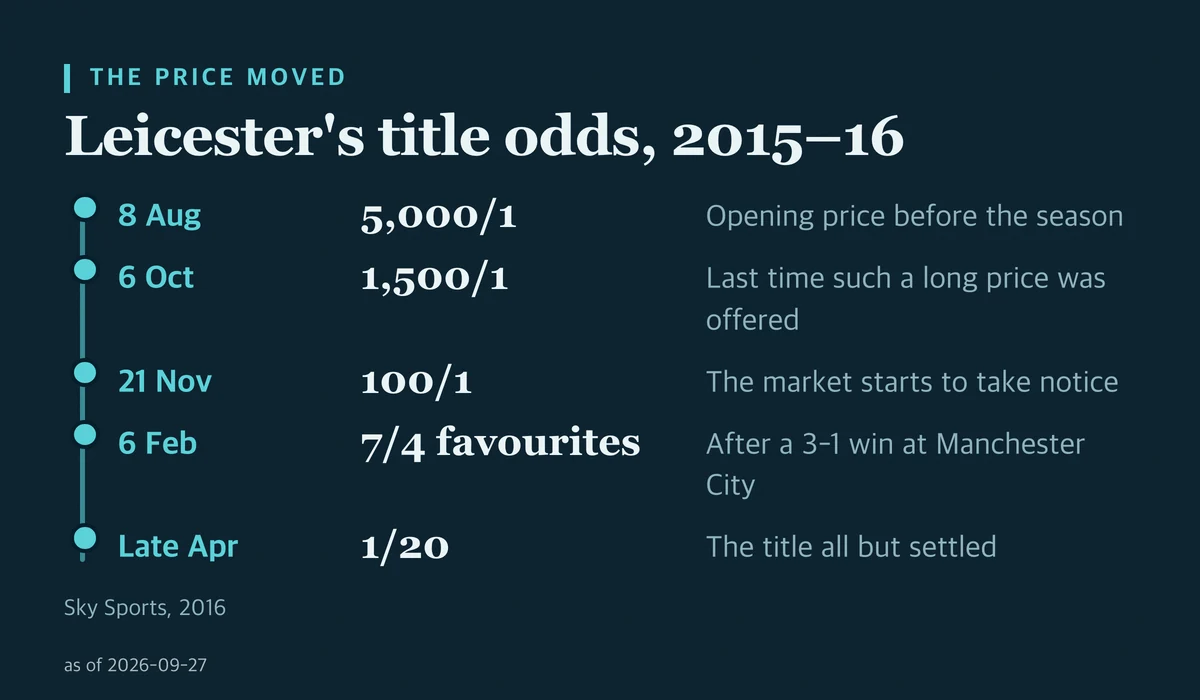
You set odds on yourself too, usually on day one. “People like me don’t start businesses.” That’s a price, set before any evidence. Three paying customers in the first month should move it. So should three bad months. Either way, your early estimate isn’t the final word.
The other side
Does this mean effort beats the odds? Not quite, and the next season shows why.
In 2016–17, Leicester finished 12th with 44 points, 37 fewer than the title year. Ranieri was sacked after a run of five league defeats. They still reached the Champions League quarter-finals, so the team wasn’t hopeless. But if skill alone explained 2015–16, far more of it should have carried over. ESPN notes the club was later relegated in 2023 and again in 2025. The strongest reading is that luck carried real weight.
The opening was also unusually wide. Chelsea and Liverpool changed managers mid-season. Both Manchester clubs were between eras. That kind of window doesn’t open every year, and no one at Leicester arranged it.
Statistics point both ways. A February 2026 preprint, not yet peer-reviewed, models the season using expected goals. It rates Leicester’s title a low-probability outcome. Yet its authors conclude the success was unlikely but not entirely detached from how Leicester actually played. Improbable, and still earned in part.
There’s also survivorship bias. We study Leicester because they won. Other small clubs have played compact, counter-attacking football and gone down. Nobody writes season-long books about them. So “stay ready” doesn’t promise a title. It raises your chances of using an opening if one comes. That’s a smaller claim. It’s also one you can act on.
Try this today
Pick one recent result from your own life, a win or a loss. Take a sticky note and draw a line down the middle. Label the left side “What opened” and the right side “What I had ready.” Write three things in each.
Then look at the right-hand column. Choose the one thing you’d most need if a similar opening came next month. Spend fifteen minutes on it today. Update one section of the résumé. Move a small amount into savings. Pack the bag.
Try it for one day. Not forever. One day.
Leicester’s title wasn’t a miracle, and it wasn’t pure grind. Rivals stumbled and key players stayed fit. That was the luck. A settled team with a clear plan was ready to take the chance. That was the effort. You can split any big win the same way, including your own. You can’t schedule the openings. You can decide what’s ready when one arrives.