
At a glance
- A 2018 study of 918 children found the link between waiting as a preschooler and later achievement was much weaker than the famous version.
- In Mischel's own early work, children waited far longer when the treats were hidden, and trust in the adult changed waiting too.
- Self-control still matters over years, but the cheaper tool is arranging your surroundings so you need less of it.
It’s 9pm. The phone is on the arm of the sofa, face up. You told yourself you’d read tonight. The book is in the bedroom. Twenty minutes later you’re still scrolling, and the verdict you reach is a familiar one: I just don’t have enough willpower.
That verdict leans on one of psychology’s most famous experiments, the marshmallow test. Most people remember it as proof that self-control decides who succeeds. This essay looks at what the research actually found when it was tested again. By the end, you’ll see why the more useful lesson was hiding in the original study all along: move the marshmallow.
The test everyone remembers
Around 1970, Walter Mischel and colleagues at Stanford’s nursery school offered young children a choice. Eat one treat now, or wait alone in a room and get two later.
Follow-up studies became famous. Children who waited longer as preschoolers tended to have higher SAT scores as teenagers. The reported correlations were strong: .57 for the maths section and .42 for verbal.
From there the story grew. Waiting became a trait. The trait became destiny.
But those striking SAT figures came from a small group. They were based on about 35 children whose scores were available.
What happened when it was tested again
In 2018, Tyler Watts, Greg Duncan and Haonan Quan revisited the idea with a much larger and more varied sample. They used a national study that followed 918 children, and focused on 552 whose mothers had not finished college. The children did a version of the task at 54 months, about four and a half, and the researchers looked at their achievement at age 15.
Waiting still predicted later achievement, but much less. The raw link was about half the size of the original studies’. Then the team accounted for family background, early cognitive ability and the home environment. The link shrank by about two-thirds. In their main group the estimated link fell from 0.28 to 0.10, and to a non-significant 0.05 once more measures were added. Most of the difference came from children who could wait at least 20 seconds.
Watts was careful about what this meant:
Of course, these new findings should not be interpreted to suggest that gratification delay is completely unimportant, but rather that focusing only on teaching young children to delay gratification is unlikely to make much of a difference.
A later study went further back to the source. Researchers found 113 of the original Stanford participants in their late 40s. Their preschool waiting times had almost no power to predict 11 mid-life financial and educational outcomes, with an average correlation of 0.02.
Why environment does the heavy lifting
If waiting as a child doesn’t decide your life, what does help people behave the way they intend? The evidence keeps pointing at the situation, not the struggle.
First: hide the cue
This part was in Mischel’s own early work. When the treats were hidden from view, preschoolers waited more than 11 minutes on average. When the treats were in sight, they waited less than 6. Similar children. Same prize. Different room.
The adult version is the phone on the sofa. The problem isn’t only your resolve. It’s that the cue is sitting within reach.
Second: make waiting worth it
Researchers at the University of Rochester ran the test with a twist, published in 2013. First, an adult either kept or broke small promises to each child. Then came the marshmallow.
Children with the reliable adult waited about 12 minutes on average. Children with the unreliable one waited about 3. In the reliable group, 9 of 14 waited the full 15 minutes. In the other, 1 of 14 did. Waiting, it turns out, is partly a judgment about whether waiting pays off.
Third: let repetition take over
The people who seem to have great self-control may simply need it less. A review of 102 studies, covering 32,648 people, found that trait self-control is linked more strongly to automatic behavior than to effortful restraint.
People who score high on self-control don’t achieve successes in life by exerting control. They are not practicing self-denial by white-knuckling through life. Instead, they know how to form habits that meet their goals.
Wood’s research suggests that about 43 percent of what we do each day is repeated in the same context. In one well-known study of 96 volunteers, the median time for a new daily behavior to feel automatic was 66 days. Missing a single day didn’t meaningfully set people back.
The other side
None of this means willpower is a myth. The 2018 study still found a link between waiting and later achievement, just a smaller one than the legend. And in the study of the original participants at mid-life, a combined measure of self-regulation across their lives did predict 10 of those 11 outcomes, with an average correlation of 0.19. Self-control seems to matter as a pattern over years, not as one test at age four.
The Rochester study was also small, with 28 children. And the famous 66 days is not a rule. It was a median from a subset of participants, and the range ran from 18 to 254 days, with the longest estimates projected well past the end of the study. Some habits form quickly. Some take much longer.
So the fair reading is this: effort matters, but it’s the expensive tool. The cheap one is arranging your surroundings so you need less of it.
Try this today
Choose one habit you keep blaming on willpower. Then change one thing in the room, not in yourself.
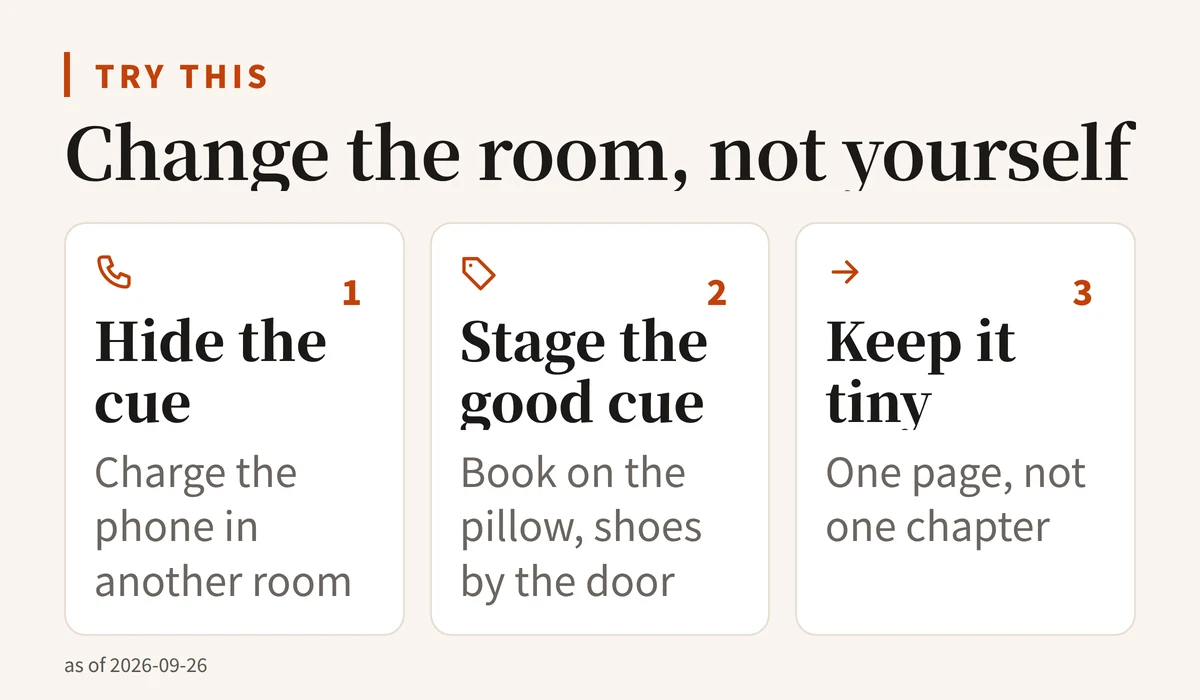
- Move the cue away. If it’s the phone at night, charge it in another room from 9pm. If it’s snacks, put them on a high shelf, out of sight.
- Put the good cue in the way. Leave the book on the pillow. Put your running shoes by the door.
- Keep one small promise to yourself. Make the first step so easy you’ll actually do it. Read one page, not one chapter.
Try it for one evening. Not forever. One evening.
You started this essay believing the problem was a shortage of willpower. The better explanation is that the marshmallow was on the table. Tonight, move it.
Change one thing in the room tonight, not in yourself.